


March 19, 2026 — 11:04am
Save
You have reached your maximum number of saved items.
Remove items from your saved list to add more.
Save this article for later
Add articles to your saved list and come back to them anytime.
Got it
AAA
Crime in Victoria is at its highest rate since 2016, driven largely by theft, but police analysis suggests some types of offending are beginning to stabilise after several years of sharp increases.
In 2025, the rate of crime was 8885.5 offences per 100,000 people, an increase of 2.4 per cent on 2024. Overall 630,592 offences were recorded in the state last year, an increase of 25,250 offences, or 4.2 per cent.
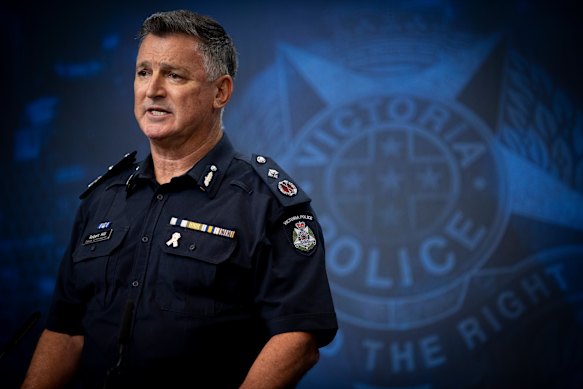 Victoria Police Deputy Commissioner Bob Hill on Thursday.Arsineh Houspian
Victoria Police said the 2.4 per cent increase was a positive sign crime was beginning to become more controlled, after years of a surging crime rate. From 2022 to 2025 the crime rate increased by more than 19 per cent.
However, Deputy Commissioner Bob Hill said a major reduction in overall crime was unlikely to happen soon, due to ongoing problems like the cost-of-living, recidivism and the increased use of technology.
“While it’s heartening that crime appears to be stabilising, it will take time before offending reduces to levels more traditionally seen in Victoria,” Hill said on Thursday.
“With 230,213 different victims of crime, we are seeing far too many innocent community members harmed.
“This is simply not acceptable as we want Victorians to not only be safe but feel safe in their community.”
Hill said although “no crime is acceptable” and it was difficult to pinpoint a decrease in crime that would be acceptable, Chief Commissioner Mike Bush previously said Victoria Police was aiming to reduce serious and violent crime by 5 per cent.
Police Minister Anthony Carbines attributed the slowing growth of Victoria’s crime rate to new hard on youth crime laws passed by Labor last year.
“What it shows is that our reforms: adult time for violent crime, our violence reduction unit, the reorganisation of Victoria Police to get them out from behind desks and out on the front line … continues to roll out in the community,” he said on Thursday.
There was an increase in the number of offenders being refused bail by the courts, which Carbines said was a sign that laws targeting violent young and repeat offenders were working.
But despite law changes designed to put and keep more people behind bars, 26,645 people were arrested a combined 78,014 times in 2025, which highlights that repeat offenders remain a problem. Over the course of the year, 1200 underage offenders were arrested more than 7000 times.
Theft accounts for one-third of crime and was the biggest driver in the increase in the number of offences committed. Police said the cost of living suggested this was unlikely to reduce.
More than 32,000 cars were stolen in 2025, the highest level since 2001. Since 2022, there has been a 96.9 per cent increase in the number of stolen cars, and an 83.97 per cent increase in the rate of stolen vehicles per 100,000 people.
The data also showed that despite Labor’s three-month machete amnesty last year, a record number of knives and machetes were seized (17,400).
“Anecdotally, I’m told the machete has not been as prevalent amongst that offending cohort as it was six to 12 months ago, but it’s still early days,” Hill said.
However, the head of the police union said crime would continue to increase until more officers were recruited.
Related Article
“The only aspect of crime in Victoria that shows a steady downward trajectory is the number of police in our communities fighting it,” said Wayne Gatt, the secretary of the Police Association Victoria.
“If you want to tackle the problem, start recruiting the solution.”
Victoria Police has 1500 vacancies, but Hill said that was not responsible for the increase in crime because the force’s internal reorganisation had ensured there was no decrease in the level of police patrolling the street.
The deputy commissioner said an initiative for officers using body-worn cameras to do in-field interviews and to charge and bail low-level offenders on the spot would free up 53,000 more policing hours.
With Daniella White
Be the first to know when major news happens. Sign up for breaking news alerts on email or turn on notifications in the app.
Save
You have reached your maximum number of saved items.
Remove items from your saved list to add more.
 Angus Delaney is a reporter at The Age. Email him at angus.delaney@theage.com.au or contact him securely on Signal at angusdelaney.31Connect via email.From our partners