
It has been clear for a few days now that Australia will not be sending a warship to the Strait of Hormuz.
There are a few reasons being offered – primarily that the US hasn’t directly requested a warship and Australia has a firm position it will only offer “defensive” support to countries in the gulf.
US President Donald Trump has also declared the US no longer “needs or desires” the involvement of countries like Australia in its efforts to reopen the vital shipping route, days after asking for help.
Iran war live updates: For the latest news on the Middle East crisis, read our blog.
But it has prompted another question. If Australia did need to send a warship, is the navy in a position to do so?
The Royal Australian Navy is in an uncomfortable spot, leaning on a largely aging fleet of warships, as it waits for new, more capable replacements, which are due to arrive in the 2030s.
Many defence experts agree this is not the time for Australia to be sending one of its few ships into a precarious situation.
A small, stretched fleet
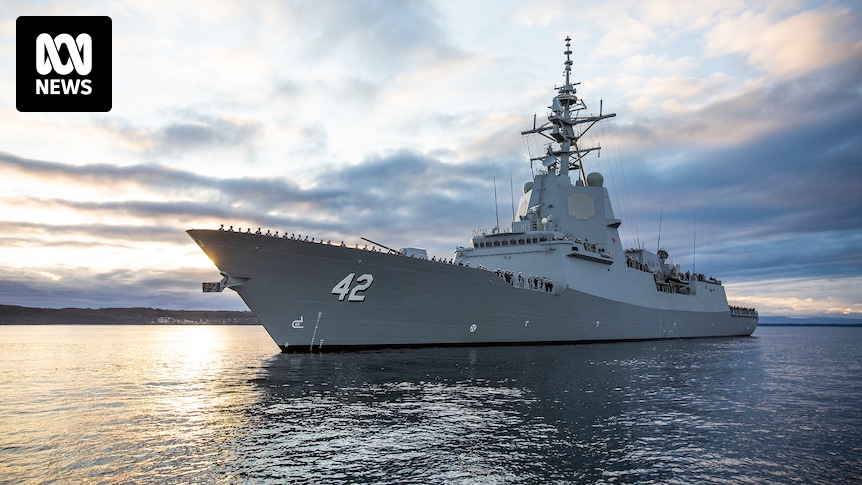
Australia operates two kinds of surface combatants. They are Anzac-class frigates and Hobart-class air warfare destroyers.
There are seven Anzac-class frigates still in service. HMAS Anzac, which was one of eight of the frigates Australia had in service, was commissioned in 1996 and has already been retired.
Others like HMAS Toowoomba remain very much at work. It was involved in a serious incident with a Chinese military helicopter in the Yellow Sea earlier this month.
The frigate is also familiar with the Strait of Hormuz — it was deployed to the Persian Gulf in 2019, when tensions between Iran and the US were escalating.
But requests since then to send warships to the region have been declined, and defence analysts have raised questions about the ability of HMAS Toowoomba to counter Iranian drone and missile strikes.
Jennifer Parker, a former naval officer and adjunct professor at the University of Western Australia, said it was no secret the Anzac-class frigates were rapidly aging.
“They have limited missile capability and limited ranges of their missiles,” she said.
“They were commissioned predominantly in the 1990s and early 2000s and they are well past the time they should have been replaced.”

Jennifer Parker says Australia’s Anzac class frigates have limited firepower. (ABC News: Callum Flinn)
Ms Parker argues one of Australia’s three newer and better equipped Hobart-class destroyers would be better placed to handle a situation like the Strait of Hormuz.
But she said the opportunity cost of sending it, particularly delaying long-awaited upgrades — wasn’t worth it.
“Could we technically send a ship? Yes. Would it undermine our current preparedness? Yes,” Ms Parker said.
“The navy is trying to increase the lethality of those 10 [warships] we have by upgrading both the combat system in the Hobart destroyers and the missile capability of our Anzac-class frigates.
“So deploying one of our 10 ships over there would undermine those processes, and it would not have a material operational impact for the US.”
LoadingReplacements on the way
While Australia’s warship fleet is both smaller and older than many would like it to be, replacements are coming.
In the middle of last year it was confirmed that the Anzac-class frigate would be replaced with 11 Mogami frigates, built by Japan’s Mitsubishi Heavy Industries.
The first three ships will be built in Japan, with the first hopefully entering service in 2030, while the remaining eight will be built in Western Australia.
How Australia’s surface naval fleet is being reshaped
On top of that, work is also continuing on building six new Hunter-class frigates. These are larger, anti-submarine ships being built in South Australia.
But the first Hunter-class frigate isn’t expected to hit the water for eight years.
Malcolm Davis from the Australian Strategic Policy Institute said the navy was clearly in a difficult period — waiting for newer, far better equipped warships to replace what it was currently relying on.
“We are going to go through a period over the next several years where our navy is on the small side,” Dr Davis said.
“There’s not much we can do about it. We can’t produce extra warships overnight.
“Warships take a good deal of time to actually manufacture and we have to have the workforce to crew them.”
He said that challenge underlined why making commitments to efforts like securing the Strait of Hormuz just wasn’t possible at present.
“Right at the moment, [the] navy is poorly placed to provide a frigate to support this supposed multinational effort inside the Strait of Hormuz,” he said.
“And I don’t think we have the luxury of doing so, given that we need to focus on Indo-Pacific security issues in particular.”
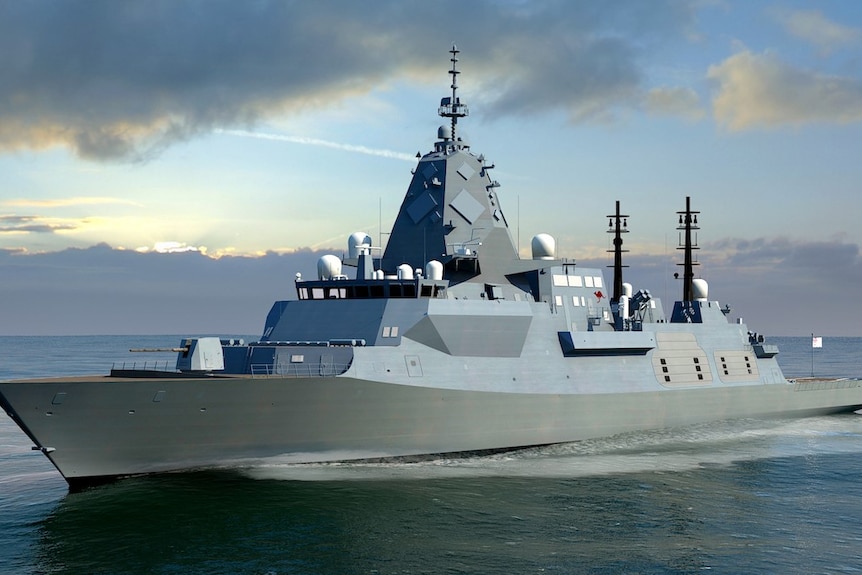
Six new Hunter-class frigates are due to be delivered within the decade. (Supplied)
Both Malcolm Davis and Jennifer Parker make the point that any warship – Australian or otherwise – sailing into the Strait of Hormuz at present would face an extremely dangerous situation, making any such mission unlikely.
Given the likelihood of facing Iranian forces equipped on-shore with anti-ship missiles, aerial drones and maritime drones, any warship will face significant threats.
Expert analysis on the Middle East:Is there a non-ship option we could send?
Australia already has a presence in the Iran conflict, with a Royal Australian Air Force Wedgetail surveillance plane sent to support the United Arab Emirates, along with 85 Australian Defence Force personnel.
Importantly, the government has said that deployment is a purely defensive mission to help the UAE protect itself against a barrage of Iranian missiles and drones, and no offensive operations are being carried out against Iran.
But Dr Davis said if there was a desire to make a greater contribution, for example to a multinational effort to keep the strait open in future, Australia could offer another air asset.
“We could deploy, for example, a P-8 Poseidon maritime patrol aircraft or airborne refuelling aircraft to support the overall mission requirement of maritime security,” he said.
Ms Parker agrees more air support is an option, but argues the benefits might be more political than practical.
“Often providing a limited contribution is less about the operational impact and more about the political support to allies,” she said.
Loading…