
When NASA’s OSIRIS-REx spacecraft first reached asteroid Bennu, scientists expected to find a sandy, beach-like surface. Instead, the mission uncovered a jagged landscape filled with boulders. Bennu is a rubble pile asteroid about half a kilometer wide, formed from the broken pieces of a much larger parent body.
The surprise was immediate. “Scientists expected some boulders, but they anticipated at least some large regions with smoother, finer regolith that would be easy to collect. Instead, it looked like it was all boulders, and we were scratching our heads for a while,” the mission team recalled.
This wasn’t the first puzzle Bennu had posed. Back in 2007, NASA’s Spitzer Space Telescope had measured low thermal inertia. It suggested that the surface heats up and cools down quickly, like sand. But the picture was different from the one captured by OSIRIS‑REx’s cameras. The data showed massive boulders that should have behaved more like concrete, holding heat long after sunset. Something didn’t add up.
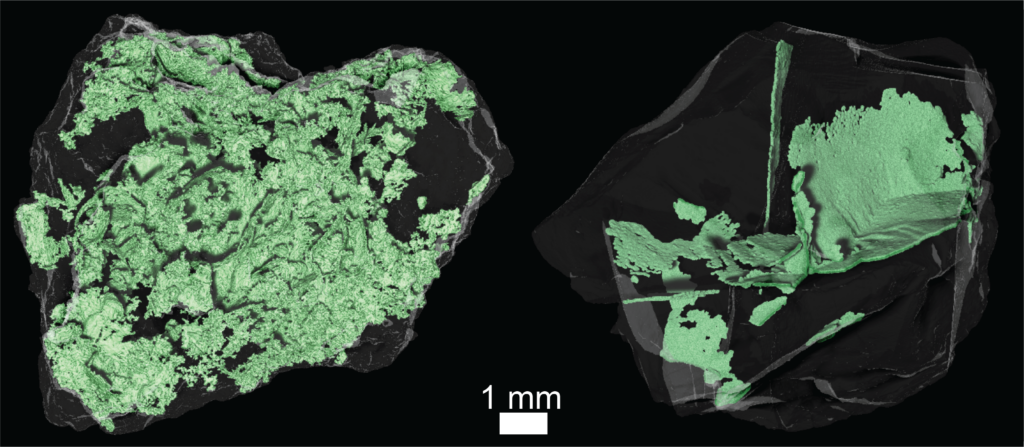
The answer began to emerge when OSIRIS‑REx delivered 121.6 grams of Bennu’s regolith to Earth in September 2023. Laboratory analysis revealed that the boulders were not solid blocks; they were porous and riddled with cracks.
NASA probe discovered water on Bennu
“That’s when things became really interesting,” said Andrew Ryan of the University of Arizona. “The thermal inertia measured in the lab samples turned out to be much higher than what the spacecraft’s instruments had recorded, echoing similar findings obtained by the team of OSIRIS‑REx’s partner mission, JAXA’s Hayabusa‑2.”
To test the role of cracks, researchers at Nagoya University used lock‑in thermography, firing lasers at tiny particles to observe heat ripples.
Meanwhile, at NASA’s Johnson Space Center, samples were sealed in nitrogen‑filled glove boxes, scanned with X‑ray computed tomography, and digitally archived. “The sample goes into its own ‘spacesuit,’ gets a CT scan, and then comes back to its pristine environment, all without having any exposure to the terrestrial environment,” explained Nicole Lunning, OSIRIS‑REx sample curator.
Scott Eckley, an X‑ray scientist at NASA Johnson, added: “X‑ray computed tomography allows us to look at the inside of an object in three dimensions, without damaging it.”
Ryan’s team scaled up these scans into computer models of boulder‑sized rocks. The results finally matched the spacecraft’s thermal readings. “It turns out that they’re really cracked too, and that was the missing piece of the puzzle,” Ryan said.
For Ron Ballouz of Johns Hopkins University, the implications are profound: “We can finally ground our understanding of telescope observations of the thermal properties of an asteroid through analyzing these samples from that very same asteroid.”
Bennu’s cracked boulders may look chaotic, but they Bennu’s broken boulders may look messy, but they actually hold clues to the asteroid’s past. Each crack and fracture is a record of ancient cosmic collisions and survival. Thanks to NASA’s OSIRIS‑REx mission, scientists discovered that even a pile of rubble can tell a story, one written in stone over millions of years, finally revealed when humans reached out to study it.
Journal Reference:
Ryan, A.J., Ballouz, RL., Macke, R.J. et al. Low thermal inertia of carbonaceous asteroid Bennu driven by cracks observed in returned samples. Nat Commun 17, 2443 (2026). DOI: 10.1038/s41467-026-68505-1