
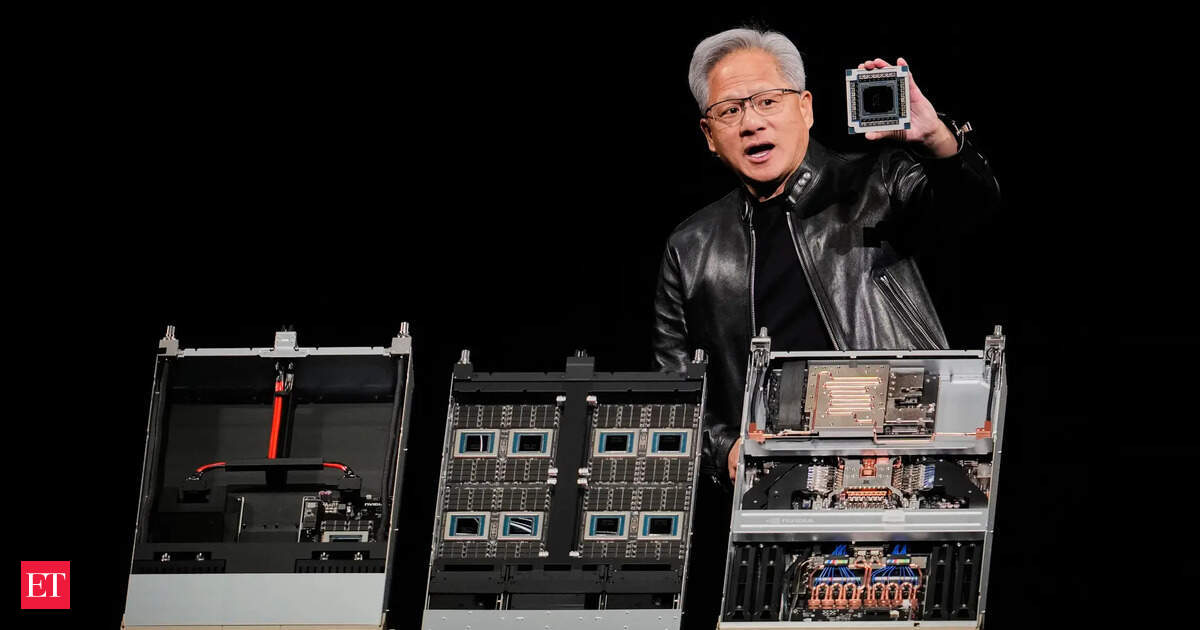
Jensen Huang, chief executive of Nvidia, has outlined a new approach to hiring engineers, suggesting companies may soon offer annual “token budgets” as part of compensation, where tokens are small units of text processed by AI systems and used to measure computing usage.
Speaking during his keynote at the GPU Technology Conference, the 63-year-old said he could see a future where “every single engineer will need an annual token budget,” adding that he is open to providing it as part of pay packages.
Token budgets may become a key recruitment tool in silicon valleyHuang said engineers earning a few hundred thousand dollars annually could receive additional compensation in the form of tokens.
“They’re going to make a few hundred thousand dollars a year, their base pay. I’m going to give them probably half of that on top of it as tokens so that they could be amplified 10X. Of course, we would,” he said.
Also Read: Nvidia bets on AI inference as chip revenue opportunity hits $1 trillion
 Live Events
He added that token allocation is already emerging as a hiring differentiator. “It is now one of the recruiting tools in Silicon Valley: How many tokens comes along with my job? And the reason for that is very clear, because every engineer that has access to tokens will be more productive.”
What tokens mean in AI and why they matterTokens are small units of text processed by AI systems, typically representing parts of words, and are used to measure computing usage. Since longer text requires more tokens, pricing is often tied to cost per thousand or million tokens.When users input prompts into AI tools such as ChatGPT or Claude, the system breaks text into tokens. For example, the word “unbelievable” may be split into “un,” “believe,” and “able.” Generating around 750 words typically requires about 1,000 tokens, while more complex tasks like coding or running AI agents consume significantly more.
Also Read: Nvidia gets Beijing’s nod for H200 chip sales, adapts Groq chip for China
Rising token costs driving shift in compensation modelsAI companies charge based on token consumption. OpenAI, for instance, prices its most advanced model at $15 per million tokens.
These costs can escalate quickly. One engineer at Vercel reportedly incurred a $10,000 bill in a single day while deploying AI agents to build a service.
As AI adoption grows, companies are increasingly tracking token usage per employee. Firms such as Zapier and Kumo AI are monitoring consumption to identify inefficiencies and high-performing engineers.
AI compute emerging as fourth pillar of compensationA previous report by Business Insider noted that Silicon Valley firms are exploring ways to compete for talent beyond salary, bonuses, and equity by incorporating AI inference power into compensation.
Investors are beginning to view tokens as a “fourth component” in recruitment, with some suggesting companies should clearly specify token budgets in job listings.
Thibault Sottiaux, engineering lead for Codex at OpenAI, said AI compute is becoming increasingly scarce and valuable. He noted that candidates are now asking about dedicated inference compute during interviews.
Nvidia growth outlook tied to token generationHuang also highlighted expectations that purchase orders between Blackwell and Vera Rubin could reach $1 trillion by 2027, driven by their ability to generate tokens at scale.
With AI workloads expanding rapidly, tokens are increasingly being seen as a new currency of productivity, and their inclusion in compensation packages could soon become standard across the industry.
(With inputs from TOI)