
GLP-1 drugs such as Ozempic and Wegovy are taken for weight loss and diabetes management, but another potential health boost has now emerged: a reduced risk of complications in people recovering from a heart attack.
The medications may help prevent further tissue damage after a heart attack (myocardial infarction), according to a new study that examined the effect of a GLP-1 compound on blood flow in mouse hearts. Their experiments revealed that the compound relaxes cells that often continue constricting tiny blood vessels called capillaries after a heart attack.
The researchers behind the study, from the University of Bristol and University College London (UCL) in the UK, suggest that GLP-1 drugs, including those already on the market, could be used to improve heart attack recovery rates – though much further study will be required to get there.
When someone has a heart attack, blood flow to the heart is blocked (this is called coronary ischemia). Typically, the most urgent fix is to open the main artery supplying the heart with blood – but this doesn’t always restore blood flow. It’s this problem that GLP-1 might be able to overcome.
“Our results provide a potential therapeutic approach for dealing with the fact that, following coronary ischemia, lack of reflow in the microcirculation after an upstream artery is unblocked has a negative impact on clinical outcome,” writes the team in their published paper.
GLP-1 drugs mimic the natural glucagon-like peptide-1 (GLP-1) hormone, which can slow digestion, reduce hunger, and help keep blood sugar levels in check. They’ve also been linked to improved heart health in people with pre-existing conditions.
Those previous links led the researchers behind the new study to hypothesize that GLP-1 medication may help with heart attack recovery.
To find out, they replicated a heart attack in surgically removed mouse hearts, then analyzed what happened to the capillaries when those hearts were injected with the GLP-1 compound, compared with when they weren’t.
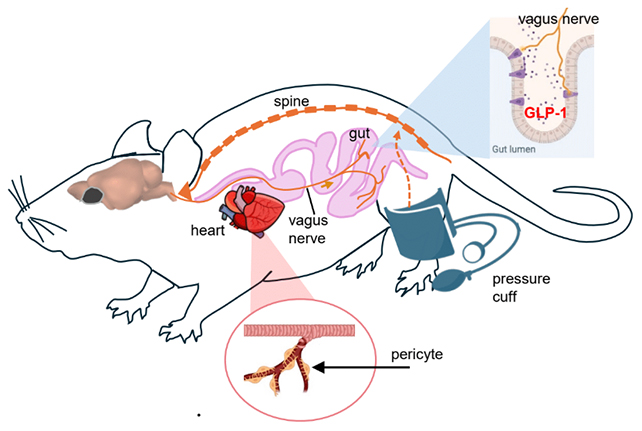 The researchers looked at the effects of GLP-1 on cells called pericytes, which encase capillaries. (Mastitskaya et al., Nat. Comm., 2026)
The tests showed that GLP-1 can act on blood vessel wrapper cells called pericytes, relaxing them by activating ion channels in the cell membrane. In turn, this restores the capillaries to their pre-heart-attack state, allowing blood to flow again.
“Our previous research has shown that this narrowing of blood vessels contributes significantly to ‘no-reflow’, a complication that increases the risk of death or hospital admission for heart failure within a year of a heart attack,” says immunologist Svetlana Mastitskaya, from the University of Bristol.
“But our latest findings are surprising in that we have found GLP-1 drugs may prevent this problem.”
The discovery also helps explain an experimental procedure called remote ischaemic conditioning (RPc), which has been shown to help in heart attack recovery in animal studies. RPc involves restricting blood flow to one of the limbs to trigger a protective response in the brain, opening the capillaries to allow blood to flow properly again.

While a 2016 study by Mastitskaya and collaborators had previously linked RPc to GLP-1 release, we now know much more about that process. There’s a brain-to-gut-to-heart connection happening here (the gut is where the GLP-1 hormone is primarily released from).
Researchers are still in the very early stages with this: These experiments were conducted in surgically removed mouse hearts, and it remains to be seen whether branded drugs such as Ozempic and Wegovy could have the same capillary-relaxing effect in people.
Related: Ozempic-Like Drugs Linked With Lower Risk of Substance Addiction
Still, it’s a promising discovery for improving recovery rates after a heart attack, and something that can be explored in future research. Although the odds of surviving a heart attack are now very good, long-term recovery rates are less encouraging.
“With an increasing number of similar GLP-1 drugs now being used in clinical practice, for conditions ranging from type 2 diabetes and obesity to kidney disease, our findings highlight the potential for these existing drugs to be repurposed to treat the risk of ‘no-reflow’ in heart attack patients, offering a potentially life-saving solution,” says UCL physiologist David Attwell, who co-led the study.
The research has been published in Nature Communications.