
In-painting is a restoration technique that fills in damaged or missing parts of an artwork. From afar, newer parts are almost indiscernible from the original; cohesion and completeness take priority over authorship. But on closer inspection, the skilled and measured hand of an in-painter distinguishes itself, protecting the artwork’s integrity and revealing a craft of its own. Breathe’s renovation of a house in Melbourne’s inner north is a lesson in the architectural interpretation of this technique.
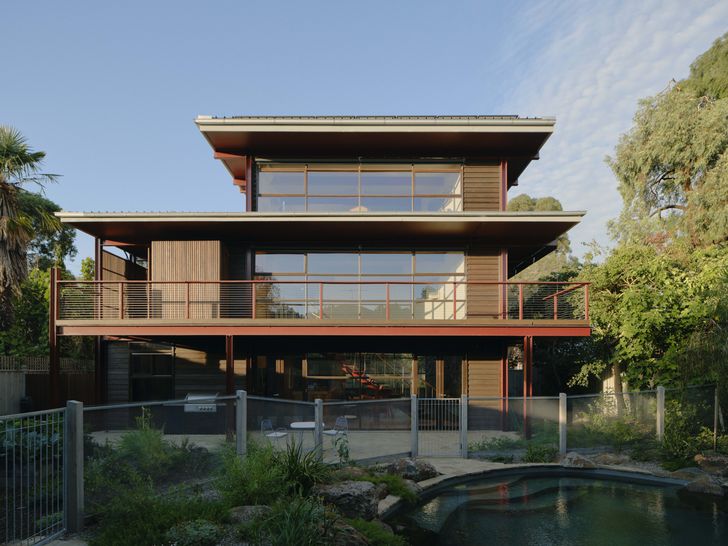
Originally designed by Goad Fink in 1990 and later renovated by Fink and McMahon Architects, the striking three-storey house is of timber and red-painted steel construction. Its wraparound verandah and stacked flat roofs are reminiscent of both a Queenslander house (a quintessentially Australian typology) and a pagoda – perhaps a nod to the influence of Japanese design on modernist architecture in Australia. Like many buildings of the era, the existing house had extensive single-layer, floor-to-ceiling glazing, and a mere 2.6 star energy rating. This is far lower than the mandatory 7 stars of today, and consequently, the home struggled to regulate temperatures.
View gallery
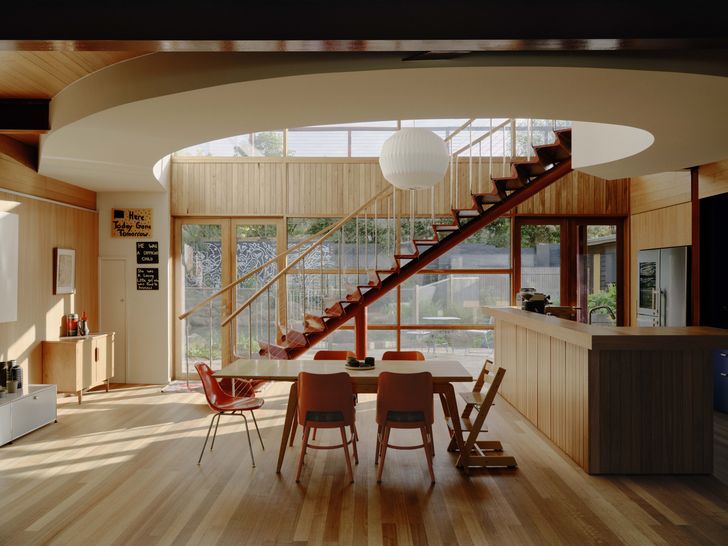
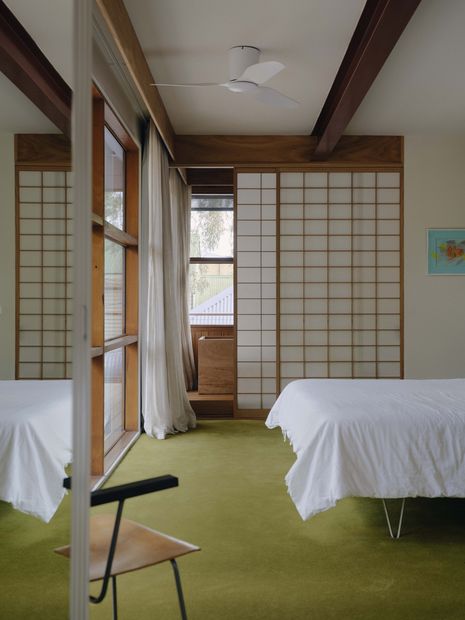
Like an in-painting, Breathe’s work has cleverly reduced the extent of glazing by stitching infill panels into existing window frames. These timber-clad panels are insulated to improve thermal comfort and, as a result of an onerous sampling process, the blackbutt seamlessly blends in with the existing tones of the Western red cedar frames. New timber is arranged vertically, a subtle visual distinction that separates new from existing while maintaining a strong sense of overall cohesion.
Single glazing was replaced with double glazing fitted with “hush” technology for sound insulation, and motorised external blinds were installed to control heat gain. It may sound simple, but improving a building’s thermal comfort is not always straightforward, particularly when dealing with steel. Finding suitable pathways to duct airconditioning between rooms among a matrix of steel beams is a challenge, but one that Breathe pulled off seamlessly.
View gallery
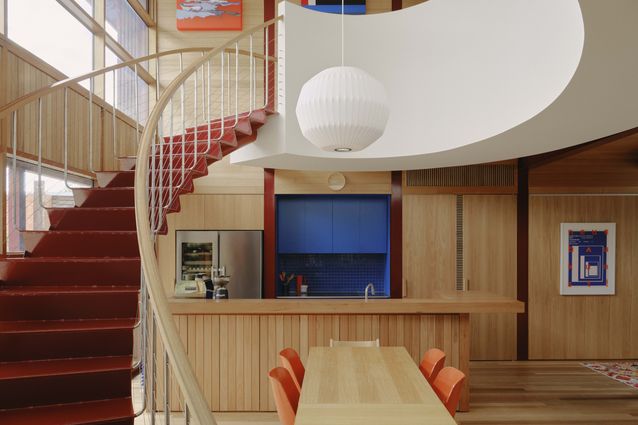
Working within the existing footprint, Breathe’s approach to the renovation was as much about subtraction as it was about adding new. The kitchen has been relocated from the centre of the room to the side wall, enabling the home’s signature curved-steel staircase to be brought back into necessary focus. The move has also opened up sight lines across the living space and through to the Sam Cox-designed landscape and natural pool in the backyard.
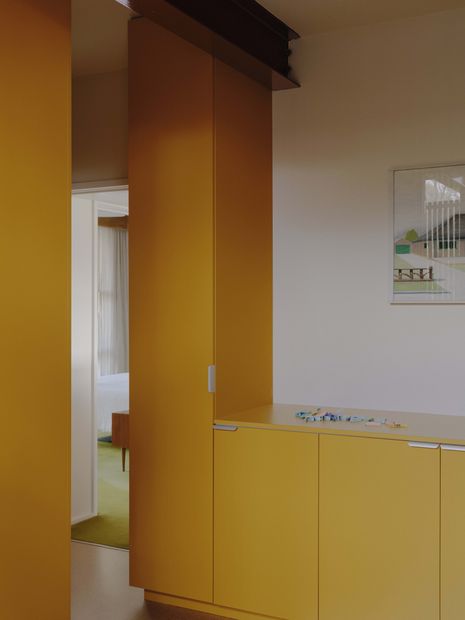
A bold use of colour is playful and inviting, and draws on the existing red steel structure and the client’s art collection. Vibrant blues, reds, greens and mustards complement the warm timber tones and masterfully give hierarchy to the interiors.
View gallery
When it comes to alterations and additions, delineations between old and new are often overstated. The conventional approach is to physically separate the new from the old, with contrasting materials and forms (the new author thus leaving their mark). Here, Breathe’s approach takes a different path: it is subtle and comprehensive. Like a good in-painter, the design team has not been afraid to come close to the original building – physically or visually – nor to intervene in invisible ways. Merri Creek House demonstrates that when integrity takes precedence over authorship, good buildings are made.
View gallery