
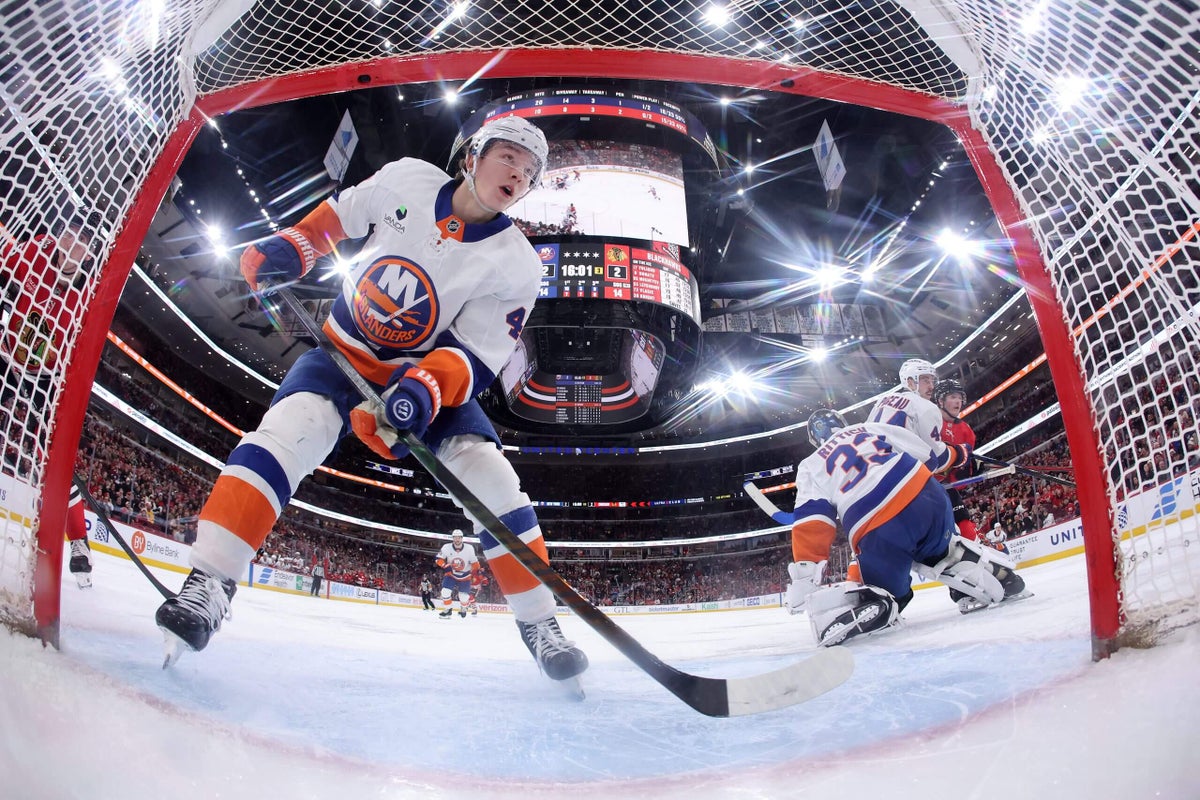
When the New York Islanders and Montreal Canadiens meet on Saturday night, much of the focus will be on the playoff race. But there will be a spotlight on two rising stars: Matthew Schaefer and Ivan Demidov.
Technically, there aren’t too many shared bonds between these two players. They play different roles and positions, are not from the same draft class and had a lot of separation between their NHL debuts. But the one common thread is their rookie status and their place as front-runners in the Calder Trophy conversation.
When Demidov made his debut with the Canadiens last spring, he instantly looked like a potential favorite for rookie of the year honors in 2025-26. And then Schaefer came along and put his stamp on the race.
In the grand scheme of things, the Calder Trophy race is just one chapter in their careers — and if their rookie seasons are any indication, those careers have a ton of potential. So what does the future hold for Schaefer and Demidov?
One way to project that is to look at similar player paths using Dom Luszczyszyn’s model.
As unique as every player is, most generally share traits with other NHLers, whether it’s their position, background, physical build, production, playing style, usage or other qualities. Those similarities help identify comparables, which can provide insight into a player’s trajectory and potential outcomes. As players develop and regress, it can move the needle on those outcomes, pointing to new best- and worst-case scenarios.
Matthew Schaefer
Out of 224 players drafted every year, only one gets to be No. 1. Players are generally drafted first for two reasons: they have an elite ceiling, and are projected to reach it sooner rather than later. But with that coveted draft slot comes a ton of pressure, thanks to an incredibly high bar set by top-end talents like the Connor McDavids, Nathan MacKinnons and Macklin Celebrinis of the world.
Except that pressure and expectation of immediate greatness is generally reserved for forwards. The story is quite different for defensemen, because only a handful have been selected No. 1 in recent history: Owen Power (2021), Rasmus Dahlin (2018), Aaron Ekblad (2014) and Erik Johnson (2006). Two of those defensemen, Power and Johnson, played in the NCAA in their draft-plus seasons, leaving someone like Schaefer, drafted out of the OHL, with even fewer comps to measure against.
Expand out to all 18-year-old defensemen since 2007-08, and the list still isn’t that deep. Sixteen defensemen have played NHL games at 18 years old since then, and only 11 hit the 60-game mark. Schaefer is in rare company for that alone. But what he has done in his 69 games as a rookie is even more remarkable, and sets him even further apart from the rest of the field.
Schaefer hasn’t just brightened the future on Long Island or made an immediate impact; he has outright transformed the Islanders. Between the lack of a past precedent for a defenseman coming into the league this hot at 18 and so much missed time in his draft year, even the most optimistic projections could not predict this kind of season.
One of the most noticeable elements of Schaefer’s game is his elite skating ability. His straight-line speed fuels his transition game, which is already top-notch. He is already above-average when it comes to retrieving pucks and turning those into zone exits. Schaefer’s numbers, according to AllThreeZones’ tracking, are pretty comparable to Lane Hutson’s last season. If Hutson’s jump this year is an indication of what’s to come after a full NHL season under his belt, Schaefer should quickly become a workhorse in that regard.
Schaefer carries the puck out at a high rate, which is something the Islanders were missing last year. Instead of passing or clearing the puck, like most Isles defensemen last year, he has the wheels to skate out of his own end, cut through traffic and gain the offensive zone.
His rate of zone entries, 14.1 per 60, is basically on an island with incredibly high-end company: Zach Werenski, Roman Josi and Quinn Hughes (since joining the Wild). The one difference that will surely grow as Schaefer continues to develop is turning those entries into scoring chances at a higher rate. He is above-average there, but his current rate is between Hutson and the next tier of Josi and Hughes. But the promise is there for him to level up already. Schaefer commands the ice and essentially quarterbacks play in his minutes. He has the speed and creativity to navigate around defenders and create his own shooting lanes to generate scoring chances himself.
But he doesn’t rush plays either, and that’s a testament to both his patience and overall maturity so early in his career. Schaefer can slow play when the situation calls for it, and roves around the zone to buy some time and space for himself.
That skill translates back in his own zone, too, even when under pressure.
One other standout as a rookie is his overall confidence and decisiveness. He extends offensive zone time with keep-ins and also knows when to activate and jump up in the play.
That ability contributes to his record-setting 20 goals for an 18-year-old. With 21 goals and 50 points in 69 games, he is on pace for 25 goals and 59 points, which is phenomenal for a rookie defenseman.
That’s the reward of Schaefer’s playing style. The risk is that it can sometimes lead to him getting caught down low as the play races the other way. But Schaefer’s skating helps him catch back up and recover, even though his workload has increased this season.
The Islanders had Schaefer logging heavy minutes in the early goings of the season, but started upping his quality of competition a few months in. While there were some growing pains against players like MacKinnon and Mikko Rantanen, he eventually hit his stride and upped his game to match the competition. While he isn’t targeted as much for entries, he still defends the blue line well and doesn’t let many entries turn into rush shots against him.
Schaefer started to hit the rookie wall ahead of the Olympic break, with more defensive slip-ups creeping into his game and more suppressed offense. It was understandable for 1) any rookie playing such demanding minutes, and 2) a player whose longest season to date was 56 games in the OHL. But since NHL action resumed, as Luszczyszyn pointed out, his expected goals rate is back up to 60 percent and his offense is back on the rise.
All together, led by his incredible offense, Schaefer is on pace for a plus-11.6 Net Rating. And there are literally no fair comparables for that among players in his age range. Ekblad (plus-5.2 Net Rating) and Dahlin (plus-3.7) had solid enough rookie years as 18-year-olds, but neither one was even in the same stratosphere at his age (as pictured below, with era-adjusted Net Ratings).

Schaefer is having one of the best seasons for an 18-year-old defenseman ever, and there are no true comps for that. His closest matches on Luszczyszyn’s model are a 20-year-old Drew Doughty back in 2009-10 and a 21-year-old Zach Werenski. The fact he is setting the bar this high this early makes him a unicorn. Instead of the usual conversations about readiness for a player in his age range, the only question now is what his ceiling will be — right now, there is clearly franchise and MVP-caliber potential, and if he keeps developing at this rate, it could spark the generational conversation.
Ivan Demidov
Two regular-season games and playoff games against the Capitals last April gave Demidov a taste of the speed and skill of NHL hockey. And he has quickly built on that with an impressive rookie season, with 52 points in 68 games.
Like Schaefer, Demidov is proving to be a special talent. The bread and butter of his game, unquestionably, is his puck-moving ability. At five-on-five, he drives play into the offensive zone often and efficiently, with 20.1 entries per 60, which stacks up well in Montreal, and a 63 percent carry-in rate.
With the puck on his stick, Demidov is both crafty and deceptive. He sees the ice well and anticipates opponents’ next moves, and can trick defenders with no-look plays. That allows him to generate space for both himself and his teammates and open up a passing lane.
Demidov draws defensemen to him and then finds ways to weave around them. It shows not only how he processes the game at such a high speed but also how quickly he creates solutions on the fly.
Just take this play against the Stars in early January. Demidov enters the zone and has the attention of all five Dallas skaters. It gives Oliver Kapanen the time and space to get in position for the one-timer, which beats Jake Oettinger to tie the game 2-2.
Demidov’s passing has quickly developed into a standout league-wide, with 10.2 primary shot assists per 60 according to AllThreeZones. Those passes alone account for a lot of his scoring chance generation, and help explain some numbers that generally aren’t super sustainable. The Canadiens’ xG being more than a shade behind their scoring rate in Demidov’s minutes (2.69 xG per 60, compared to 3.59 actual goals per 60) generally would raise a red flag. So would the team shooting 14.8 percent in that time, because what goes up tends to come down especially if there isn’t enough oomph below the surface. But that oomph is incredibly skilled passing that sets up scoring chances, which public xG models can’t fully capture due to data constraints. Pre-shot movement obviously matters a lot, especially when four defenders leave Kapanen unprotected and ready for a cross-seam pass.
With all that in mind, it’s not entirely surprising to see Demidov’s top comp be a dynamic puck-mover in Mitch Marner. That path, or Patrick Kane’s, represents the best-case scenario based on his NHL play so far.

If Demidov were to follow in Marner’s exact path, it would obviously take some development away from the puck. That side of his game has been praised by head coach Martin St. Louis earlier this season, as his anticipation translates in his own zone; not only can he break up plays, he can gain possession to shift back to offense. While he isn’t trusted in heavy defensive usage just yet, playing a more sheltered role clearly has helped maximize his best strengths so far. Kane, on the other hand, has never really been a defensive savant, but the offense has always outweighed his play without the puck enough.

Someone like Trevor Zegras provides a different outlook on the range of outcomes. Unlike the aforementioned players, he is absolutely loaded with skill and creativity, and is willing to take risks for gutsy offensive plays. But he also isn’t The Guy for a contender. Not every player is, and in Montreal, others fit that bill — Nick Suzuki is the team’s No. 1, and Cole Caufield and Juraj Slafkovský (who has taken a huge step forward this year) provide a lot of support behind him. So Demidov has leeway and could still thrive in a more complementary role in Montreal if that were the case.
Below that, players like Alex Galchenyuk and Sam Gagner are cautionary tales of how much a player’s spark can fade. And this is where those on-ice shooting percentage and lack of shot volume red flags raise some concern. Demidov has a dangerous shot when he chooses to use it. When he plays alongside Slafkovský, he has a linemate who can feed him nifty passes. Or he can skate right in and generate his own looks. Something interesting is that, while he doesn’t shoot much off the rush (his entries tend to lead to passes that set up his teammates’ chances), he does forecheck well, recover dump-ins and help boost the Canadiens’ cycle game.
And even if Demidov ultimately doesn’t convert on his chances, it can create a second-chance opportunity or add a level of unpredictability to the Canadiens’ attack. The more he adds to his repertoire, the more he will move the needle even higher. He doesn’t need to become a goal-scoring machine; he has to turn his undeniable skill from potential into tangible results.
As worrying as the worst-case scenario may be, there’s a lot more good than bad on Demidov’s comp list — which extends to include players like Matthew Tkachuk and Jonathan Huberdeau, to William Nylander and Clayton Keller. Demidov is extremely well-positioned under a coach who promotes players to use their instincts and play to their strengths, on a rising team filled with up-and-coming talent. And if his rookie year is a sign of what’s to come, he is going to play an important role throughout Montreal’s next window of contention.
Data via Evolving-Hockey, HockeyViz, HockeyStatCards, All Three Zones Dom Luszczyszyn, and Natural Stat Trick. This story relies on shot-based metrics; here is a primer on these numbers.