
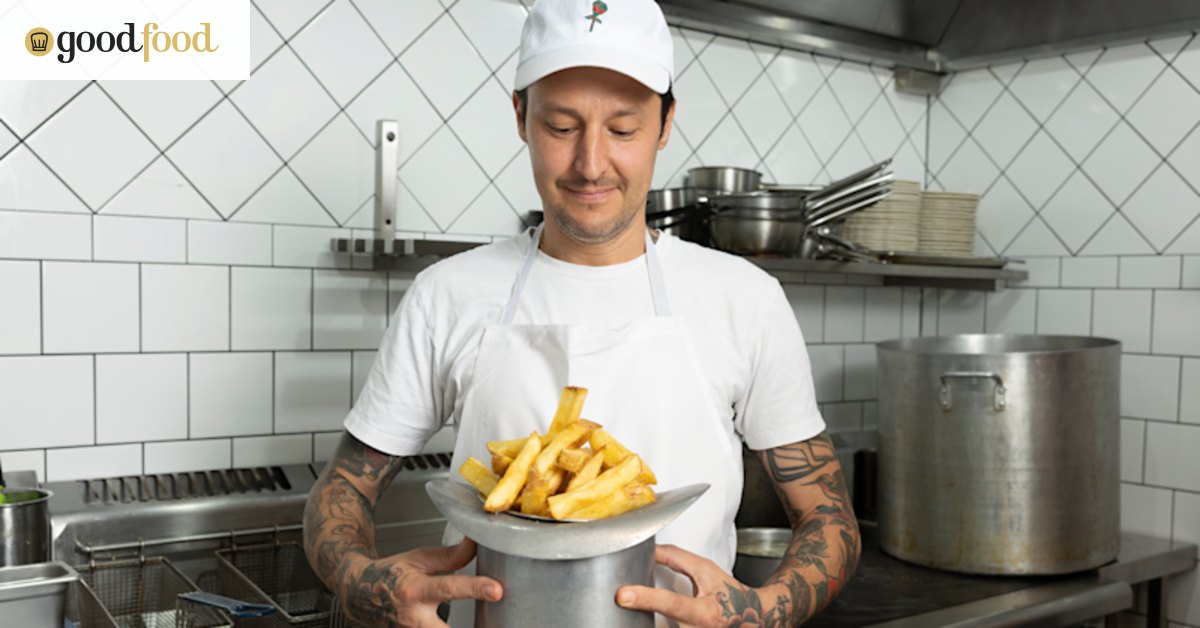
To hand cut or buy frozen – that’s the question we put to restaurants. Some declined to answer, others say it’s a necessary corner to cut. Good Food looks into the pros and cons.
 Save
Save
You have reached your maximum number of saved items.
Remove items from your saved list to add more.
Save this article for later
Add articles to your saved list and come back to them anytime.
Got it
AAA
It’s not uncommon for a chef to have a chip on their shoulder about, well, chips. Specifically, hot ones, and the discreet use of frozen over hand-cut in top restaurants.
“When you have a restaurant you have to make your own chips,” says Sydney chef Elvis Abrahanowicz. “That’s what people are coming in for, not us buying in the frozen stuff.” He fries various handmade versions across his venues, which include Joe’s Tavern and Mister Grotto in Newtown.
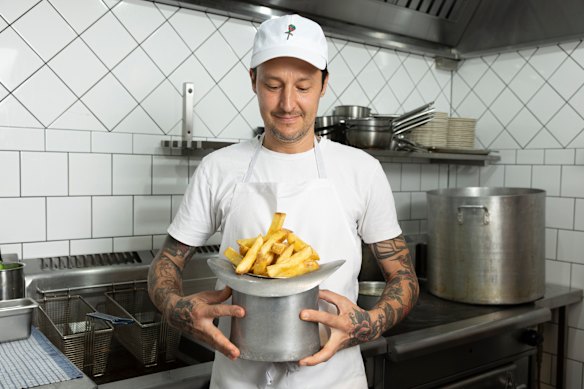 Elvis Abrahanowicz with his hand-cut chips served at Joe’s Tavern and Mister Grotto in Sydney. Janie Barrett
Even more emphatic on the matter is Ben Shewry, chef-owner of Melbourne fine diner Attica, whose memoir dedicates an entire chapter – entitled “Chipgate” – to how much he loves fries but loathes that “in Australia, hardly any restaurants make their own”.
It’s an inconspicuously contentious issue, with a number of leading restaurant groups declining to comment on whether they use fresh or frozen for this story.
But is sourcing whole potatoes to slice on-site – either by hand or with a machine – actually superior? And why are so many restaurants reaching for the freezer?
Santiago Aristizabal, culinary director of Hunter St Hospitality – which runs dozens of restaurants in Melbourne, Sydney and Perth, including Rockpool Bar & Grill – puts it plainly: “Hand-cut chips are always going to be the much better product: you control the potato you’re using, the size [of the chip], the crispiness; you can season it however you like.”
That’s what happens at the various Rockpools, where the teams unite mid-afternoon to perform the tedious task of turning hundreds of kilos of potatoes into the next day’s chips.
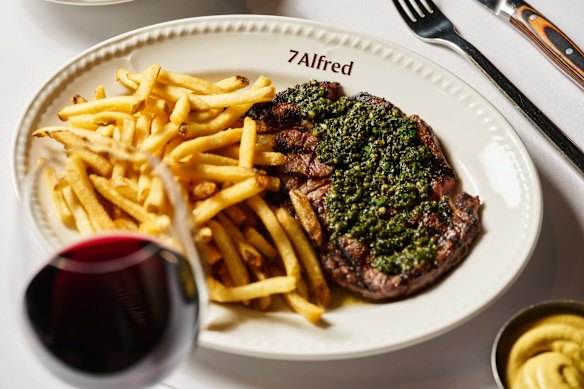 Steak frites is the main menu item at Hunter St Hospitality’s 7 Alfred and 24 York.Steven Woodburn
Things are different at the group’s new steak-frites-only diners, 24 York in Sydney and 7 Alfred in Melbourne, which respectively serve roughly 3000 and 1500 portions a week.
With fries on almost every plate, “we wouldn’t be able to keep up [hand-cutting],” says Aristizabal. “We’d need three chefs just for that, and it would be extremely expensive.”
The alternative? Frozen, produced by American company Lamb Weston, which sources potatoes from Australian and US growers. The skin-on shoestring fries do get some cheffy touches, though, fried in beef tallow for deeper flavour and crunch, and seasoned with Murray River pink salt.
“For us it’s all about consistency,” says Aristizabal. Having just one main dish, “people go thinking it will be very good every time … so we want it to always be the same”.
“You’d be surprised how much a potato can change,” he adds, referring to the sugar-testing that often occurs before a restaurant chooses which variety to buy. “Sugar content needs to be low for potatoes not to get too dark too quickly [while frying].”
At 24 York and 7 Alfred, frozen fries are key to the business model’s success, maintaining quality, quantity and a reasonable $48 price point for the signature steak frites.
“At our more casual venues, hand-cut is just too hard to do,” says Aristizabal.
Related Article
For veteran chef and restaurateur Neil Perry it’s a similar story between his neighbouring eateries in Sydney’s Double Bay. “We do a combination,” he says: house-made at two-hatted flagship Margaret, frozen at less-fancy sibling Cafe Margaret.
Unwavering demand for fries – nearly 3000 portions in a recent week – led Chris Lucas’ Melbourne-based Lucas Collective to outsource production. “Centralising the process ensures total consistency,” says Damian Snell, the group’s general manager of culinary.
Rotating through in-season potato varieties from sebago to nicola to russet, a third party now makes the fries for Maison Batard, Society and Grill Americano, adhering to the group’s specifications. They’re cut, then frozen before delivery, which Snell says is “a common trick used to create a fluffier internal, and crispier external, fry”.
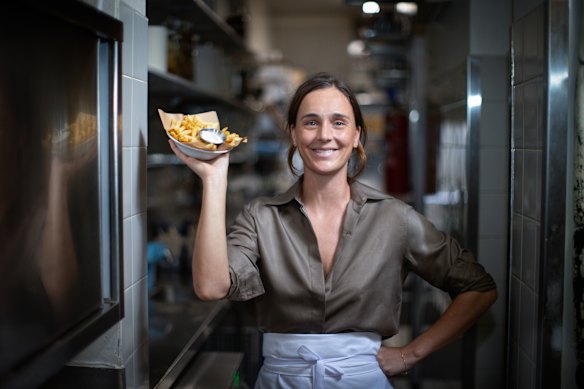 Audrey Shaw with her Bar Carnation’s hand-cut chips. Simon Schluter
Decidedly anti-freeze is Melbourne chef Audrey Shaw, whose Carnation Canteen and Bar Carnation champion produce and provenance. “We’re always looking to bring guests something they wouldn’t go to the effort to do themselves at home,” she says.
For the bar she sources the best potatoes she can through star Victorian supplier Spud Sisters, which are scrubbed and swished through a potato chipper, blanched once and fried twice. “Any time you get an ingredient that you can do the least to, the better it’s going to be,” Shaw says.
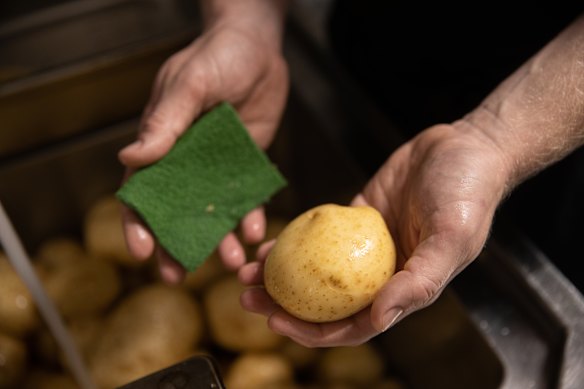 Bar Carnation’s Spud Sisters potatoes are hand-scrubbed before chipping. Simon Schluter
Abrahanowicz is also a chip purist, proud of the thick-cut, triple-cooked creations in Mister Grotto’s takeaway fish’n’chip packs. “Frozen chips can be delicious, but they don’t taste like potato,” he says. “And they’ve gotta be hot. Macca’s fries are great once every 30 times when they’re just-fried. Two minutes later and they’re garbage.”
Related Article
In saying that, he’s sympathetic to the financial realities local businesses are faced with. “Labour costs – that’s what it all comes down to,” Abrahanowicz says. “If you’ve got someone cutting chips all day, every day, at a pub, the numbers just don’t add up.”
‘When you have a restaurant you have to make your own chips. That’s what people are coming in for.’
Elvis Abrahanowicz
Frozen chips have very few chefs in their corner. For those like Abrahanowicz, “there’s no comparison [to hand-cut].” And even those who rely on the freezer are pro-fresh.
The frozen stuff isn’t ubiquitous because it’s better. It’s ubiquitous because it’s better for the bottom line. At worst, it’s laziness. At best, it’s a necessary corner for restaurants to cut while navigating razor-thin margins. Regardless if they’re fresh or frozen, spuds sell.
Related Article Related
 Related
 Save
Save
You have reached your maximum number of saved items.
Remove items from your saved list to add more.
From our partners