
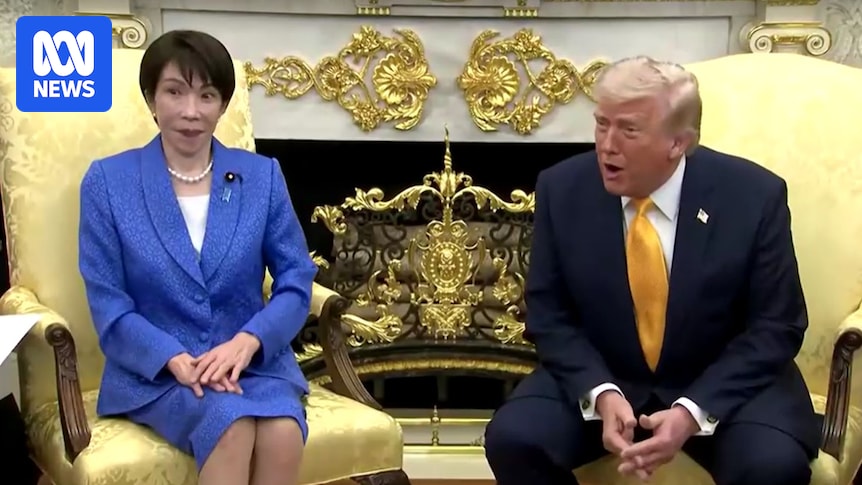
A meeting between US President Donald Trump and Japan’s Prime Minister Sanae Takaichi has taken an awkward turn after the United States president joked about the Pearl Harbor World War II attack in response to questions about the war in Iran.
When he was asked in a pre-meeting White House press conference on Thursday local time why the US did not notify allies like Japan ahead of the strikes on Iran, Mr Trump drew a parallel with the Japanese air raid in 1941.
“We didn’t tell anybody about it because we wanted surprise. Who knows better about surprise than Japan?” Mr Trump said.
“Why didn’t you tell me about Pearl Harbor, OK?”
As Mr Trump said that, the Japanese prime minister’s smile appeared to drop as her eyes widened and she shifted in her seat.
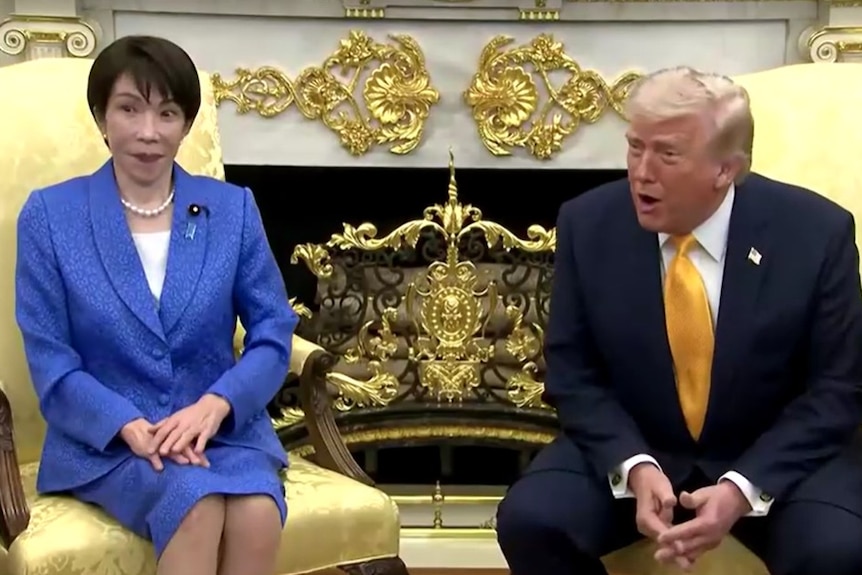
Sanae Takaichi shifted in her seat as Donald Trump joked about the Pearl Harbor attack. (Reuters)
The Japanese attack on the US naval base in Pearl Harbor, Hawaii, on December 7, 1941, killed 2,390 Americans and the US declared war on Japan and entered World War II the next day.
Wartime US president Franklin D Roosevelt called the attack “a date which will live in infamy”.
The US defeated Japan in August 1945, days after the US atomic bomb attacks on Hiroshima and Nagasaki killed hundreds of thousands of civilians.
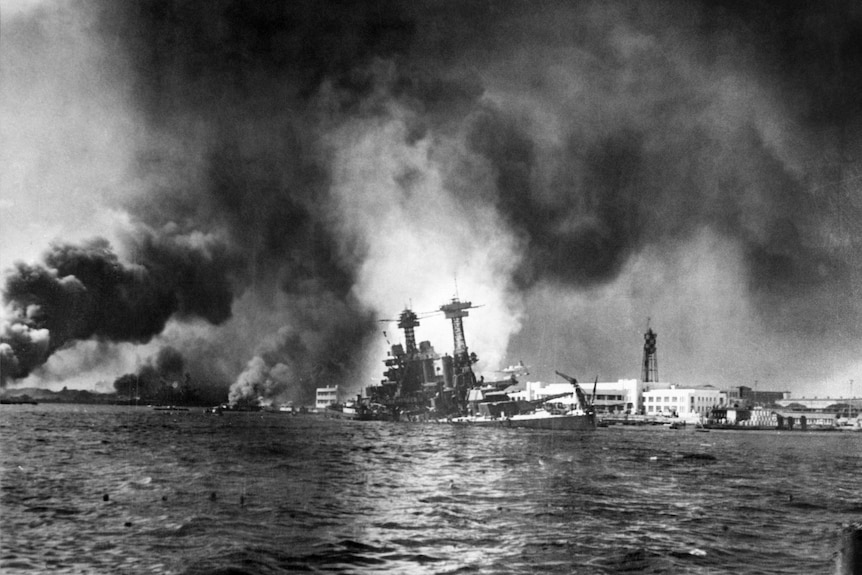
The surprise Pearl Harbor attack brought the US into World War II. (AFP)
Mr Trump’s comments on Pearl Harbor were not the first time he has awkwardly quipped about World War II history during White House meetings with foreign allies.
Meeting Germany’s chancellor, Friedrich Merz, in June, Mr Trump joked that the 1944 D-Day landing of Allied forces in Normandy was “not a pleasant day for you”.
In response, Mr Merz said: “In the long run, Mr President, this was the liberation of my country from Nazi dictatorship.”
US, Japan discuss Strait of Hormuz
Mr Trump’s meeting with Japan’s prime minister followed his complaint this week that US allies, including Japan, did not heed his request to help safeguard the critical Strait of Hormuz waterway for oil and gas transport.
He later said the help was not needed, but made other comments indicating he still expected help.
Earlier on Thursday, the leaders of five European countries and Japan issued a joint statement demanding that Iran stop attacks on the Strait of Hormuz that blocked commercial shipping, and said they were ready to contribute to “appropriate efforts” to ensure ships could pass safely through the strait, though it is not clear what that entails.
Trump names Australia in outburst over lack of ally support in Iran
The US president’s tone towards Ms Takaichi on Thursday was far more friendly than comments he has directed at allies, including British Prime Minister Keir Starmer, on the issue in recent days.
“I’m very proud of you. We’ve become friends,” Mr Trump said of Japan’s first female prime minister, whom he backed ahead of a landslide election victory in February.
Mr Trump told reporters that he and Ms Takaichi would discuss in their meeting Japan’s level of support for the US in the Iran war, saying: “They are really stepping up to the plate.”
He did not offer details.
The US president later said that much of the oil Japan relied on passed through the Strait of Hormuz and said, “so that’s a big reason to step up.”
He also mentioned US spending in Japan and the number of troops it had stationed there.
“I expect Japan to step up, you know, because we have that kind of relationship,” Mr Trump said.
The prime minister acknowledged before she left Japan that she expected her meeting with Mr Trump would be “very difficult”.
The constraints on Japan’s involvement in Iran include a provision in its post-World War II constitution that bans the use of force except to defend its territory.
The country’s military is called the Self-Defense Force.
After her meeting with Mr Trump, Ms Takaichi told reporters that they agreed that ensuring the safety of the Strait of Hormuz was of the utmost importance, but she gave Mr Trump a detailed explanation of the actions Japan could and could not take under its law.
The two countries also announced a $US40 billion ($56.5 billion) project to build nuclear reactors in Tennessee and Alabama, and a $US33 billion ($46.6 billion) investment in natural gas power generation facilities in Pennsylvania and Texas.
ABC/wires