
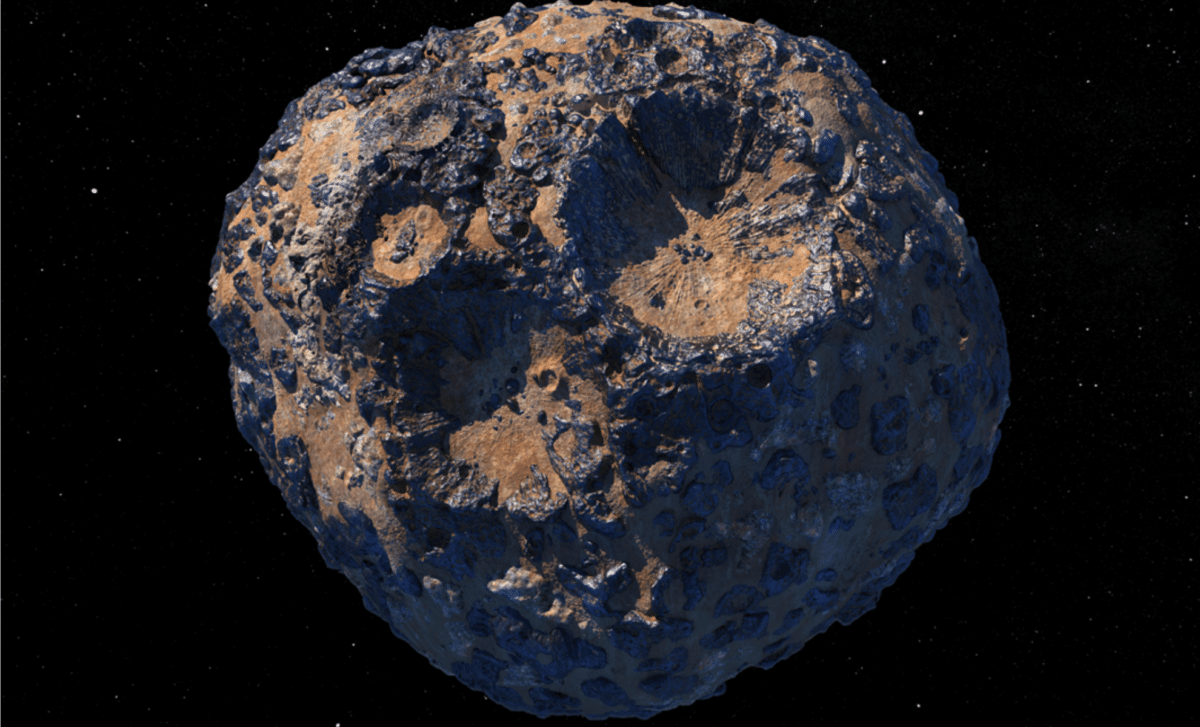
Asteroid 16 Psyche, one of the largest and most enigmatic objects in the asteroid belt, is set to be the focal point of NASA’s Psyche mission in 2029. But as scientists eagerly await the spacecraft’s arrival, a new study offers critical clues about the asteroid’s composition, challenging longstanding theories about its origin. Published in the Journal of Geophysical Research, this groundbreaking research leverages simulations of massive craters on Psyche’s surface to predict the structure of this metallic asteroid, helping guide the upcoming mission’s investigation.
The study, led by researchers at the University of Arizona’s Lunar and Planetary Laboratory (LPL), is the first to rigorously simulate the formation of large craters on Psyche. By recreating the impact processes that might have shaped the asteroid, scientists hope to uncover whether Psyche is a planetary fragment or a remnant of a primitive, metal-rich object from the early solar system.
Simulating Psyche’s Craters to Understand Its Interior
According to Namya Baijal, a doctoral candidate at LPL and the first author of the study, the formation of large impact craters on Psyche offers vital clues about the asteroid’s internal composition.
“Large impact basins or craters excavate deep into the asteroid, which gives clues about what its interior is made of,” said Baijal. “By simulating the formation of one of its largest craters, we were able to make testable predictions for Psyche’s overall composition when the spacecraft arrives.”
The researchers focused on a prominent crater near Psyche’s north pole, simulating how it might have formed under two different models: one where Psyche has a layered structure with a metal-rich core and rocky mantle, and another where the asteroid is a uniform mix of metal and silicate. Their simulations, which involved virtual impactors hitting the asteroid at typical collision speeds, suggested that an impactor about three miles across would create a crater of the right dimensions, matching both proposed interior models.
Baijal emphasized the importance of considering the asteroid’s porosity, its internal emptiness, often overlooked in past models. “One of our main findings was that the porosity, the amount of empty space inside the asteroid, plays a significant role in how these craters form,” she explained.
“Porosity is often ignored because it’s difficult to include in models, but our simulations show it can strongly affect the impact process and shape of craters left behind.”
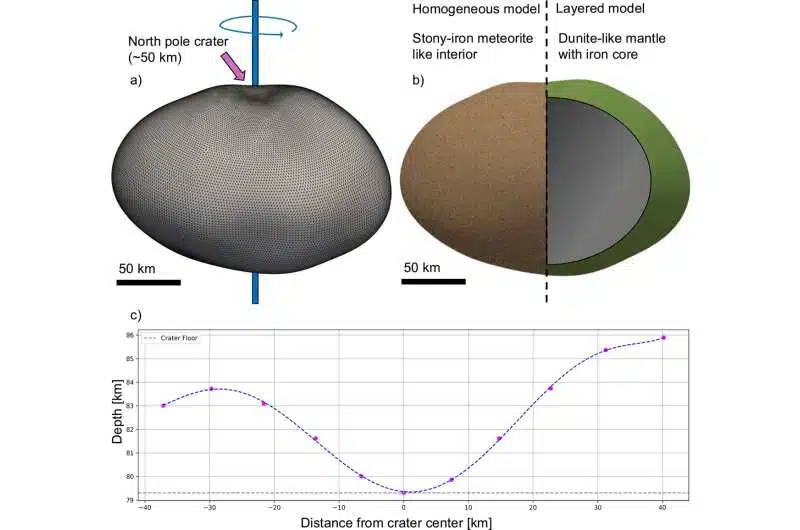 (a) Latest shape model of Psyche from Shepard et al. (2021) with spin axis oriented up. (b) Two end-members for Psyche’s interior structure (left) a mixed metal-silicate interior throughout (right) a layered interior with a large iron core surrounded by a dunite-like mantle. (c) Cross-sectional profile of NP crater extracted from the shape model. Diameter is ∼50 km and depth is ∼5.1 km. Credit: Journal of Geophysical Research: Planets (2026). DOI: 10.1029/2025je009231
Psyche’s Puzzle: Could It Be an Exposed Planetary Core?
The new study also touches on the larger question of Psyche’s origins. Scientists have long speculated that the asteroid might be an exposed core of a larger planetesimal that was shattered during violent collisions in the early solar system. This would make Psyche a rare, direct glimpse into the metallic heart of a planetesimal, offering clues about the processes that shaped our solar system’s planets.
As Erik Asphaug, a professor at LPL and co-author of the study, put it,
“The cooks have long left, but you can look at what’s left behind—the ovens, scraps of dough, the toppings—and make inferences about how the pizzas were made. We can’t get to the cores of Earth or Mars or Venus, but maybe we can get to the core of an early asteroid.”
The two models tested in the study propose different scenarios: a layered structure with a metallic core and rocky mantle, created by a collision that stripped the outer layers, and a more chaotic mixture of metal and silicate, formed by catastrophic impacts. The study’s results suggest that either scenario could explain the observed crater dimensions, leaving researchers with more questions than answers, but importantly, offering a clear starting point for future research.
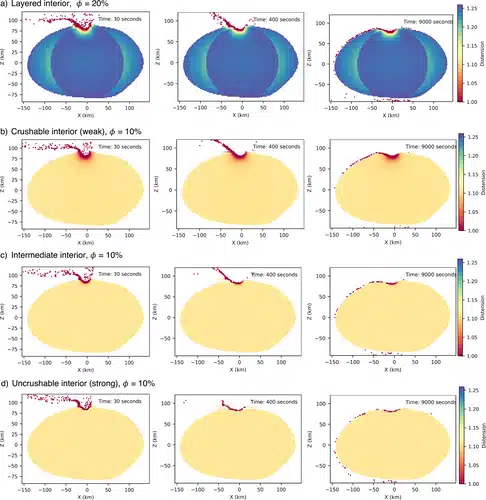 (a) Time series of a 4.5 km radius projectile hitting a layered Psyche target with a 20% porous, spherical iron core, and surrounding porous dunite mantle. (b) Same impactor striking a crushable, weaker 10% porous stony-iron Psyche (c) same impactor striking an interior with intermediate crushing strength (d) Time series of the impact into a stronger, resistant to crushing Psyche target with 10% porosity. All impacts occur at 45°. The colors represent distension, a measure of porosity where 1 corresponds to 0% porosity (red), 1.1 is 10% and 1.25 20% porosity (blue) respectively. Left to right follows the excavation of the crater cavity, followed by the formation of the transient crater, redistributing metal to the surface, and lastly the final North Pole (NP) crater formation.
A Critical Head Start for NASA’s Psyche Mission
The simulation’s detailed predictions of how impacts could shape Psyche’s surface are invaluable for interpreting the spacecraft’s findings.
“By rigorously treating Psyche’s shape, porosity and composition, this work represents a true watershed moment for our capacity to realistically simulate impacts into unique types of asteroids,” said Adeene Denton, a postdoctoral researcher and co-author of the study.
These insights will guide the mission’s team of geochemists, geologists, and modelers when they begin to examine Psyche’s surface in just a few years.
As the team prepares for the spacecraft’s arrival in 2029, Asphaug notes the importance of this study in setting the stage for a more precise interpretation of the data:
“When the spacecraft arrives at Psyche in a few years, the geochemists, geologists and modelers on the team will all be looking at the same object and trying to interpret what we see. This work gives us a head start.”