
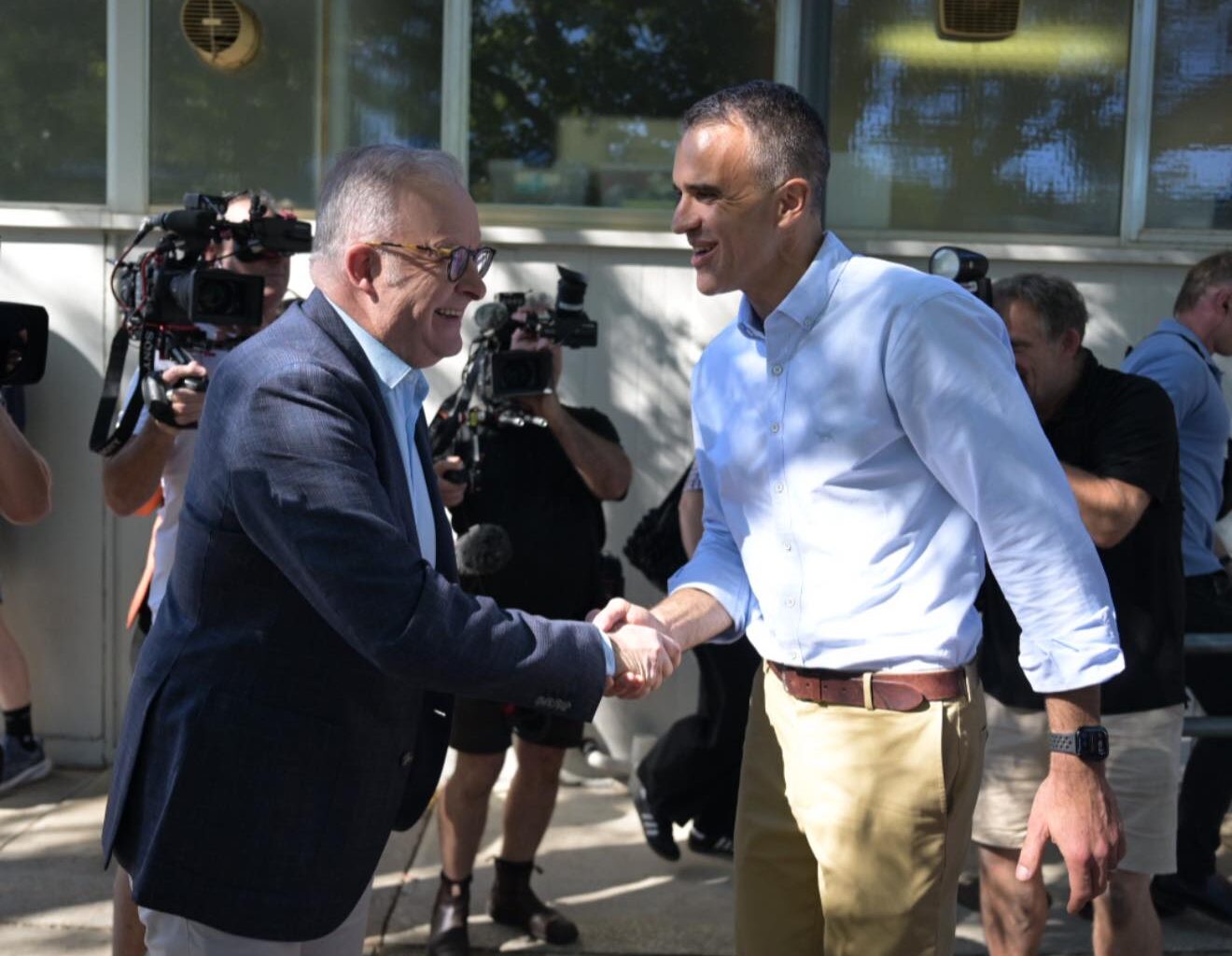
 Prime Minister Anthony Albanese with Premier Peter Malinauskas on election day, with Malinauskas returning to power for a second term in South Australia. Photo/X
Labor has secured a second term in South Australia, with Premier Peter Malinauskas returning to government after a strong early count pointed to a decisive result across metropolitan and regional seats.
With around 35.4 per cent of votes counted late on Saturday night, Labor’s primary vote stood at about 37.8 per cent, ahead of One Nation on 21.3 per cent and the Liberals on 18.9 per cent. The two-party preferred vote was tracking between 57.7 and 58.5 per cent in Labor’s favour. The party had already secured 31 seats, with the Liberals on four and a number of contests still undecided.
The outcome confirms a clear victory for Labor, while the Liberal Party faces a reduced presence in the House of Assembly and a sharp loss of support across key suburban electorates.
Premier Peter Malinauskas addressed supporters in Adelaide shortly after Liberal leader Ashton Hurn conceded defeat, striking a measured tone despite the scale of the result. “Although this is the best result our party has ever achieved, it’s very important that no one confuses tonight’s result as adulation. It should be seen as an invitation to continue to work our guts out for the next four years,” he said.
He pointed to economic and social priorities that shaped the campaign, including employment, housing and healthcare. “South Australia is a different place to what it was four years ago. People do not make jokes about South Australia anymore. We are the envy of the nation,” he said.
Labor’s campaign focused on cost of living pressures and job creation, themes that remained central amid broader economic uncertainty.
 Victorian Premier Jacinta Allan said, “In uncertain times, people look to Labor for the things that matter. Cost of living. Health. Education. Safety. Jobs.”
Federal and state leaders were quick to respond. Prime Minister Anthony Albanese wrote, “Congratulations, Peter Mal on your well deserved election victory. Looking forward to continuing our work together.” Victorian Premier Jacinta Allan said, “In uncertain times, people look to Labor for the things that matter. Cost of living. Health. Education. Safety. Jobs.”
Ashton Hurn conceded defeat before 9:30pm, calling the campaign “an honour and a privilege” and urging supporters to “celebrate the Liberal cause and to give hope for the future… there is still so much to fight for,” while emphasising a continued focus on “bread and butter issues.”
“The Liberals have been squeezed so badly they are running fourth,” Kos Samara said, describing the electorate as “a warning about the future”
 Kos Samaras, director at RedBridge Group Australia. Photo/X
The result also highlighted a reshaping of the vote across suburban South Australia. Analysis from RedBridge Group Australia director Kos Samaras pointed to shifts in seats such as Davenport, where middle-income, mortgage-heavy households have remained with Labor while protest votes have moved toward minor parties. “The Liberals have been squeezed so badly they are running fourth,” he said, describing the electorate as “a warning about the future.”
One Nation recorded a notable rise in its vote share, emerging as a major beneficiary of dissatisfaction among conservative voters. The Greens also held a double-digit share of the vote.
KD Singh, running for the Liberals in the Legislative Council, mounted a grassroots campaign but is unlikely to secure a seat given the broader decline in the party’s vote
 Former Liberal leader Vincent Tarzia door knocking with upper house candidate KD Singh during the campaign
In individual contests, former Liberal leader Vincent Tarzia lost his eastern suburbs seat of Hartley, which he had held since 2014. Jenn Roberts secured one of the remaining metropolitan seats for Labor.
In the upper house, results remain uncertain. KD Singh, running for the Liberals in the Legislative Council, mounted a grassroots campaign but is unlikely to secure a seat given the broader decline in the party’s vote. Final outcomes for the upper house are expected to take up to two weeks due to the proportional voting system.
Counting will continue through the weekend, with most lower house results expected to be confirmed by Monday.
Post Views: 12

Support Independent Community Journalism
Dear Reader,
The Indian Sun exists for one reason: to tell stories that might otherwise go unheard.
We report on local councils, state politics, small businesses and cultural festivals. We focus on the Indian diaspora and the wider multicultural community with care, balance and accountability. We publish in print and online, send regular newsletters and produce video content. We also run media training programs to help community organisations share their own stories.
We operate independently.
Community journalism does not have the backing of large media corporations. Advertising revenue fluctuates. Platform algorithms change. Costs continue to rise. Yet the need for credible, grounded reporting in a multicultural Australia has never been greater.
When you support The Indian Sun, you support:
• Independent reporting on issues affecting migrant communities
• Coverage of local and state decisions that shape daily life
• A platform for small businesses and community groups
• Media training that builds skills within the community
• Journalism accountable to readers
We cannot cover everything, but we work to cover what matters.
If you value thoughtful reporting that reflects Australia’s diversity, we invite you to contribute. Every donation helps us maintain the quality and consistency of our work.
Please consider making a contribution today.
Thank you for your support.
The Indian Sun Team
