
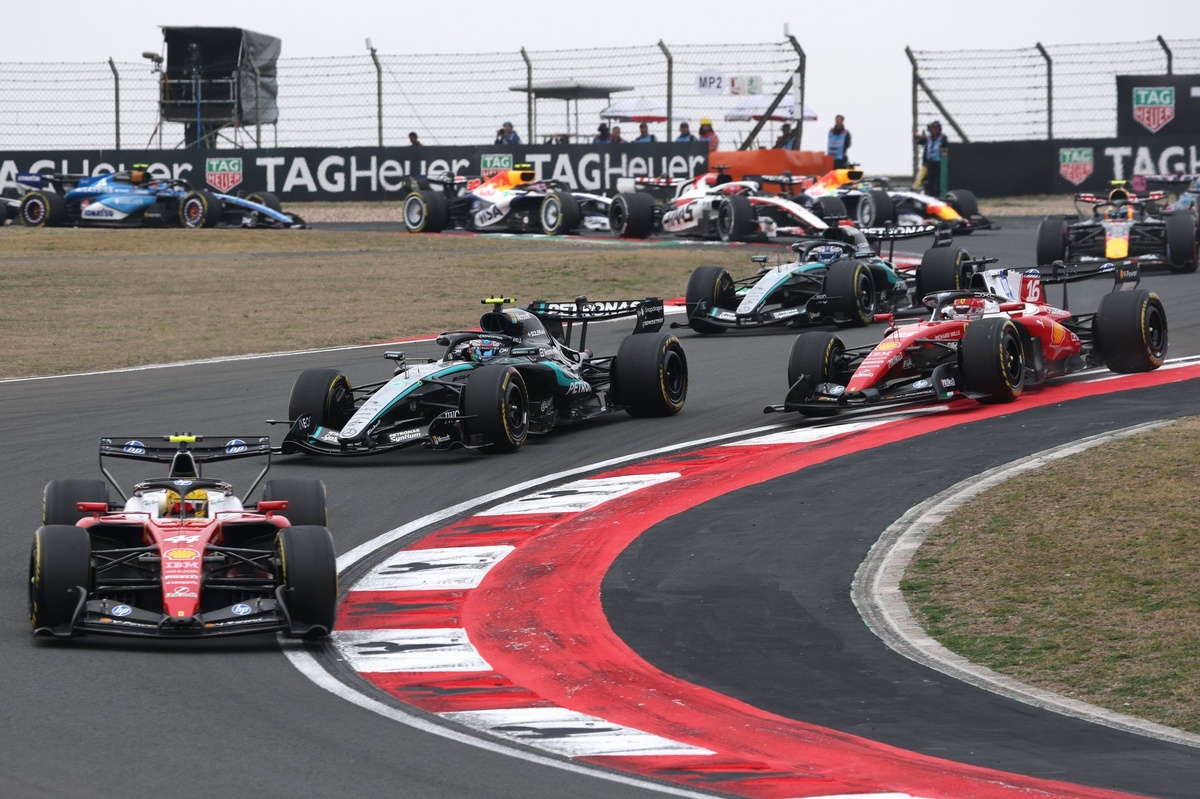
Although the FIA had originally set a target to review Formula 1’s new technical regulations after the Chinese Grand Prix, particularly on the powertrain side, the governing body declared itself relatively pleased with how the races had shaken out. Thus, it’ll delay any review and outcomes to the “spring break” ahead of Miami, since the cancellation of the Bahrain and Saudi races cleared the decks for a free April.
Many of the more vocally opposed spectators may have preferred an expedited assessment, but rolling everything into April gives the FIA more time to do a proper job rather than enforce a knee-jerk decision.
So, what are the main issues at play? Although there will be extreme views on either side: some will love the new visage of F1 and will hope for few changes, while others will abhor the current regs and want F1 to change everything within the space of four weeks. Let’s approach the concerns from a third-way standpoint, aggregating the viewpoints into a sensible manifesto.
From a visual perspective, much of the discontent hinges on qualifying and the apparent lack of flat-out-ness seen in the more energy-hungry circuits. Conspicuous drops in speeds, seen at Melbourne’s Turn 9 and Shanghai’s Turn 14, took away some of the sting from the all-or-nothing laps that drivers usually trade in across qualifying. While the laps are still technically all-out in the context of the new regs, most don’t want to have to grapple the reality of stitching together context and spectacle when there’s a firmly set precedent for an entirely different style of qualifying.
The racing arena seems to be a little more divided. Most would probably be okay with qualifying being, as Charles Leclerc put it, “more F1-like”, but the notion of what constitutes as racing is a bit more nebulous. Stripping it down to bare bones, racing requires only two cars aiming to get to a finishing point first, and that’s it; anything else is supplementary. When we consider further definitions of racing and raceability (as far as we know, not an unreleased Jane Austen novel) from an etymological point of view, it becomes a bit more hazy. ‘Cars that can race each other’ has been a phrase used to describe facilitating on-track action and the utopia of close-quarters battles, where the neologism of ‘raceability’ is simply an extension of this.
So, if that’s how we define racing, surely 2026 is closer to that utopian view? Not so, apparently; the nature of Melbourne’s race and the differing state of charge from corner to corner could be viewed as contrived, although one might argue that each car had the same tools available for the lap. It’s just another variable, like tyres, like engine power, like driving ability – but because it’s a new variable, the differences couldn’t be more stark. But compare that to an age when aerodynamics were first explored, or even when F1 cars experimented with forced induction: this was something not everybody had, and hadn’t gone through that iterative process of shallowing the performance wave.
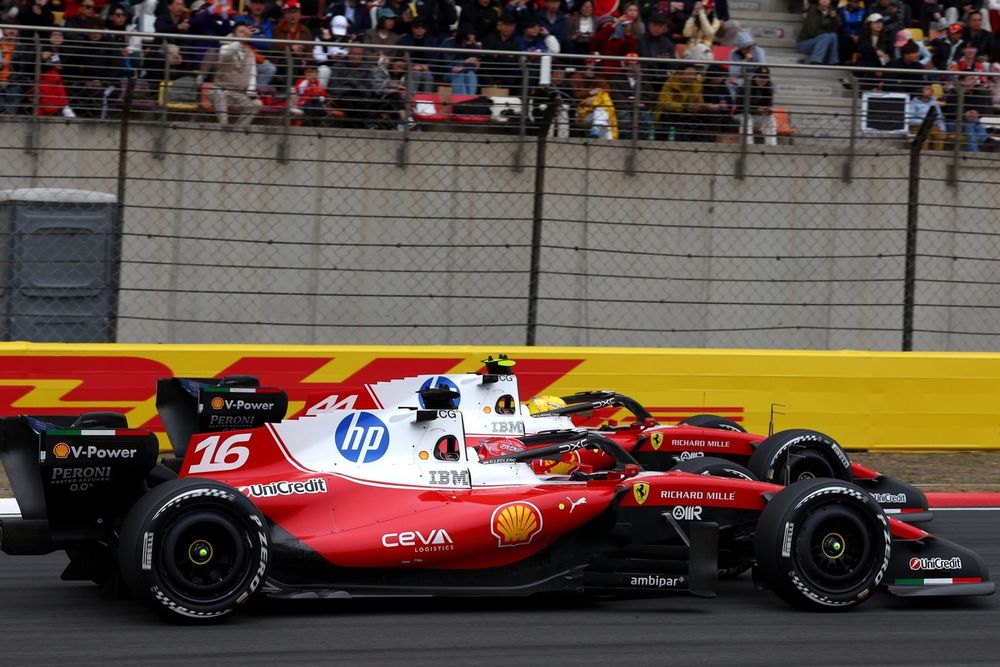
The new rules allowed both Ferraris to race wheel-to-wheel for much of the Chinese GP
Photo by: Andy Hone/ LAT Images via Getty Images
Digression aside, the key points of debate here currently concern the starts (again), and the differences in energy exposed at circuits like Melbourne. Had the Chinese Grand Prix come first, where much of the head-to-head racing in the first half had not really been energy-critical, it’s likely that this side of it might not be viewed so dimly. Perception is everything, and Melbourne showed the new regs at their ‘worst’…or at least, the delta effect of deployment at its zenith.
This will start to close up naturally as teams’ software engineers iterate their deployment processes and the powertrain manufacturers converge in terms of power and efficiency, putting a bit more cachet in the drivers’ hands.
For a circuit like Melbourne, the parameters set by the FIA’s regulations made it difficult to recover energy, largely because of limitations on energy flow, battery size, and MGU-K usage. Could the FIA shuffle some of these about to ensure teams can harvest a bit more in corners and not lose quite so much speed on the straights? We’ve sought out some expert advice to understand the framework in which the teams are currently bound within.
“The maximum state of charge is only 4MJ, and we are charging it with 8.5MJ,” said Estanis Buigues Mahiques, a powertrain engineer with experience of F1. “It means that we are charging and discharging the battery twice, more than twice per lap, which is mind-blowing compared to what road cars are able to do. Now we are only able to charge the battery during braking events, and one may think, well, perhaps you can use the engine at a range extender, so be at full load and charge the battery, one compensating for each other.
“But in Article 5.2, it states when the driver is at part load, like mid-corner braking events, it very strictly defines how much electrical power you can be harvesting, or indeed, how much fuel flow you can be flowing when the driver is at part load. All of that is defined in 5.2, and it’s very strict. And this is, as you or maybe some of the viewers can guess, this is made to prevent people using the engine as a range extender or putting some crazy anti-lag strategies to propel you out of corner.
“All of that is, I won’t say banned, but it’s very, very regulated. You still have to allow for some energy flow when you’re cornering, of course, but it’s very, very limited, just to prevent secondary ways of charging the battery other than braking.”
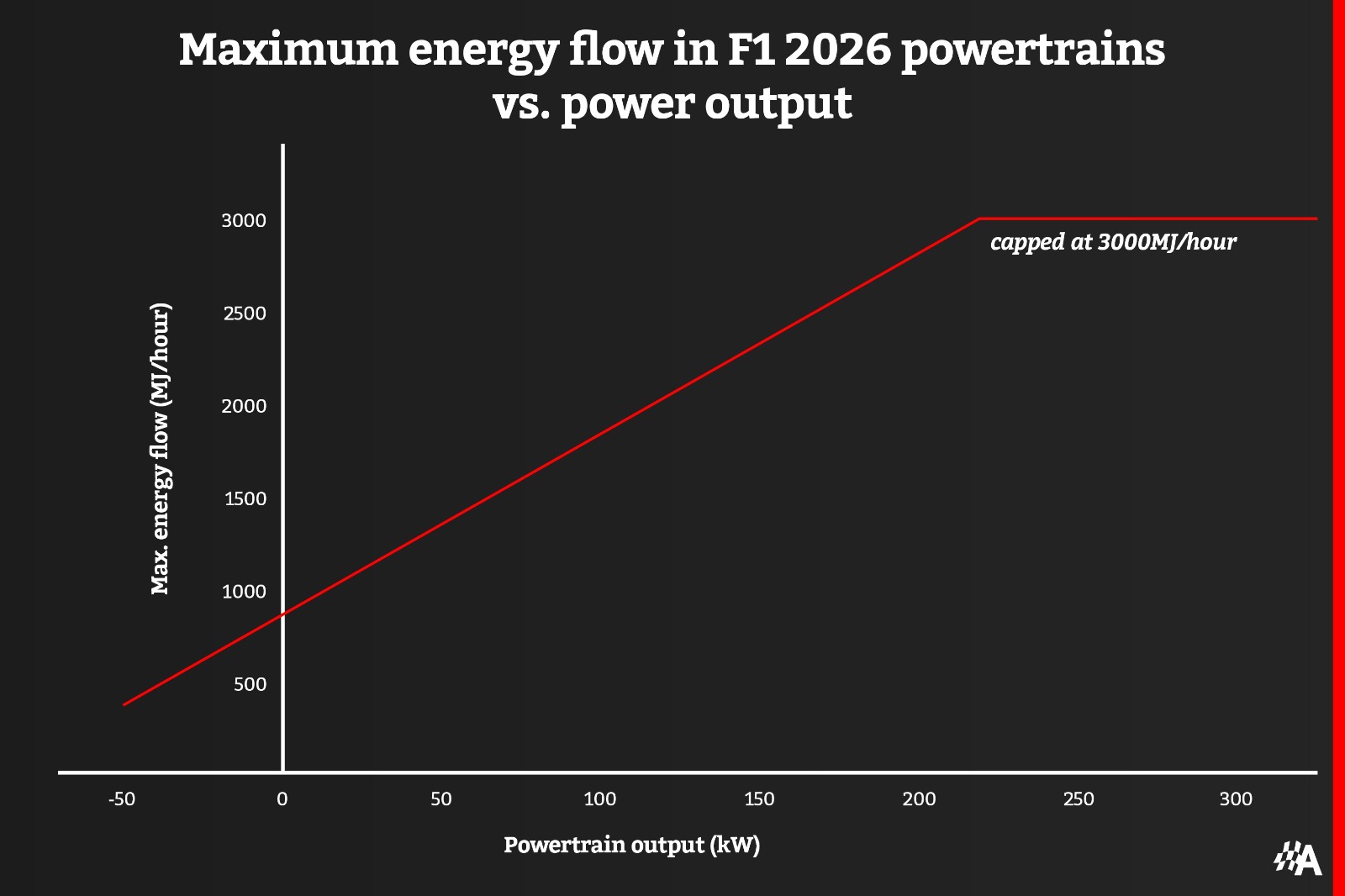
A graph showing the maximum energy flow (total energy from fuel and electrical systems) versus power output, illustrating the difficulty of regenerating power in certain instances
Photo by: Autosport
While 3000 MJ/hour is the absolute limit of energy flow between the powertrain and its energy sources (both the battery and the fuel tank), this does not apply all the time; it in fact changes with applied power and revs. In the first case at partial load, cars cannot regenerate more than 380MJ/hour when running at or below -50kW to minimise drivers running through corners with part-throttle to recuperate energy. For example; if the driver has kept the car at a rev count that demands only 200kW from the internal combustion engine, and the motor is regenerating at 250kW, it can only regenerate just north of a tenth of the maximum that it can theoretically achieve from off-throttle braking. And that just doesn’t seem like enough.
The current F1 cars generally have no problem recovering energy under braking and can often fill up the battery in a couple of corners, but it doesn’t take long to discharge the 4MJ battery on throttle. While releasing the shackles here might help, especially when it comes to energy flow from the fuel on board, it would ultimately encourage drivers into using more throttle into corners to keep the regen going – something the FIA wanted to avoid. Upping the 8.5MJ per lap limit to beyond that could help, but the drivers need to find that extra energy around the circuit to pack it into the battery – and do it in a way that doesn’t seem so obtuse.
One method that has been considered is to raise the MGU-K super clip limit from -250kW to -350kW. This was tested in Bahrain, and the theory is that the distance of the speed drop ahead of the braking zone is reduced. When the MGU-K reverses to charge against the internal combustion engine, power is pulled out of the system and contributes to the loss of velocity against the overall drag of the car. If this interval was shorter and later on, then theoretically the super clip would be less obvious; instead, it would be more miscible with the conventional braking zones and recharge the same level of energy in a shorter time period.
But then you’re still hovering at 400kW (circa 530bhp, for those more used to horsepower as a unit for power) at the end of the straight, and it’ll be much harder to maintain top speed as power to overcome drag increases with the cube of velocity.
“Unfortunately, the way the rules are written, it doesn’t allow to be using all of the potential of the ICE and the electrical motor power all of the time,” says Mahiques. “The amount of power that you can deliver from the MGU-K decays or derates with car speed up to zero kilowatts of electrical power at 345km/h.
“This means the car gets less powerful as it goes quicker. And there are a few formulas, again, in section 5.2, which define exactly how that’s happening.”
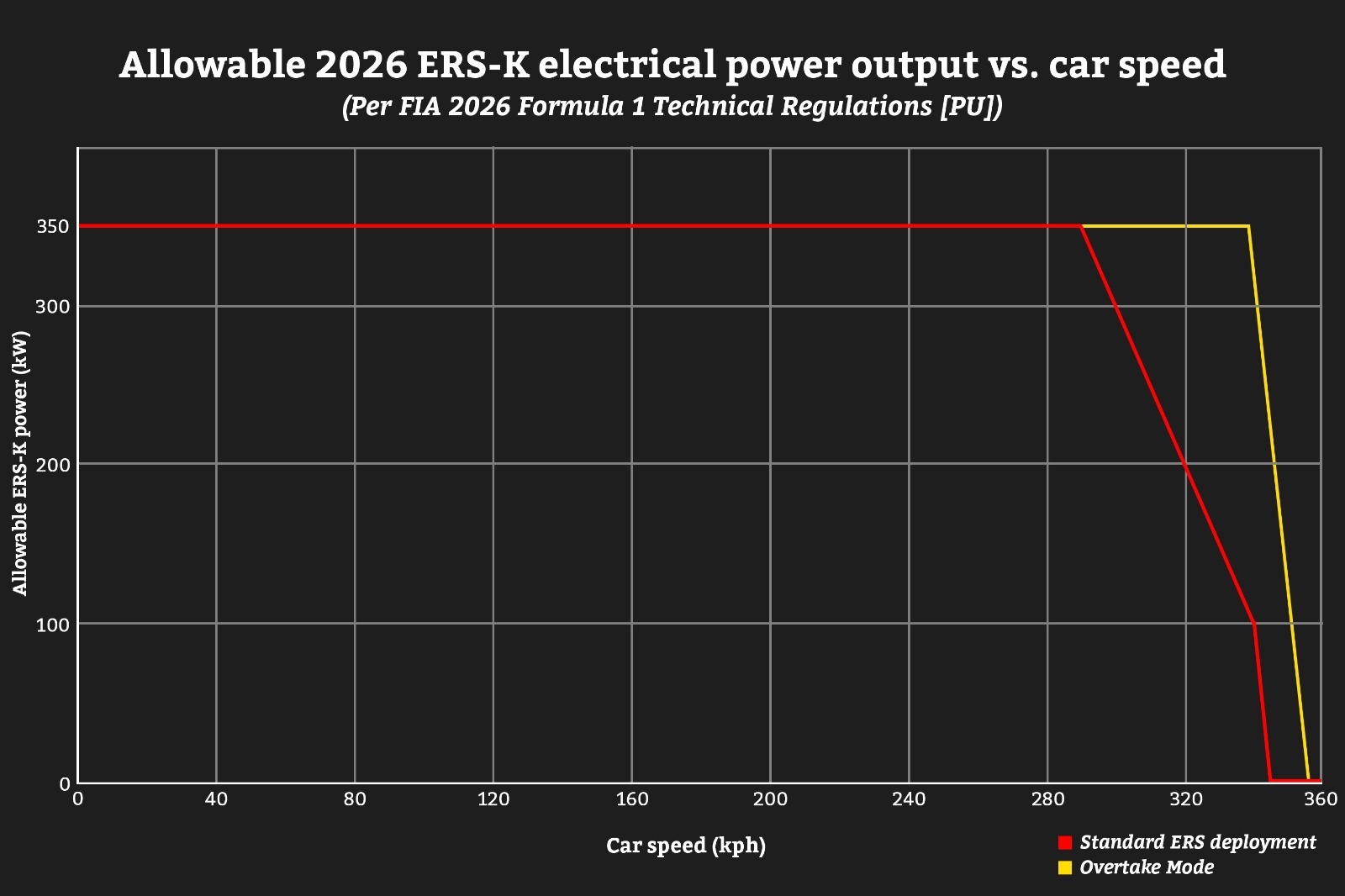
Maximum power allowed from the MGU-K – note the rampdown in output beyond 290kph
Photo by: Autosport
“It’s a bit sad that the fuel flow is so limited or the MGU-K harvest is so limited, because hey, you could perhaps use the MGU-K to slow down the engine and put more fuel flow.
“So you’re building a boost for when the driver puts the pedal down, then have more power readily available, but all of this is bound within the rules. No secondary air injection or nitro, all of those things a motorsport enthusiast can think of that WRC or hill climbers are using to mitigate turbo lag.”
One idea that this writer had suggested previously was to reduce the maximum MGU-K output to 250kW in races, reducing the energy consumption per lap and reintroducing the 350kW limit as a potential push-to-pass mode, but the opening pair of races have suggested that this would be way too powerful and ‘cheapen’ the on-track passes even more. Thus, one shall perform a U-turn on this – especially since the races appear to be less of an issue.
To fix qualifying on certain circuits, a temporary increase in energy flow and maximum limit may be the solution here. Battery charge will not be an issue at circuits like Monaco, Singapore, et al; even with 2026’s restrictions, it would be very surprising if the nature of qualifying in Monaco changed. This works for the mid-range circuits, however; if you’re able to attain full battery more often over a lap, this should help to cover off the longer straights at the likes of Barcelona, Mexico, Qatar, et al.

Watch: Autosport Explains: F1 2026 Engines
Where it gets difficult is Baku and Las Vegas; ‘energy-starved’ circuits where the straights are gratuitously long, and it’s hard to find a catch-all answer for this. They’ll run out of battery regardless long before the end of the straight, and we continue with the aesthetic problem of slowing cars in qualifying laps.
So, what can F1 and the FIA do in the short term? “Go back to the old engines” is not an option here; it might be ahead of 2030/31, if F1 wants to do something totally different, but today is not the time for that conversation. Play with energy flow restrictions more? Reduce the maximum MGU-K output for circuits where the straights are massive? Or there’s a third option: it could do nothing and just let everyone get used to it.
I don’t mind that final option, personally – but my views will certainly not represent those of most fans watching.
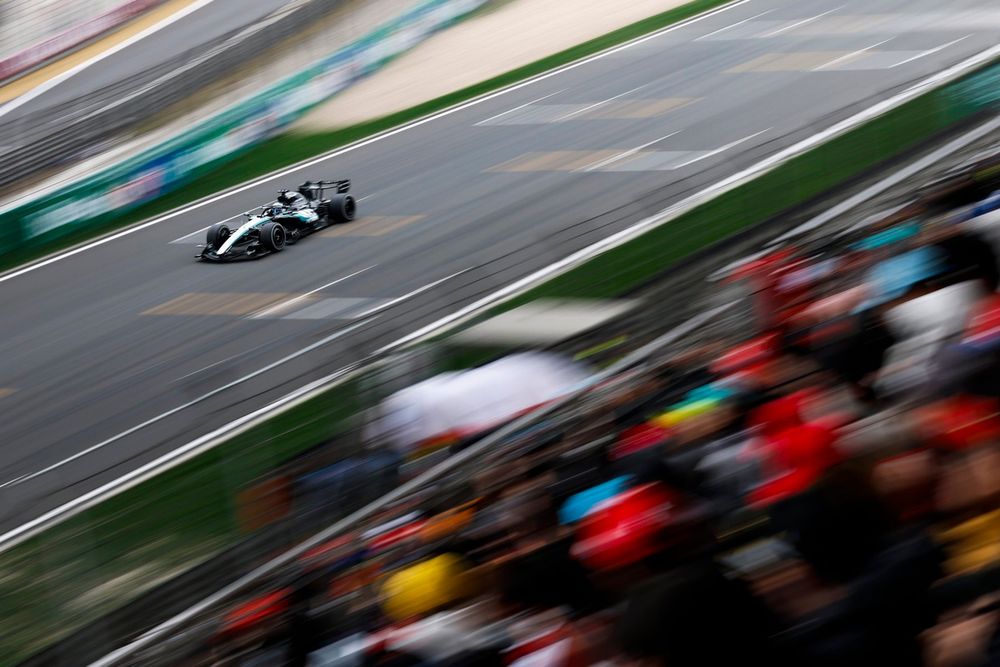
The FIA doesn’t have much scope to reduce the quantity of ‘energy-starved’ circuits beyond changing energy flow rates
Photo by: Lintao Zhang / LAT Images via Getty Images
We want to hear from you!
Let us know what you would like to see from us in the future.
– The Autosport.com Team