
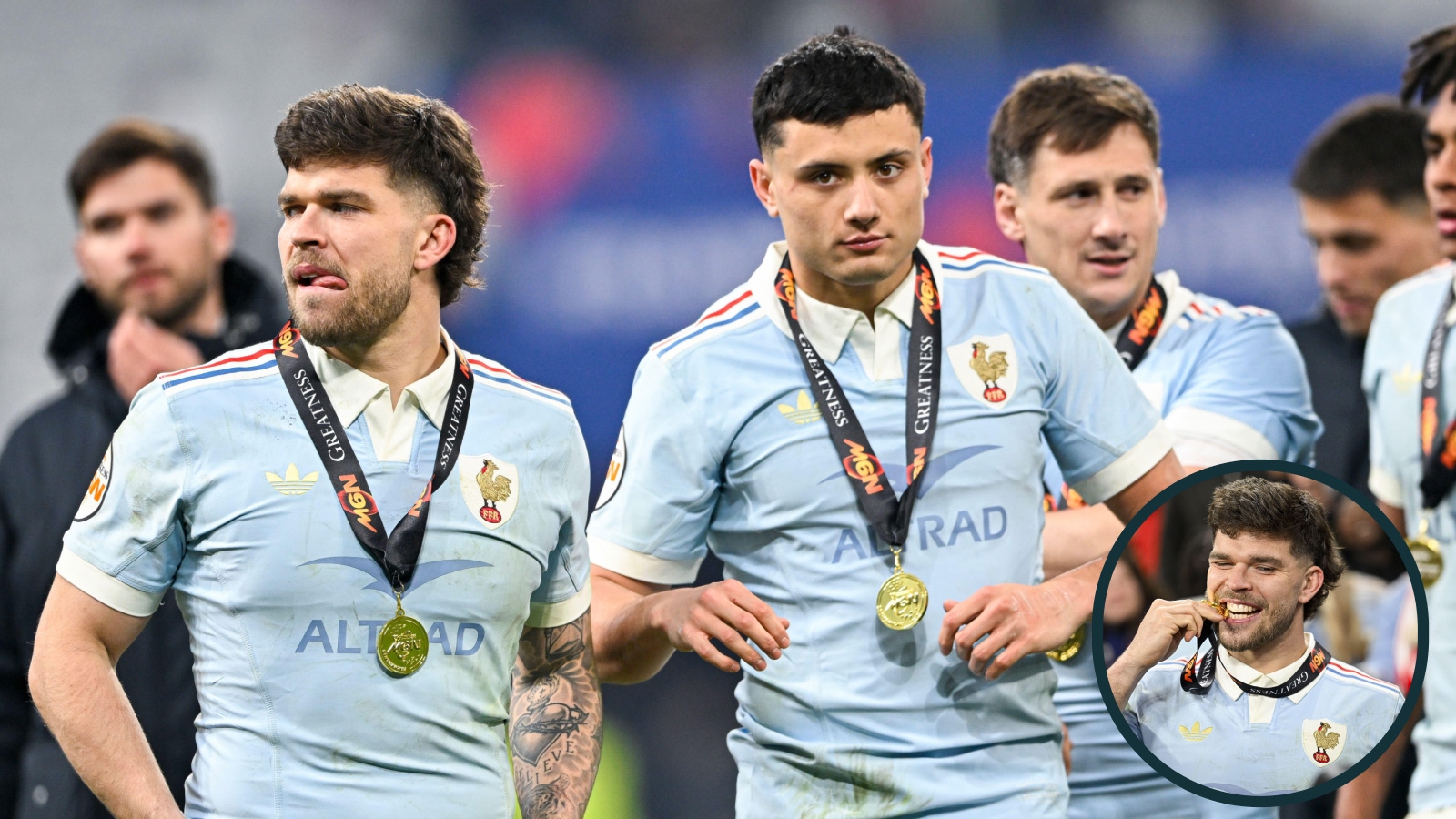
France reclaimed the Six Nations title with a last-gasp Thomas Ramos penalty to earn a 48-46 win over England last Saturday evening.
Their third championship in five years, delivered through resilience, tactical flexibility, and a talent pool capable of losing badly and still winning across five weeks. The mechanism was straightforward: four victories built on attacking brilliance, one defeat that exposed systemic vulnerability, then recalibration and the nerve to finish it.
The tournament was one of typical French extremes. Ireland were destroyed 36-14 in the opening round. Wales were demolished in round two. Italy was a celebration in Lille that allowed France to test their depth. Murrayfield was a 50-40 reckoning that revealed structural problems running through the entire defensive and set-piece system. The defeat of England came down to nerve and ice-cold execution in the moment that mattered most. No neutral observer could watch these five matches and conclude that France were consistent. Consistency is what South Africa deliver, and, true to stereotype, France produced brilliance and volatility in equal measure, something they will need to address before 2027.
Uini Atonio’s retirement just before the tournament meant France went into battle without their tighthead, and that absence rippled through everything, exposing a real structural weakness that required set-piece recalibration across five games. When your forward platform is compromised, every attacking phase depends on individual brilliance rather than systematic execution. France had enough individual brilliance to win a championship, but not enough consistency to build on it or to prevent catastrophic collapse when they faced a team of Scotland’s desire and disruption.
Galthié dropped Alldritt, Penaud and Fickou, three established players and borderline greats of French rugby, removing them from the squad entirely before a ball was kicked. Penaud was France’s all-time record try scorer, Alldritt had captained the side through the 2025 title campaign. Fickou had 98 caps and was two away from a century. The French press called it “une bombe.” Penaud had paid the price for defensive deficiencies; Alldritt, not at his best for La Rochelle, had reportedly told the coaching staff during the autumn that he needed “a little bit of love”; Fickou’s centre partnership at Racing 92 had struggled all season.
After Scotland dismantled them 50-40 in round four, the questions about those three omissions became the loudest noise in Paris, and the pressure on Galthié to justify his decisions was acute. He brought Jalibert at ten and, with him, the entire Bordeaux attacking philosophy into the competition. That ruthlessness was vindicated through four victories that showcased rugby of genuine speed and creativity. And in the final analysis, it was Thomas Ramos who delivered the moment when eighty thousand voices in Paris seemed to pause as one and then explode as the ball crossed the goalposts.
Six Nations summary
Ireland arrived injury-ravaged, with players of the calibre of Porter, Keenan and Henshaw missing. France won 36-14 with attacking rugby that looked destined for a Grand Slam, as Jalibert orchestrated brilliantly at ten and the forwards dismantled a strong Irish pack.
Wales arrived in round two and were cut open with clinical efficiency. France were clinical and direct, the back three exploited space in transition with regularity, and the scoreboard never suggested a contest. The Bordeaux philosophy had arrived at Test level, and it looked entirely operational.
Italy in Lille was a celebration that afforded Galthié the opportunity to test his depth, rotate his squad and assess fringe talent. France won 33-8 with ease, and the result was secondary to the intelligence gathered.
Murrayfield exposed the system. Scotland arrived playing rugby of architectural precision, real pace and real ambition, maintaining high possession and kicking minimally, denying France’s attack the oxygen they crave. France capitulated 50-40 as their defensive intensity and set-piece collapsed. Dupont’s second-half drift was evident when Scotland compressed the ruck space and forced immediate distribution rather than allowing the processing time that generates his best work. Questions emerged about whether the defensive system could survive pressure against elite opposition.
England arrived in Paris believing they could win. France faced a choice: deepen the experimental approach or reset to systematic rugby. They reset, and against England they locked into systematic excellence. Ramos’s penalty ended it at 48-46. That reset, that abandonment of experimental edges, was the coaching decision that won the championship.
Nigel Owens weighs in on controversial final France penalty as clarity provided after confusion
Stat leaders
Ramos accumulated 74 points across five matches, his fourth consecutive Six Nations as the championship’s leading scorer. As a standalone statistic, it obscures some of his creative genius. His volleyed through ball for Bielle-Biarrey in round one was a moment no other ten or fifteen in this championship could construct, and it was not the first time he had done it. More important was what this campaign revealed; a player who walks through pressure as though selecting produce at the Toulouse food market. At 45-46, every element of execution in the final phases had to be flawless. Ramos delivered it. That composure, that capacity to control matches rather than merely score points, is where championships are won.
Louis Bielle-Biarrey scored nine tries, a new tournament record, and has reached the echelons of true rugby greatness. At twenty-two years old, he is France’s all-time Six Nations try scorer. This is not emergence into potential; France’s attacking system did not generate opportunities and deliver them to him, he generated the opportunities himself through speed and pure rugby IQ that the system alone could not create. He operated in transition and from set-play at a standard that elevated everyone around him, reading space and operating at pace with a regularity no other player could achieve.
Jalibert missed round three through injury, with Ramos dropping to ten against Italy, but returned to play all four other matches and produced moments of genuine excellence alongside the limitations that will define his career if he cannot solve them. He was brilliant against Ireland, his chip for Ollivon’s try from his own half showing instinct that separates the great tens from the very good. He was brilliant against England when his line breaks in the final twenty minutes set the table for the winner. Against Scotland, Russell’s tempo through the ruck simply outpaced his decision-making and, as in moments from the 2023 Rugby World Cup, he faltered, overplaying at times. When the possession clock accelerates beyond your processing capacity, instinct fails. That is the limitation of this brilliant ten that matters for 2027, and that is the question Galthié must answer if France are to build on this title. The answer determines whether Jalibert is a generational ten or a player whose limitations surface under elite pressure.
Dupont remained world-class throughout despite the half yard of pace surrendered to his ACL recovery. His steal in contact on Tuipulotu before Bielle-Biarrey’s try in Edinburgh was a reminder of what separates him from every other scrum-half on the planet. Still the best in rugby. The honest assessment is that the margin has narrowed. He is still capable of controlling matches through distribution and physical presence, and the recovery from eight months away from Test rugby has been remarkable. What remains is whether he can recover that final margin of pace that separated him from everyone else. In the compressed space of Murrayfield, where Scotland forced immediate decisions, that missing margin became visible. In the space of Paris against England, he adjusted his game accordingly. That adaptability may matter more than pace recovery for his future championship success.
Charles Ollivon shifted into the second row and operated as the most complete forward in the tournament, taking his try-scoring record to new heights and averaging a score every 2.5 Tests. His sporting background, once ranked national number two in France’s amateur pelota leagues, accounts for a hand-eye coordination and instinct for angles that no training regime can manufacture. He works across lock, eight and flank depending on match requirements, with ball skills that owe more to squash courts and pelota than to rugby textbooks. His try against Ireland, initiated by Jalibert’s chip, was typical of a player whose instinct for space and the tryline transcends the normal forward envelope. That hybrid positional capability made him essential to France’s attacking system when the platform weakened elsewhere.
François Cros, who had managed only one match in six months for Toulouse, played all five Tests and every minute of the tournament. He will never grab headlines, and he neither wants nor needs to. He works as connective tissue between French defence and counter-attack, securing fast ball from the ruck and policing the breakdown with exceptional intensity. Remove him and French ruck speed collapses, because the speed of ball from the breakdown depends entirely on his work rate and the precision of his decision-making at the contact area.
Jean-Baptiste Gros accumulated 43 tackles at one hundred percent completion. He emerged from the tournament in credit as France’s most reliable front-rower on a platform fundamentally weakened by Atonio’s loss. Scrummaging was not a foundation from which France could impose themselves, and that weakness meant everything else had to compensate. That France won despite it reflects attacking genius and nothing more.
Success story
Talent depth won this championship. Galthié’s selection ruthlessness was vindicated through four victories. He backed young talent, removed established players, backed the Bordeaux attacking philosophy when it worked and recalibrated away from it when Scotland exposed the system.
The real engine of France’s success, most evident early against Ireland and Wales, was their transition attack. When opposition possession fractured, or wayward kicking found its way into their back field, France became lethal. Cros and company generated quick turnover ball, Jalibert scanned early, and Ramos, Attisogbe and Bielle-Biarrey attacked space before defensive lines could reset. Kicking long into the French back three, as Jack van Poortvliet discovered to England’s cost, handed France precisely the attacking platform they sought.
Up front, Ollivon’s extraordinary handling allowed France to move the ball through a forward who could link play at pace, keeping transition phases alive when most packs would slow the ball. Oscar Jegou and Mickel Guillard proved enthusiastic and capable cohorts, and the speed of that transition, from turnover to wide channel in two or three passes, meant opponents rarely had time to organise. That is where France’s attacking brilliance lived: not in structured phase play but in the moments when structure collapsed.
Ramos’s final penalty erupted the Stade de France. That roar validated every selection decision Galthié had made in the off-season. For a team that had lost to Scotland and seemed to be coming apart, the discipline to reset and beat England when it mattered most provided the truest measure of championship quality. They did not recover through brilliance; they recovered through tactical recalibration and the character to execute it under pressure.
Main regret
France are mercurial. Four spectacular wins and one catastrophic 50-40 collapse created a tournament that revealed more about volatility than championship quality. Ireland destroyed, Wales demolished, then, without warning, Scotland dismantled them. That is the vulnerability, the inconsistency that costs championships against elite opposition when tournaments are decided across five weeks of competition. The numbers are extraordinary: only two matches in Six Nations history have seen both teams score more than forty points, and both occurred in France’s final two games of this tournament. Shaun Edwards, who built Wales teams that went entire tournaments without conceding a try, had to make his peace with that reality. His own verdict after Paris, that going five games without conceding a try is now impossible, was less a defence than a description of the world his team inhabit.
This volatility is precisely what separates France from the benchmark teams in world rugby. South Africa is that benchmark. Less attacking spectacle, far more consistency across tournament durations. The Springboks tend to produce the same match regardless of opposition or moment; rarely spectacular, seldom wrong. They accept lower highs because they eliminate the lows entirely. Their average performance across five matches is higher than France’s average. That is what wins World Cups. That is the distinction France must learn.
The set-piece weakness ran through the entire campaign. Atonio’s retirement removed their tighthead. Aldegheri started at Edinburgh and was bullied by Pierre Schoeman repeatedly. That should not happen at this level when defending a championship. France entered the England finale with a fundamental scrummaging liability that would have cost them against any other top-tier opposition. They are one genuinely world-class tighthead prop away from being a top-three global force. Without that prop, they remain beatable in the moments that matter most.
This is the architecture of French rugby in 2026. They won this championship because their attacking talent exceeded their structural weaknesses and because Galthié possessed the tactical flexibility to reset when the moment demanded it. That flexibility won a title. Building consistency into the system will determine whether they can win 2027 or whether the mercurial pattern will repeat.
Results
France BEAT 36-14 Ireland (Stade de France, Paris)
France BEAT 54-12 Wales (Principality Stadium, Cardiff)
France BEAT 33-8 Italy (Stade Pierre-Mauroy, Lille)
France LOST 40-50 Scotland (Murrayfield, Edinburgh)
France BEAT 48-46 England (Stade de France, Paris)