
You’re not watching a scene from the latest28 Years Later movie. This is real-world K-pop star Park Sung-hoon, running for his life.
Haunting new footage shows the ENHYPEN idol being mobbed by a gang of groupies lurking in wait at Seoul’s Incheon International Airport.
The video has ignited intense online debate over South Korean celebrity security, the dark side of the K-pop boom and obsessive fan culture.

But it’s far from the first time a K-Pop star has been terrorised by fanatical fangirls.
They’re called the sasaengs.
“Private fans”.
Because they stop at nothing to violate the privacy of their idols.
And unlike the lonely popstar stalkers of the West, these ones operate like organised gangs.
Hidden cameras. Poisoned drinks. Blood-brushed letters. Even prostitution in exchange for information.
This is the dingy underworld of the real-life K-Pop Demon Hunters.
‘Like the yakuza’
Professor Renata Iwicka, from Poland’s Jagiellonian University, tells news.com.au the sasaeng run a rigid hierarchy.
“Their hierarchical structure is not unlike the yakuza,” Iwicka says.
“To join, you must provide intimate information about – or items belonging to – an idol. The more you share, the higher you’ll rise through the ranks.”
So where did these extreme fangirls come from?
The subculture traces back to the 1990s, when groups of mostly teenage girls came together to worship their K-pop idols.
But this worship veered into violence. Break and enters. Even sexual services offered for idol information.
“They started to lurk around idols’ houses and gather on social media to trade information and personal items like towels or underwear.”
Some K-pop stars were even met by urine and faeces left outside their homes – as though the territory had been marked.
“The more competitive they became, the more extreme they became. They were all determined to be the best.”
Iwicka says the sasaeng are driven by mob mentality.
“Sasaeng’s entire existence is built on group recognition. They cease to exist alone.”
Iwicka says the behaviour became “much more violent” when K-pop began to widen its global foothold in 2017.

This was compounded by the streaming services boom, which pushed K-Pop idols from regional fame onto the worldstage.
In August, animated movie K-pop Demon Hunters topped the Netflix movie charts.
This kind of recognition further emboldens the sasaeng.
“They’ve become less visible and more secretive.”
Around this time, the groupies began gathering on encrypted platforms to trade private information including flight schedules.
Airports became a key hunting ground.
“They’re easily accessed spaces where everyone can enter and wait around, with minimal security,” says Iwicka.
“There are also many hiding places and escape routes to use after invading their idol’s personal space by kissing and touching them.”
In an indication of the sasaengs reach, some idols have even reported tampering with their on-flight meals.
So how do young girls accomplish such extreme stalking?
The internet hasn’t helped.
While Beatles fangirls were known for screaming – and wetting themselves with excitement – they had little means to chase their muse once they stepped offstage.
In the digital age, personal information goes to the highest bidder. And everything is for sale: addresses, phone numbers, even live idol locations.
Iwicka says encrypted social media has empowered the sasaengs to shroud such trading in the shadows.
It’s not just the idol’s lives being laid on the line.
In pursuit of the stars, some sasaeng will speed up to 200 km/h, threatening innocent people along with the idols.
It’s becoming a liability.
‘Extreme, dangerous and delusional’
But where is the line between a passionate fans and sasaeng?
“It’s about ownership. Even passionate fans understand idols are entertainers. Sasaengs believe they own them.”
Some critics blame K-pop managers for enabling the harassment.
In the 1990s, K-pop management began to emulate the intense Japanese artist management system.
This includes shackling recruits into long exclusive deals to carve a polished, picture-perfect image, with little control or financial reward.
As part of this system, some agencies manufacture an air of accessibility by tolerating obsessive fan behaviour. Many discourage idols from having a love life to enhance their availability.
Iwicka believes this legacy enables incidents like the latest airport ambush.
“There’s still a lack of security for idols at events or airports,” she says.
ENHYPEN’s management companies, Belift lab and Hybe Corporation, did not respond to news.com.au’s request for comment.
‘Illusion of intimacy’
But Iwicka says Idol’s themselves must take some ownership for feeding into fan obsession.
“Part of the blame must also land on idols.”
“Many talk about their fans like lovers or siblings, refusing to condemn their behaviour. This creates an illusion of intimacy.”
“Sometimes this parasocial relationship evolves into something extreme, dangerous and delusional.”
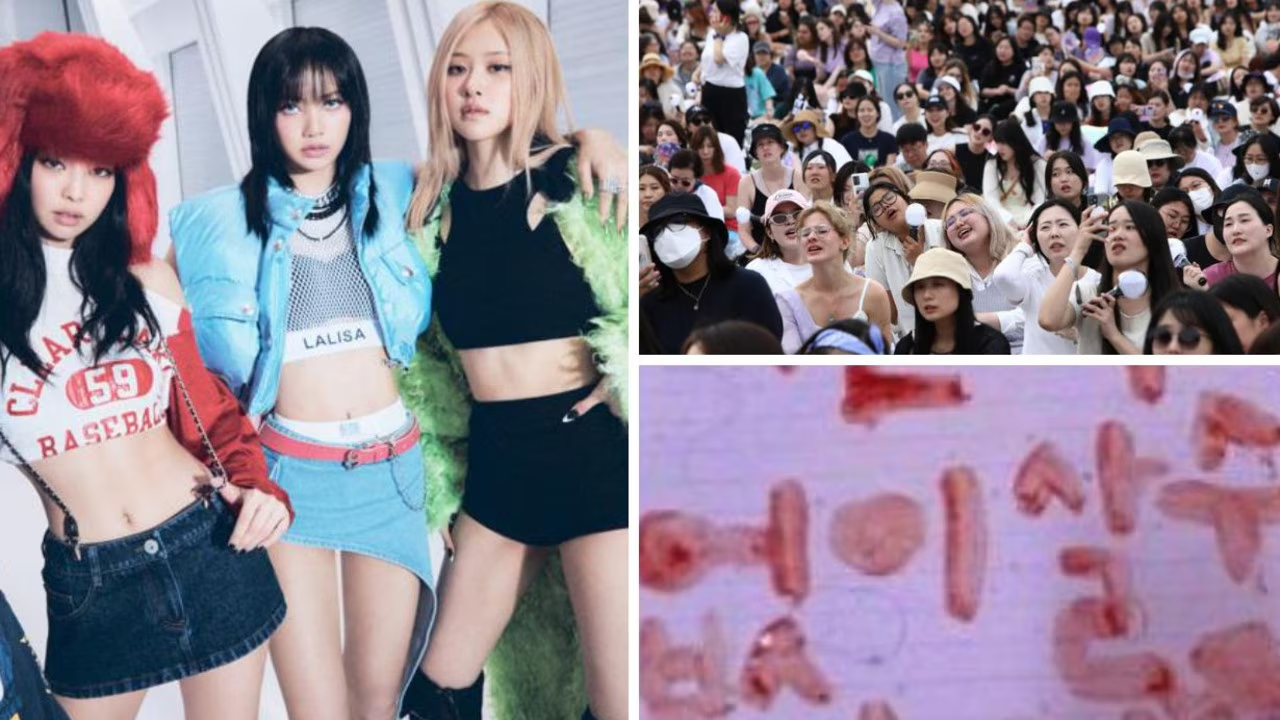
In 2010, a sasaeng sent a letter to their idols 2PM. The problem? It was inked in menstrual blood.
And it’s not only females. In 2011, a member of the girl group Girl’s Generation was nearly kidnapped onstage by a male sasaeng who posed as a staff member.
And in perhaps the most chilling incident, TVXQ member Yunho was hospitalised after drinking a beverage spiked with superglue by a sasaeng in 2006.
Iwicka says some sasaeng behaviour is culturally bound.
“In the West, we generally perceive artists as human. They may be more talented or prettier than us, but they’re still in our realm.”
“In Korea, there’s a wider chasm between fans and idols. Their status is unattainable.”
“In the West, we generally perceive artists as human. They may be more talented or prettier than us, but they’re still in our realm.”
“In Korea, there’s a wider chasm between fans and idols. Their status is unattainable.”
In Korea, stalking was traditionally considered a minor offence punished with a small fine.
“The laws need to change in Korea to crack down on sasaeng behaviour as a deterrent.”
The stalking can have tragic consequences.
Last year, actor Song Jae-rim was found dead in his apartment at the age of 39. It was later revealed he’d allegedly been severely harassed by a sasaeng fan.
‘Really scary’
One ENGENE – the official name for ENHYPEN fans – condemned the airport incident on the condition of anonymity.
“It’s really scary to even watch these videos of aggressive, obsessed fans,” the fan told news.com.au.
“ENHYPEN need more security and bodyguards to protect them.”
The fan also distanced the ENGENE community from sasaeng.
“Even in public, passionate fandom respects boundaries, safety, and consent.”
“When people crowd, follow, film and invade personal space in places like airports, it becomes intrusive.”
“It’s not a fan event.”
But another fan but sasaengs alone can’t take the blame.
“It’s not just about fans controlling their behaviour. Agencies must plan and enforce stronger protection, and airports need to take crowd control more seriously.
“Blaming only sasaengs ignores the system that allows these situations to keep happening”
‘Only escape’
Professor Roald Maliangkay, from the Australian National University, says sasaeng will go to extreme lengths to get their hands on their idols.
“We’ve seen some sasaeng getting jobs at the airport, telephone companies or CCTV providers.”
“That’s quite a commitment to get close to someone.”
Reports have even surfaced about sasaeng prostituting themselves to fund their daily hunting. Planting GPS trackers and hidden cameras. Spiking star’s drinks.
But Maliangkay says obsessive fan behaviour is not new in Korea.
“The Korean geisha of the colonial period (Gisaeng) were also known for behaving like obsessive fans.”
“Social media doesn’t help because it’s anonymous, offers imagined relationships and even supports bad behaviour.”
“People who are really isolated may find dopamine in this.”
“They have no friends or family to tell them to stop it. Many are under intense pressure cramming for all kinds of exams and their only escape is having someone to idolise.”
But Maliangkay says it’s crucial to remember how key these fans are to their idols’ glory.
They’re the engine who wins them elite ranks on charts (ENHYPEN last week debuted at number two on the US Billboards 200). Who makes them trend on TikTok. And who helps them win awards.
“Sasaeng are really obsessed, but they don’t always want to misbehave. They’re just incredibly passionate.”
“That doesn’t justify their behaviour. But we need to keep in mind that this whole industry relies on fans being completely obsessed with these beautiful people.
“However ironic that is.”
Nelson Groom is a freelance writer. Learn more on his Instagram.
Got a story? Get in touch: nelsonsamuelgroom@gmail.com