
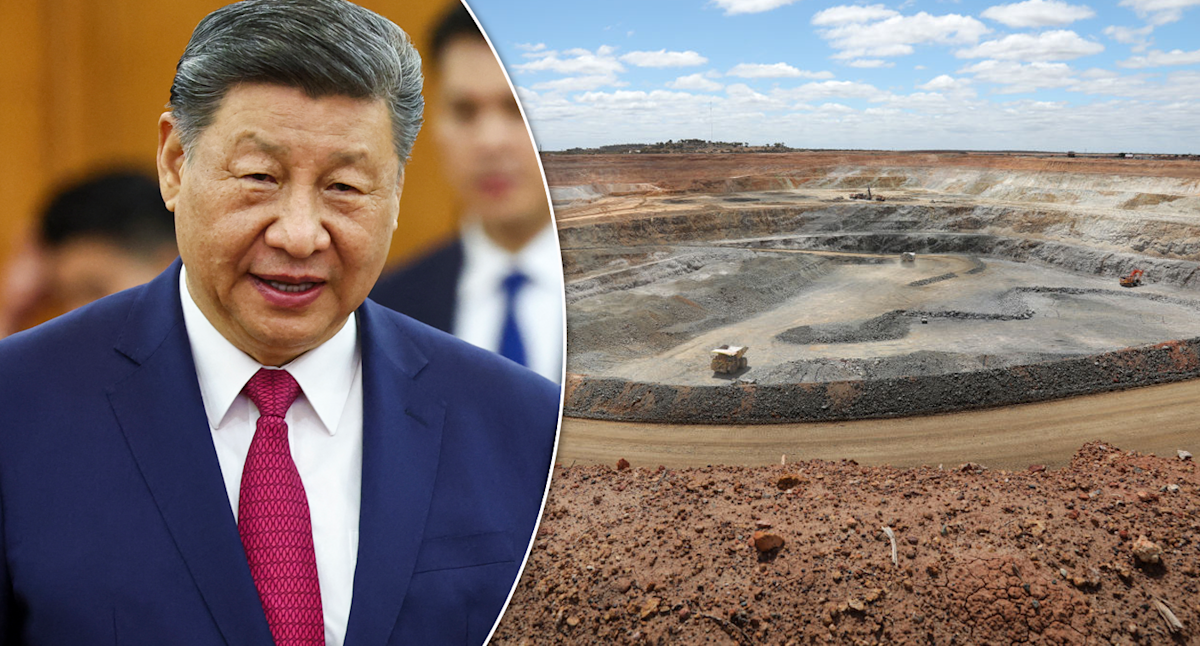
 Australian mining is primed for another potential wave of growth. (Source: Getty)
While it wasn’t meant to be flattering, over the last 30 years the Australian economy has lived up to its adopted moniker of being “the lucky country”. Again and again, we avoided major recessions that afflicted our developed world rivals, with the exception of the global Covid pandemic.
Much of that good fortune has stemmed directly or indirectly from the nation’s resources sector. Surging mining investment and government revenue from mineral exports have helped insulate the Australian economy from many economic challenges, at least in headline terms.
And now, as one door starts to close, others are opening.
RELATED
Thirty years ago, as a proportion of the broader economy, resources exports were the equivalent of 6.2 per cent of GDP.
At the most recent cycle peak in June 2022, which followed the outbreak of the war in Ukraine, that figure had risen more than three-fold to equal 19.9 per cent of GDP.
After undergoing the most meteoric expansion in the history of the industrial world, the Chinese appetite for steel continues to wane. As a result, Australia’s largest exports by value – iron ore and coking coal – are now potentially facing a very different long-term outlook.
The future outlook for steelmaking commodities overwhelmingly rests on the role of China. It imports more iron ore than the rest of the world combined and produces more steel than the rest of the world combined.
On the other hand, Australia is Yin to China’s Yang, exporting more iron ore than the rest of the world put together, leaving Australia and the Middle Kingdom inextricably tied together.
 Even if iron ore demand wanes, the appetite for rare earths, lithium, copper, gold and a multitude of other minerals is rising up. (Source: Yahoo Finance)
But with domestic Chinese steel consumption stuck in a downtrend and the once mighty Chinese property sector showing no signs of a recovery, there is a growing long-term risk that falling Chinese demand, rising trade barriers for Chinese steel exports and the recent opening of the Simandou mega mine in West Africa could spell trouble for Australia.
RELATED: Australia’s China cash cow doomed as ‘Pilbara killer’ fires up
But does that mean our luck may finally be running out after one of the strongest runs (in headline terms) in modern economic history?
It’s certainly a possibility, but a changing world may yet throw the Australian economy a lifeline and another visit from lady luck appears to be coming to our way.
Even before the war in the Middle East, the shift toward the minerals that will power the move to renewable energy and the AI economy was already underway.
Demand for rare earths, lithium, copper, gold and a multitude of other minerals was surging.
Against the backdrop of an increasingly volatile and uncertain geopolitical landscape, ensuring the supply of rare earths minerals and other resources from reliable sources such as Australia has become increasingly more paramount.
Since the latest round of trade wars kicked off between the United States and China last year, the issue of rare earth imports has become increasingly vital, as the Chinese government reduced the supply to the market as a response to being hit by President Trump’s various tariffs.
With China controlling 67.9 per cent of global rare earth production and holding what is some cases a near monopoly on the supply of certain refined rare earth minerals, there is a strong push across the Western world to secure supplies from a nation where supply can be maintained with a greater degree of certainty.
Although a small portion, Australia is the third biggest player in rare earths. (Source: Data Capitalist)
The United States and others have looked to Australia, now the third largest producer of rare earths in the world.
In October last year, the Albanese government inked an agreement with the US to provide at least $1 billion in investment towards an $8.5 billion pipeline of critical mineral projects over the next 6 months.
One major driving force for the increased demand for copper comes from the world of vehicle manufacturing.
Imagine for a moment two identical car factory’s, each produces half a million cars per year.
In the factory that produces normal internal combustion engine cars that run on petrol or diesel, each car requires around 24kg of copper, for a total of 12,000 tons of copper across its annual production run.
In the one that produces battery only electric vehicles, each car requires an average of 85kg of copper, requiring a total of 42,500 tons of copper a year.
According to figures from the International Energy Administration and Benchmark Minerals Intelligence, the number of EV’s sold each year globally has risen from 2.1 million in 2019 to 20.7 million in 2025.
That represents a dramatic increase in the amount of amount of copper being consumed by the global auto manufacturing industry alone.
As Australia’s economy has begun to pivot away from coal we are now opening copper mines. And re-opening them, in some cases.
EV uptake, along with solar panels and data centres has led to a surge in copper demand. (Source: IEA)
While the upswing in demand for the resources to power the evolving world of electricity generation and transportation was always going to be a tailwind for elements of the Australian resources sector, the war in the Middle East and the closure of the Strait of Hormuz has intensified that potential significantly.
Senior Rabobank economists Benjamin Picton mused this month that the changing nature of the world’s resource needs could be the thing that actually lifts the living standards of Aussies higher.
“Between LNG, copper, gold, and rare earths, are the stars aligning for an Aussie mining and energy investment boom?” he wrote.
“Increased production and employment in high productivity goods-producing industry might be just the ticket for stagnant productivity and living standards.”
In the coming months a protracted crisis in the Middle East would throw up all manner of challenges for Australia, from securing adequate fuel supplies to providing the nation’s farmers with enough fertiliser to avoid crop yields being negatively impacted.
But there may be a huge silver lining in the long term as a world looking to new technologies and reliable partners for mineral and energy exports can turn to Australia’s mining sector.
Get the latest Yahoo Finance news – follow us on Facebook, LinkedIn and Instagram.