
This is part of BoxingInsider.com’s ongoing series on the Muhammad Ali American Boxing Revival Act. Part 1 examined what the bill means for club promoters and independent boxing. Part 2 broke down what drug testing actually costs at every level of the sport. Part 3 covered how the bill turns win tourism into the default path for young fighters. Part 4 investigated who runs the ABC and why Congress is giving them federal power. Part 5 asked what the bill gets right and why the people who work in boxing deserved a seat at the table. This piece looks at what Bob Arum—the most experienced active promoter in boxing—told Congress the bill takes away from fighters.
The first fight I ever went to was a Top Rank card at Resorts Casino in Atlantic City. I was a kid. My dad would drop me and my friends off for a few hours—he’d go gamble and we’d go watch fights. The host gave us a giant stack of comp coupons for soda and hot dogs and we handed them out to Michael Buffer and the crew. We’d yell “down in front” to anyone who dared block our view. I went to a lot of Top Rank shows after that.
I grew up in a world where Bob Arum and Don King ruled boxing—and if you listened to Don King, it was always “loathsome Bob.” I had the opportunity to interview Arum once on the Boxing Insider podcast. He is exactly what you’d expect from the greatest boxing promoter alive—sharp, direct, and sixty years deep in this sport. Before he ever promoted a fight, he was an Assistant United States Attorney under Robert F. Kennedy. He helped create Ali. He helped create Floyd. He built Pacquiao into a global icon. He has worked with Tyson Fury, Oscar De La Hoya, Sugar Ray Leonard, and dozens of other world champions across six decades.
How can Congress write a bill that reorganizes professional boxing and not have Bob Arum in the room?
Not everyone in boxing likes Bob Arum. Plenty of people have grievances. He and Dana White have had a public feud for years. But his legal analysis of what the Ali Act was built to do is not an opinion—it’s the perspective of someone who was there when the law was written and has operated under it for a quarter century. You can dismiss the messenger. You can’t dismiss the three provisions he identified.
In December 2025, Arum submitted a two-page letter to the House Committee on Education and the Workforce calling the Muhammad Ali American Boxing Revival Act (H.R. 4624) “incredibly problematic and entirely unjustifiable.” But Arum didn’t just oppose the bill. He identified exactly what it does wrong—in language specific enough for any congressional staffer to understand.
Arum wrote: “As presently drafted, the conditions required for an entity to qualify as a UBO do not include the protections for fighters set forth by the original Ali Act. A UBO is not prohibited from entering coercive contracts with fighters, is not required to provide financial disclosures to fighters, and is not subject to the rule establishing a firewall between managers and promoters.”
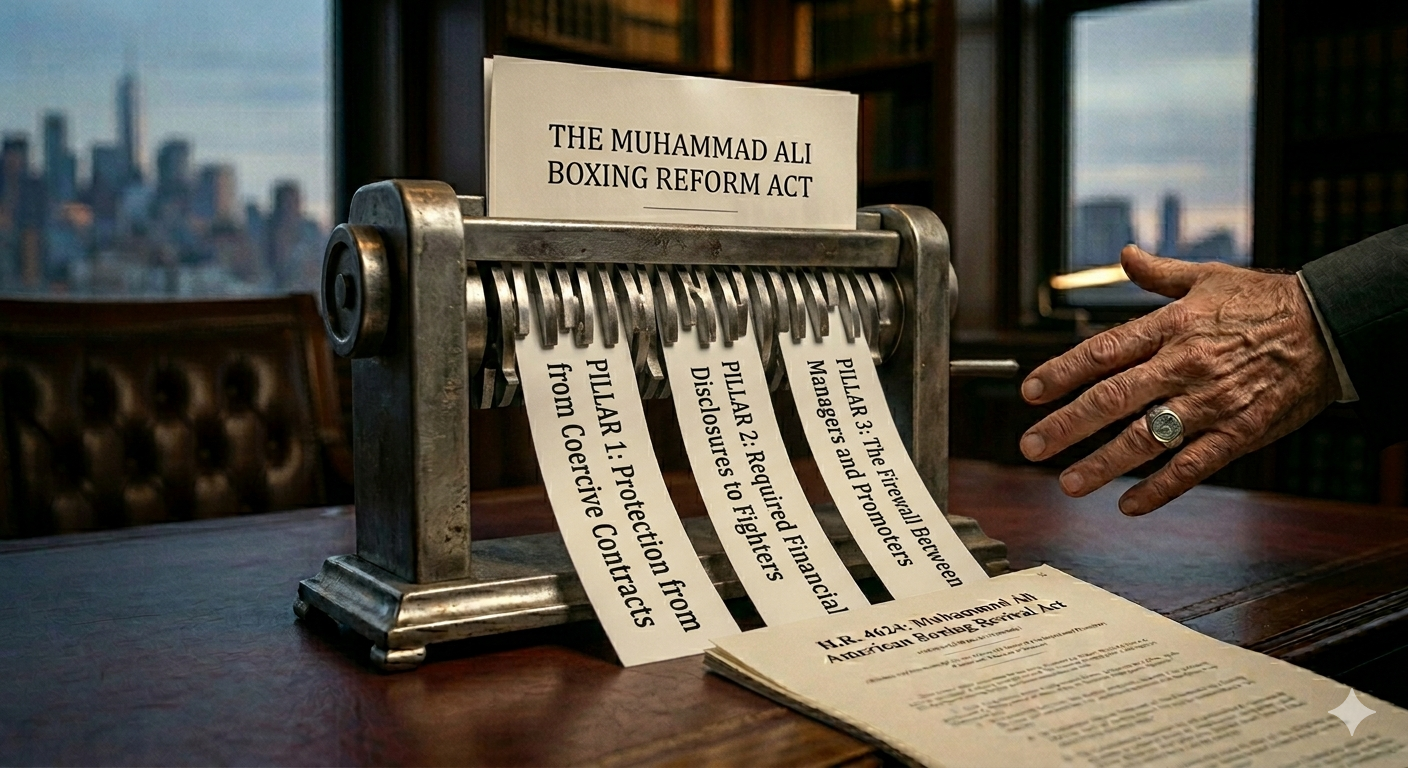
Those are the three pillars of the Muhammad Ali Boxing Reform Act of 2000. Every one of them exists because fighters were exploited before the law was written. The Revival Act removes all three for any fighter who signs with a Unified Boxing Organization. These exemptions survived the March 17, 2026 suspension version of the bill—the version heading to the House floor. Even USA Boxing—the national governing body for amateur boxing in the United States—has formally withdrawn its initial support, with its board stating the earlier endorsement letter “does not represent an official position of USA Boxing.”
Arum concluded: “There is no reason for Congress to actively remove these protections for those fighters who choose to sign with a UBO, and there is no reason for a UBO to be exempt from complying with these protective measures.”
Here is what each protection does, why it was created, and what happens to fighters when it’s gone.
1. Protection from Coercive Contracts
The original Ali Act made it illegal for a promoter to lock a fighter into a long-term contract as a condition of getting a fight. Before the law existed, promoters routinely forced fighters to sign multi-year option contracts just to get on a card. If you wanted to fight, you signed away your future. The promoter decided when you fought, who you fought, and for how much—for as long as they wanted.
The most notorious example was Don King’s relationship with Mike Tyson. After Tyson’s release from prison in 1995, he earned roughly $140 million over his next six fights. In a 1998 lawsuit, Tyson alleged that King had exploited his illiteracy to make him sign business contracts that paid consulting fees to King’s family members and billed Tyson for King’s own travel, security, renovations, and legal battles. Tyson alleged King defrauded him of over $100 million. The case settled for $14 million—a fraction of what was taken.
The Ali Act’s coercive contract provisions were written to prevent exactly this. Section 9(b) of the Professional Boxing Safety Act, as amended by the Ali Act, declares that any contract provision conditioning a fighter’s participation in a bout on the grant of future promotional rights is “in restraint of trade, contrary to public policy, and unenforceable.” It caps option contracts at one year and prohibits promoters from tying mandatory title shots to promotional concessions.
Under the Revival Act, UBOs are exempt from these provisions. A UBO can require a fighter to sign a contract of up to six years as a condition of competing in its system. If you want to fight on the UBO’s cards, on its broadcast platform, for its titles—you sign. The “choice” the bill’s sponsors describe is the choice between signing a long-term deal with one entity or not working.
That is not choice. That is exactly what the Ali Act was written to stop.
2. Required Financial Disclosures to Fighters
The Ali Act requires promoters to disclose to any fighter in a bout of ten rounds or more all sources of income the promoter receives in connection with that fight. This includes broadcast fees, sponsorship revenue, ticket sales, and any side deals. The fighter has a legal right to know how much money is in the pot before stepping into the ring.
This provision exists because, historically, fighters had no idea what their fights were worth. They negotiated purses blind—accepting whatever the promoter offered without knowing what the promoter was making on the back end. The promoter controlled all the information and all the leverage.
In 2016, former world title challenger Chris Algieri invoked the Ali Act’s disclosure provision to challenge his promoter’s 50-50 purse split. Algieri was being paid $325,000 for a fight on NBC while his promoter kept an equal share of a $650,000 pot—despite other promoters handling most of the actual promotion. As Algieri told Yahoo Sports: “Without me, he doesn’t make a dollar. So yes, I think it’s totally fair and totally in my right to know what he’s making off of my fight. Off of me stepping in the ring and risking my life. Isn’t that exactly the point of the Muhammad Ali Act?”
Years later, Algieri said on BoxingScene: “I wouldn’t want to be a fighter in a world without the Ali Act.”
Under the Revival Act, UBOs are not required to provide financial disclosures to fighters. Here’s why: the bill says a UBO is “deemed to be in compliance with the requirements of this Act” if it meets the safety standards in Section 5 and the UBO conditions in Section 24. The financial disclosure requirement lives in Section 13 of the Ali Act. Section 13 is not referenced in the UBO compliance pathway. UBOs skip it entirely. A UBO fighter would have no legal right to know what the organization earns from a broadcast deal, a gate, or a sponsorship tied to their fight. They would negotiate in the dark—exactly the way boxers did before 2000.
New York took this seriously. Every promoter fills out a notarized affidavit before each show—every dollar of revenue, every cost on every fighter, every payment to any sanctioning organization—filed with the commission under oath. The Revival Act doesn’t eliminate this requirement for the rest of us. Promoters outside the UBO system still have to follow it. Only UBO fighters lose the right to see the numbers. That’s the “choice” the bill’s sponsors keep talking about—sign with a UBO and give up your right to know what your fight is worth, or stay in a system where that right still exists.
As Evander Holyfield noted in his Wall Street Journal op-ed, MMA fighters under the UFC model earn roughly 20% of total sport revenue, compared to roughly 80% for boxers under the current Ali Act framework. The financial disclosure requirement is a major reason for that gap. Remove it, and the leverage shifts from the fighter to the promoter overnight.
3. The Firewall Between Managers and Promoters
The Ali Act established a clear separation between the roles of promoter and manager. A promoter puts on the show. A manager represents the fighter’s interests. These two roles are inherently in conflict—the promoter’s profit increases when the fighter accepts less money, and the manager’s job is to ensure the fighter gets paid fairly. When one entity plays both roles, there is no one in the fighter’s corner at the negotiating table.
Pat English—the attorney who helped draft the original Ali Act and who serves as general counsel to the Association of Boxing Commissions—has called the removal of this firewall a “betrayal of the current act and of what McCain and those who worked with him were trying to accomplish.” English wrote that the bill “is designed for a single purpose—to allow the new Zuffa boxing entity to avoid restrictions designed to protect boxers.”
Under the Revival Act, UBOs can operate as both promoter and sanctioning body. They control which fighters get ranked, which fighters get title shots, and which fighters get paid. They also negotiate the contracts. There is no independent check on that power. The fighter’s only advocate in that structure is the entity that profits from paying them less.
Critics of the bill—Arum among them—point to the MMA model as a cautionary example. Without a manager-promoter firewall, the entity that promotes the fights also controls the contracts. In 2025, TKO settled a class-action antitrust lawsuit for $375 million brought by over 1,100 MMA fighters who alleged their wages had been suppressed. A second case remains pending. That history is part of the reason the original Ali Act built the firewall in the first place—and part of the reason Arum and others argue it should not be removed.
The question Arum raises is straightforward: if the firewall was important enough to write into federal law in 2000, what changed that makes it unnecessary now?
What This Means for the Floor Vote
Arum’s letter is not an opinion piece. It is a legal analysis from the most experienced active promoter in boxing, identifying three specific provisions of federal law that the Revival Act exempts UBOs from. Those exemptions are not in dispute. They are in the text of the bill.
The bill’s supporters say fighters will have a “choice” between the existing system and the UBO system. But a choice between a system with legal protections and a system without them is not a choice. It is a pressure campaign. If the UBO controls the broadcast deals and the talent pipeline, fighters will go where the money is—and once they’re there, they will have no right to see the financials, no protection from coercive contracts, and no firewall between the entity promoting the fight and the entity deciding what they’re worth.
Every member of the House should read Arum’s letter before voting. The three exemptions he identified are not technical details. They are the foundation of 26 years of federal fighter protection. And this bill removes them.
Larry Goldberg is the founder of Boxing Insider Promotions and owner of BoxingInsider.com. BoxingInsider.com is an independent boxing news platform and the home of Boxing Insider Promotions, which stages professional boxing events in Atlantic City and New York City. We are not covering this legislation from the outside. We are one of the promoters it will directly affect.
Read the full series:
Part 1: What the Ali Revival Act Means for Club Promoters and Independent Boxing
Part 2: Drug Testing in Boxing: What It Actually Costs
Part 3: The Muhammad Ali Revival Act Just Made Win Tourism the Business Model for Independent Boxing
Part 4: The Muhammad Ali Revival Act Turns the ABC Into America’s De Facto National Boxing Commission