
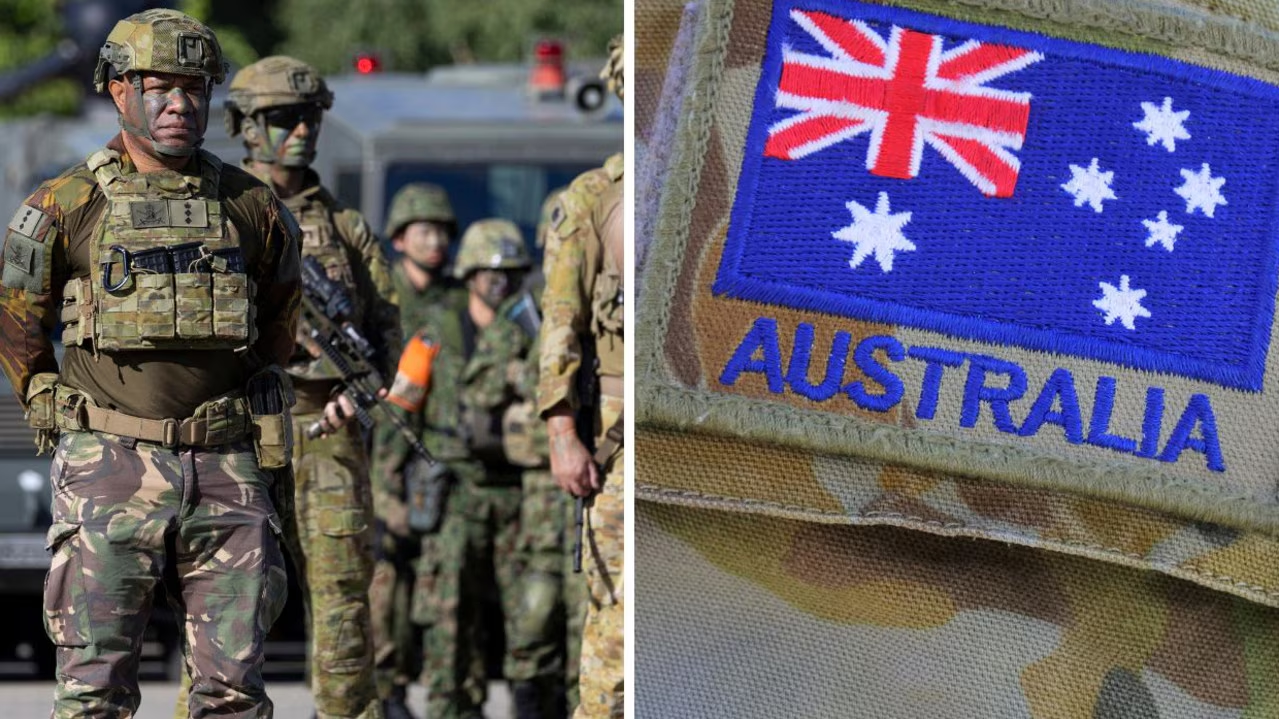
As the threat of global war continues to loom, talk of conscription has made its way into the corner of conversations across Australia.
Australians have lived relatively stress-free in terms of compulsory service in the Defence Force since former prime minister Gough Whitlam abolished conscription in 1972 during the Vietnam War.
But as global tensions begin to rise amid the war in Iran, questions have been raised about Australia’s ability to defend itself – and whether it would need significantly higher numbers of troops to do so.
In short, under extraordinary circumstances, conscription is still very much possible in Australia.
Under Part IV of the Defence Act 1903, all 18 to 60-year-old persons who have resided in Australia for at least 6 months can be called upon to serve in the Defence Force in time of conflict.
This would be done by a proclamation of the Governor-General, which must then be approved by the House of Representatives and the Senate.
Professor and Deputy Dean at the University of Queensland Law School, Rain Liivoja, said despite escalating global tensions, the reintroduction of conscription would be “highly unlikely.”
“It’s unclear what the Defence Force would do with a large number of conscripts,” Professor Liivoja told news.com.au.
“Australia has deployed a small number of Defence assets and personnel to support the UAE. There is no indication of any mass deployment of Defence personnel.”
Professor Liivoja believes that “even if the situation [in Iran] were to change”, conscription would still be an extremely unlikely next move.
“We’re talking about an overseas conflict that has been fuelled by US and Israeli acts of aggression, and that lacks strategic coherence and realistic goals,” he said.
“Compelling Australians to fight in that conflict would be political kryptonite.
“Conscription in the context of the Vietnam War proved to be highly controversial. I can’t really imagine Australia going down the same path unless the conflict poses an existential risk to us.”
Over the years, numerous Australian governments have recognised inadequate service numbers, with Australia recording some of its lowest recruitment numbers over the last decade until 2025.
In 2022, former prime minister Tony Abbott called on all school leavers to serve a period of national service.
In 2025, retired Major General Mick Ryan warned that Australia may need to introduce national service to deter potential aggression in the region.
On top of that, former Army Chief Peter Leahy urged the government to consider the return of conscription, while MP Bob Katter advocated for compulsory military training for young Australians.
In 2024-25, the Australian Defence Force enlisted 7059 full-time personnel, making it the highest annual intake since 2009 and a 17 per cent increase on the previous year.
Despite these promising numbers, Jennifer Parker, Professor at University of Western Australia Defence and Security Institute and formal Naval Officer of over 20 years, says Australia “is specifically underprepared for a major conflict.”
“The chances of a major conflict in our region are increasingly likely,” Professor Parker told news.com.au.
“However, the threat to Australia is not a threat of invasion or attack, but a threat to our maritime sea lines of communication.”
Despite this, Professor Parker is adamant that Australians should “not be contemplating conscription.”
“It would be a political risk with no reward,” she said.
“When it comes to mobilisation like that, we would need to be in the midst of a major conflict to consider conscription.”
In regard to the ongoing war in Iran, Professor Parker said it was highly unlikely it would turn into a land-based conflict that would require mass amounts of troops.
However, Ms Parker believes that in the event of a wider conflict in the Indo-Pacific region, conscription is “very much possible.”
“Politically [conscription] would never fly in Australia unless we were facing a large conflict like that,” she said.
“The Australian Defence Force does not require that amount of numbers right now.”
Instead, Professor Parker urged a restructure of the Reserve Forces to have more engagement with the community to create an “enduring and connected relationship” with broader Australia.
“The recruitment issue isn’t because Australians don’t want to join the Defence Force, it’s because the processes have been too ineffective,” she said.
Professor Parker detailed a complicated and long-term joining process that felt unattainable for the average Australian.
“The question is not whether we should bring back conscription but how we restructure the Reserve Forces to have more engagement with the community and make it possible for people to work with the ADF part-time or once a month,” she said.
Worldwide, over 60 countries maintain mandatory military conscription, including South Korea, Israel, Russia, Turkey, Finland, Greece, Switzerland and Ukraine.
“The world has fundamentally changed,” said Professor Parker.
“States are increasingly using force and we have a significant threat in terms of a militarised China, and conflicts in Europe and the Middle East.”
But the number of countries making their way back to the drawing board in terms of defence strategy has significantly increased in the last years.
Earlier this month, Croatia reintroduced mandatory military service, after not having it since 2008.
The program requires males aged 18-30 to undergo two months of basic military training, which may be used in the case of a threat of war.
Following its abolition in 2011, Germany has now voted in favour of reinstating military service on a voluntary basis.
The new law, will require all 18-year-old men to fill in a questionnaire asking if they are willing and able to join the armed forces.
From 2027, men will be required to undergo a medical examination to establish their suitability.
France, which abolished military conscription 25 years ago, has also introduced a new scheme that invites young men and women to serve for 10 months of paid military training.