
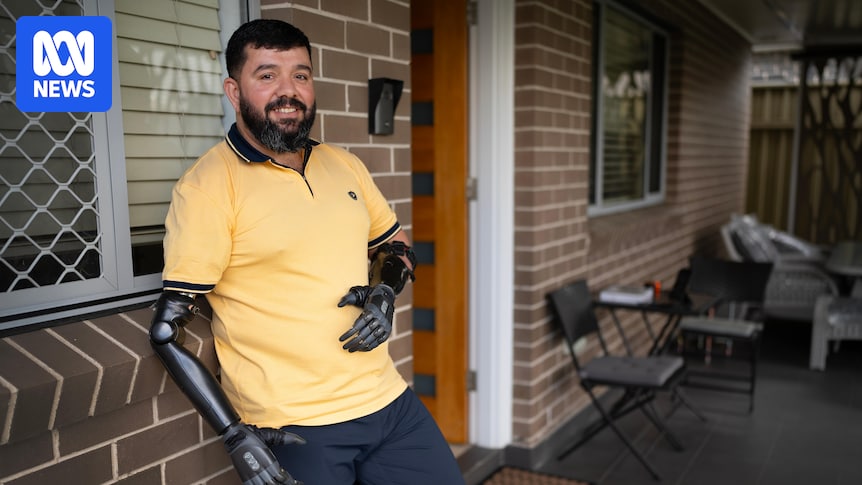
“Relax, Tommy,” says Ghanim Al Shnen, looking down at the black robotic arm attached just below his left elbow.
He concentrates and his hand twists 360 degrees at the wrist, before his thumb and forefinger move together to pick up a plastic bottle from the table.
His right arm is also robotic but attached closer to his shoulder and far harder to operate. He calls that arm Arthur.
Ghanim named his arms after brothers Tommy and Arthur Shelby, from the period crime drama Peaky Blinders.
“Tommy is a very smart and very quiet man,” Ghanim explains, “so I pick the name Tommy for the left arm because it’s quiet and helpful; easy to connect, easy to control. Arthur is crazy and make a problem. He’s always making a mess in the kitchen and hits me in the face.”
Ghanim has a remarkable ability to find humour and positivity in the bleakest situations, something that has served him well over the past 14 years.
Loading…
A former Iraqi policeman, Ghanim fled that country in fear of his life in 2012 after refusing to change an interrogation report, falling foul of local militia. Leaving his wife and three boys behind, he made his way to Indonesia and came here in a fishing boat in August that year, seeking asylum, just as the government was tightening conditions concerning boat arrivals.
He was sent to Nauru and after a year there he was allowed to return to mainland Australia after signing a document that said he could never settle in the country. He was, however, given a bridging visa, allowing him to work while his asylum claim was being heard. Twice his claim to be recognised as a refugee was refused.
Ten days before his third and final appeal, a catastrophic accident changed everything.
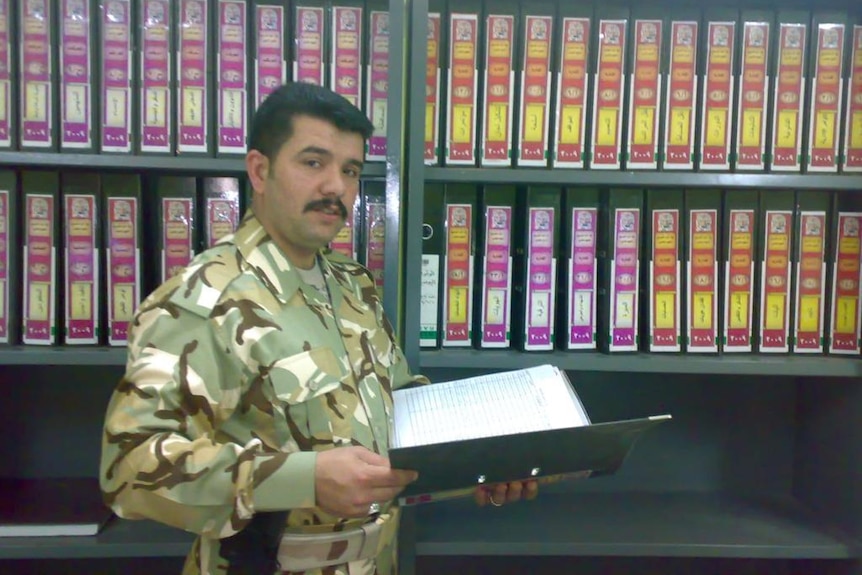
Ghanim Al Shnen worked as a policeman in southern Iraq. (Supplied)
Mind-controlled robotic arms
On the morning of November 6, 2018, Ghanim was working alone on a building site and picked up a long steel bar used for reinforcing concrete. His next memory was waking up in hospital, his arms so badly burnt they would have to be amputated.
It is believed the steel bar touched overhead wires and a massive bolt of electricity ran up both his arms before exploding out of his back.
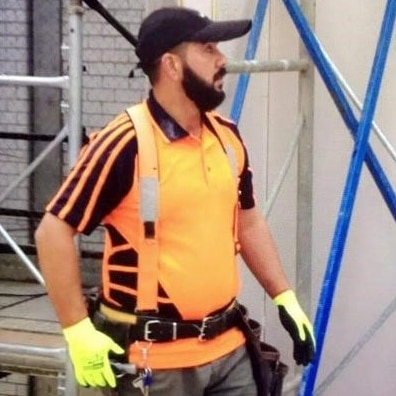
Ghanim Al Shnen worked as a labourer in western Sydney after he was released from Nauru. (Supplied)
Many months after the accident, he underwent surgery to implant titanium rods into the bones in each of his arms, a process known as osseointegration, so that robotic arms could be attached.
A collar of sensors on his upper arms picks up impulses from his nerves, allowing him to operate his hands and arms simply by thinking of the movements they used to perform.
Osseointegration is a controversial procedure and, like all surgery, carries some risk. The point at which the titanium rod emerges from the skin requires ongoing care to prevent infection and it’s not a procedure that suits every patient.
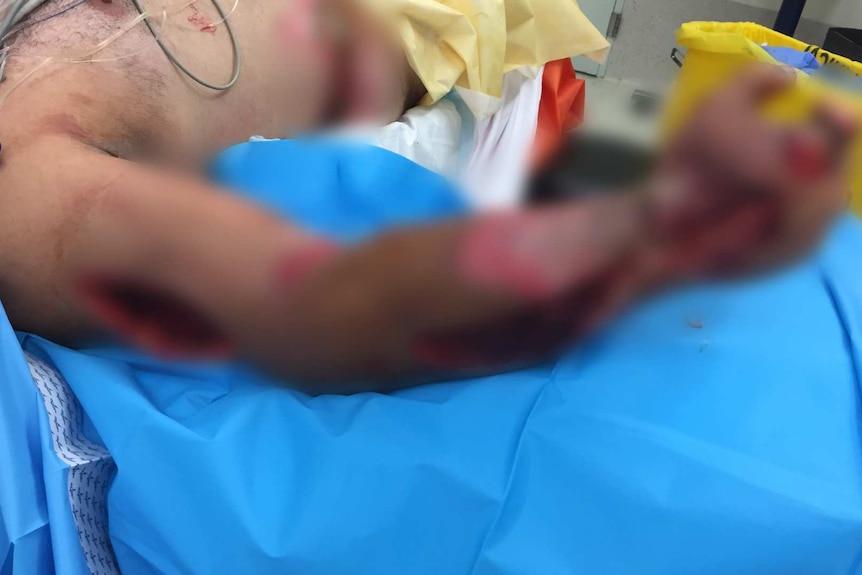
Ghanim Al Shnen’s arms were so badly burned that they had to be amputated. (Supplied)
Last year, Ghanim’s surgeon, Munjed Al Muderis, lost a defamation action against journalists who accused him of downplaying the risks of the procedure, improper sales tactics, inappropriate patient selection and inadequate aftercare. Ghanim has no issues with his treatment by Mr Al Muderis.
Given the complexities involved in fitting two mind-controlled robotic arms, there was enormous interest in how Ghanim would adapt to them.
Six years on, he is able to do many things. He can cook and feed himself. He’s even learning to drive a car. But there are many things he cannot do, including attaching the arms, and he still requires a carer 24 hours a day.
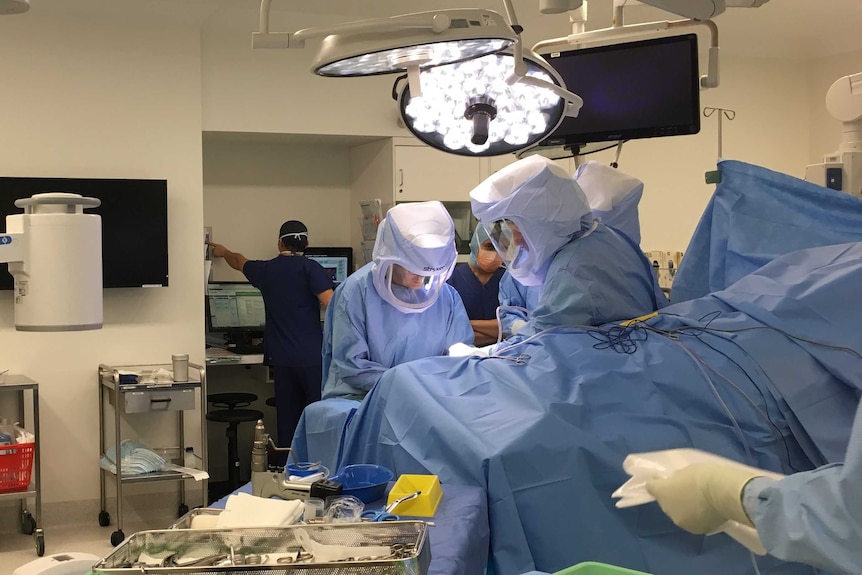
Titanium rods were implanted into the bones so that robotic arms could be attached. (Supplied)
The arms are also heavy and mentally exhausting to operate. The right arm is particularly heavy and Ghanim has ongoing problems with pain where the rod joins the bone.
As a result, he often wears lighter silicon arms, which are virtually indistinguishable from the real thing but have no mobility. And sometimes he chooses to wear no arms at all.
A child born in Finland
Ghanim Al Shnen has come a long way in the six years since Australian Story first filmed with him. Back then, he was only just starting to learn to use his left arm and his right arm was still being designed. But during those years, his visa situation hadn’t changed.
Loading…
The catastrophic nature of Ghanim’s injuries and the fact that he would require ongoing care and sophisticated prosthetics cast a different light on his visa application and raised the prospect of ministerial intervention. But the wheels of bureaucracy turned slowly.
From the moment he left Iraq, his overriding wish was to be reunited with his wife, Athmar, and their three boys, Ali, Mohammed and Ahmed. They had been accepted as refugees in Finland in 2015 but were given three-month visitor visas in 2019 to be with Ghanim in Australia during his surgery and recovery.
During that visit, Athmar fell pregnant but she and the family were back in Finland by the time Ghanim’s fourth boy, Yosef, was born.
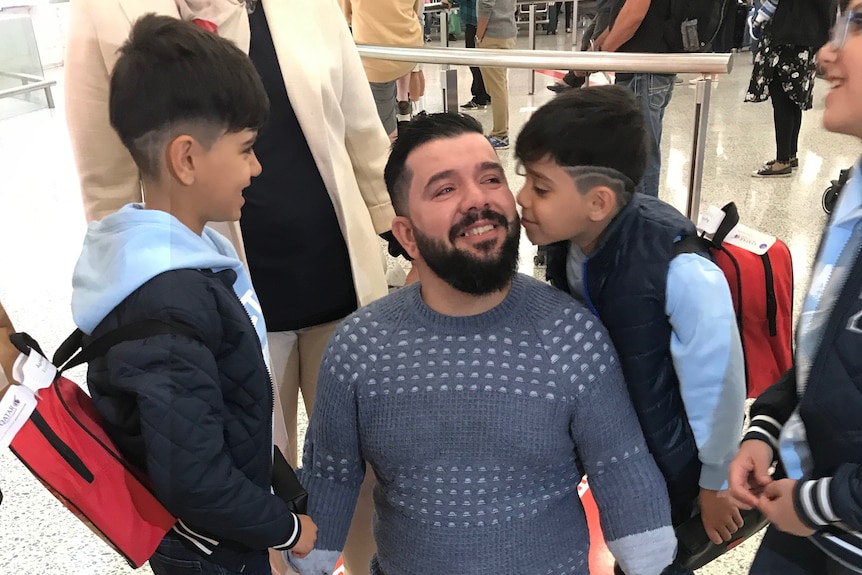
Ghanim Al Shnen’s family was granted a visa in 2019 to briefly visit him. (Supplied)
The 1.5 hour wait
After Ghanim featured on Australian Story in 2019, he was given permission to fly to Finland to see his newborn child but the COVID pandemic struck, the borders were closed and the visa expired before he was able to travel. For the next four years, Ghanim’s only contact with his family was through daily video calls.
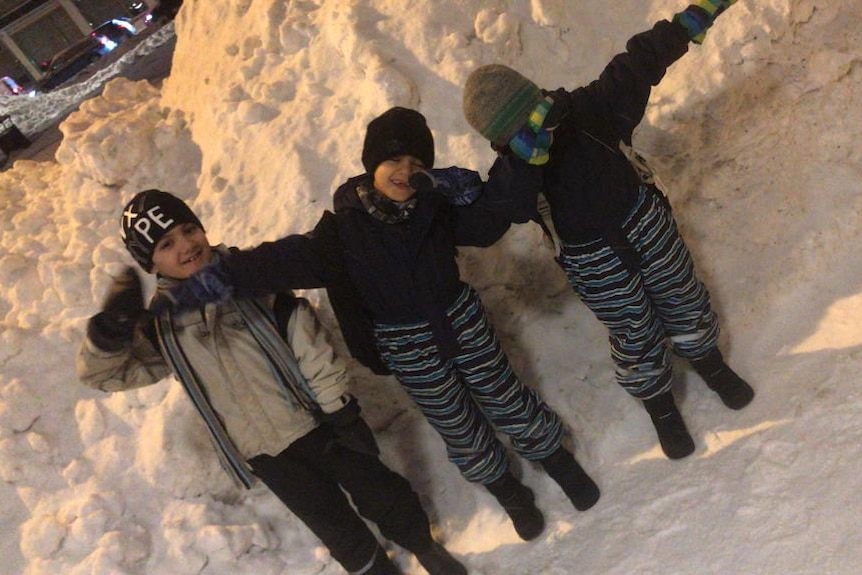
Ghanim Al Shnen’s family was accepted by Finland as refugees in 2015. (Supplied)
“I just keep sending emails to the department to get more information about my case and I always receive the same reply — you just need to be patient,” Ghanim explains. “To be in limbo is a very difficult feeling. You have no idea what’s going on and you don’t know for how long.”
Then on a Wednesday in early 2024 he got a call from his case manager asking him to come to the office the following Monday. Although Ghanim desperately hoped he was going to hear good news about his visa, he decided not to tell his family about the meeting.
Loading…
“Many times I heard good news and straight away I share it with my family and nothing happened and that is a breaking heart,” he says.
“This time I promised myself I’m not going to say anything to anyone till Monday.”
That Monday he went to the Department of Home Affairs in Parramatta, in Sydney’s west. He was taken to an office and told to sit there and not to use his phone. And so he waited. “One hour and 32 minutes exactly,” Ghanim says. “I remember.”
Eventually a staff member entered with a document, handed it to Ghanim and congratulated him on becoming a permanent resident. With one piece of paper he could now get a passport, travel overseas and apply for his wife and children to join him in Australia.

“Oh my God. I can’t describe any words,” Ghanim recalls. “I look at the time in Finland to share that news with my family. I need to wait until they wake up but I can’t; I call them straight away.
“My wife runs to the kids’ rooms one by one saying everyone wake up, wake up. I was crying and the kids are jumping everywhere. This dream is not just me, you know — everyone was waiting for this to happen.”
‘We run to our dad’
The first thing Ghanim did was fly to Finland to visit Athmar and their four sons, the youngest of whom he’d only ever seen on a screen. Then on his return he set about getting them to Australia and preparing a home for their arrival.
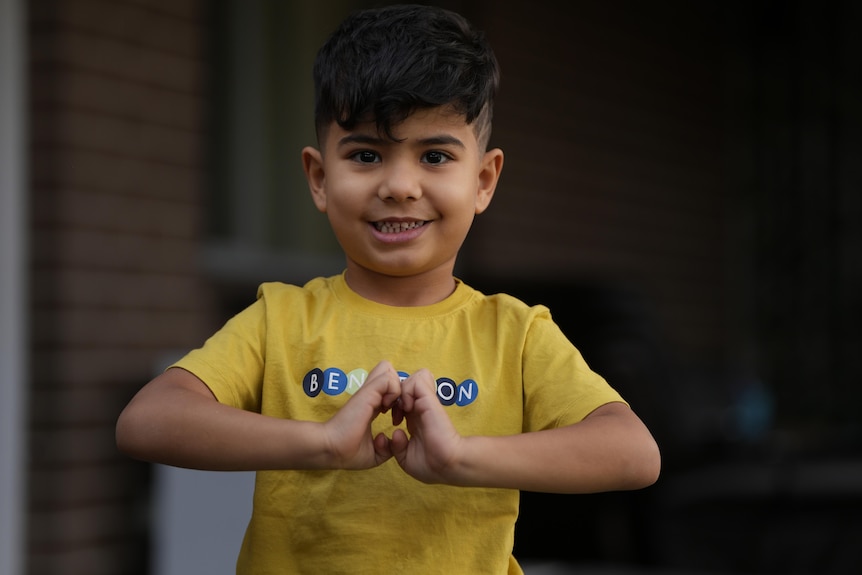
Yosef was conceived during the family’s 2019 visit and was born in Finland. (Australian Story: Tom Hancock)
“Usually in our culture, most of this stuff, the wife has done,” explained Ghanim in late 2024 as he proudly showed off the modest three-bedroom house in western Sydney he had rented and was in the process of furnishing. “But I already spoke to her and I said, ‘Please leave me to enjoy this time. Even if you need to change anything, I don’t care. It’s fine.
“Let me enjoy this moment.'”
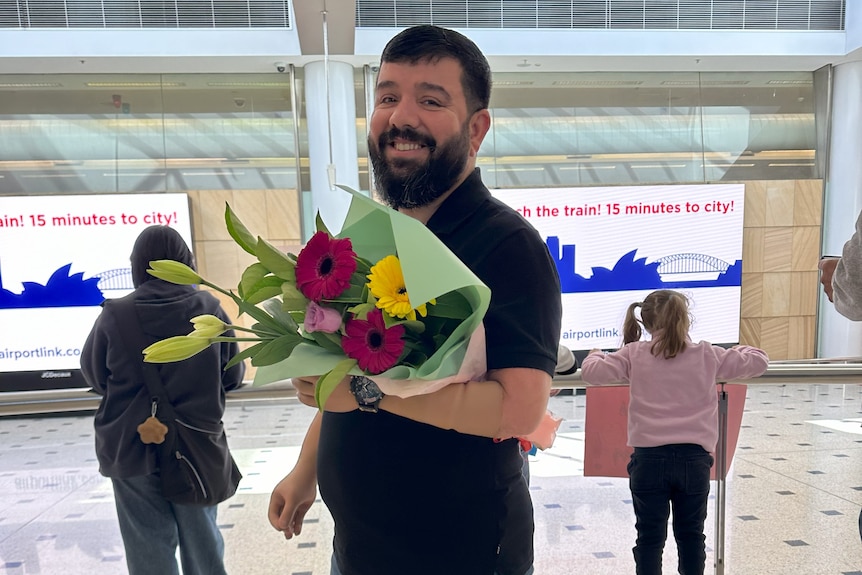
Ghanim Al Shnen waits at Sydney Airport for his family to arrive in late 2024. (Supplied)
Weeks later, Ghanim stood in the arrival hall at Sydney Airport, squeezing a large bunch of flowers under a silicon arm and sporting an enormous grin. The moment he had dreamed of for so many years had finally arrived.
Ghanim’s eldest son Ali recalls that moment vividly. “When we arrive to the airport, my mum told us, don’t run or do anything — Yosef will go first to hug his dad. When Yosef finished, we run to our dad and hugged him and we were so happy to see him again.”
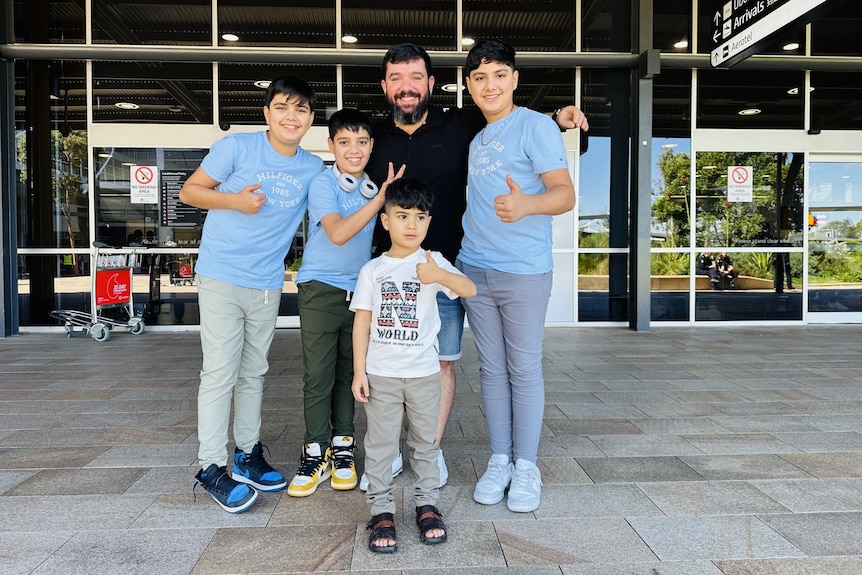
Ghanim Al Shnen and his family were finally reunited after more than a decade apart. (Supplied)
‘Full marks in everything’
Weeks later, Australian Story visited Ghanim and his family to find the house bursting with activity. In the front yard there are soccer balls, a trampoline, an assortment of toys and the squeals and shouts of four energetic boys. It’s the last day of school for the year and they’re excited about the holidays ahead.
All four boys were placed in local schools for the final few months of the year and any concerns about fitting into the Australian education system were quickly allayed. The boys speak four languages — Finnish, Arabic, Swedish and English — and are doing well.
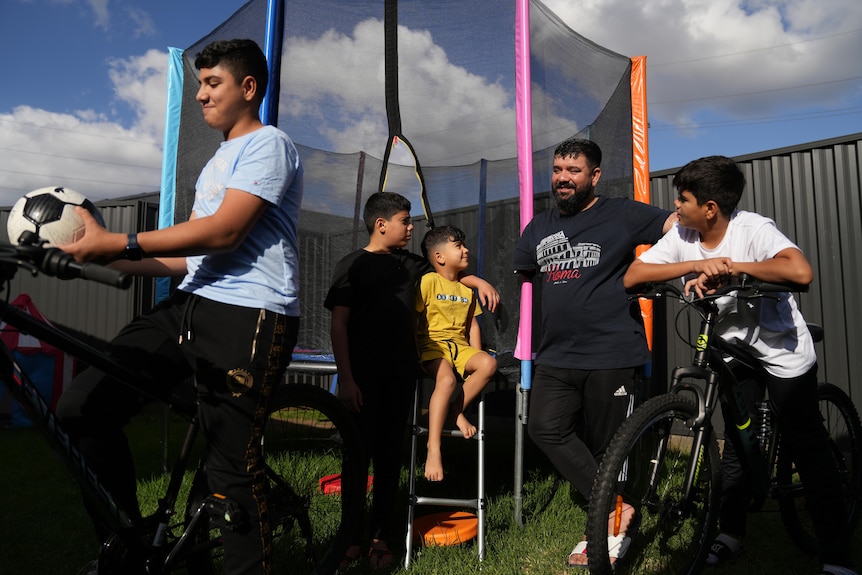
In western Sydney, Ghanim Al Shnen’s home is now bursting with life. (Australian Story: Tom Hancock)
“School is so easy that I’m getting full marks in everything,” says Mohammed with a proud grin.
“Everything we learn here we have learned in third grade and fourth grade in Finland.”
Nevertheless, it has been a challenging adjustment. Athmar and the boys had made a good life for themselves in Finland and to come from a Finnish winter to a western Sydney summer was a shock to the system.
“I was in Finland for 10 years,” Ali says. “It was a very cold place but I loved it.”
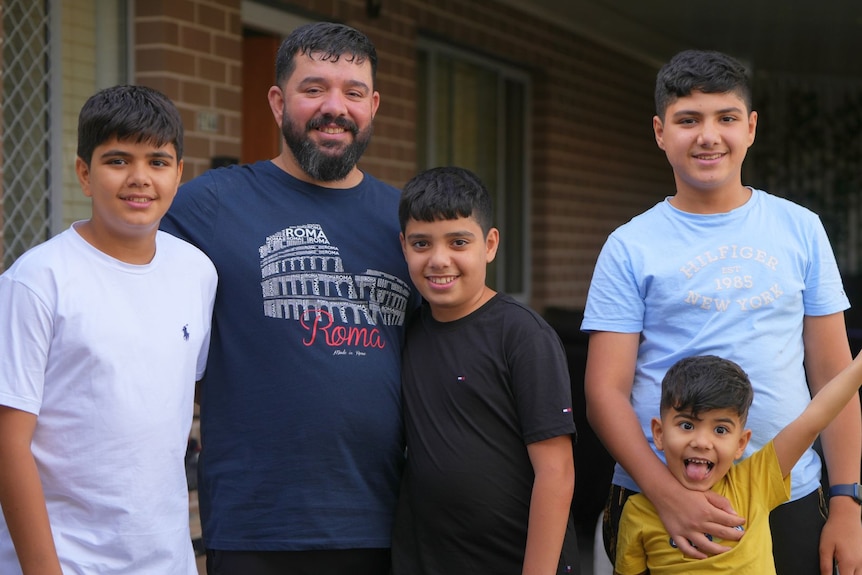
Ghanim Al Shnen with his boys (from left), Ahmed, Mohammed, Ali and Yosef. (Australian Story: Tom Hancock)
“I loved Finland because of the people there,” says Mohammad. “They welcome you to their home and everything. There are so many kind people in Finland.”
Ultimately, however, where they are is not important. What matters is that, after so many anxious years, they are all living under one roof.
“We don’t care where we need to be,” Ali says. “We need to just be together.”
‘My dream came true’
As Ghanim gazes at his children playing in the yard, there’s a look of peace in his eyes that’s been missing for a long time. The impacts of his accident will be with him forever but with his family beside him he can face any further challenges.
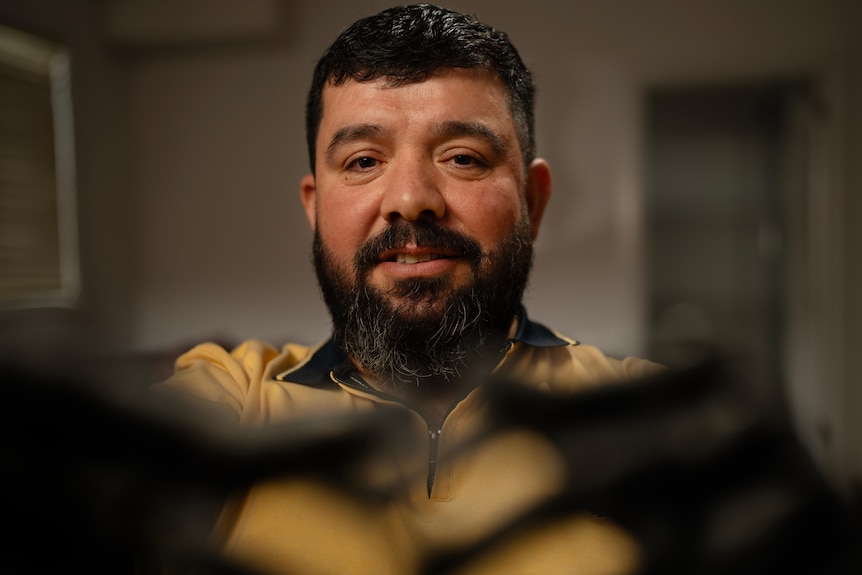
Ghanim Al Shnen never lost hope despite his catastrophic accident and prolonged separation from his family. (Australian Story: Tom Hancock)
“Most of the people who are really close to me, when I lose my arms, they thought, I’m gone. That’s it. The life end. But if you have something to really fight for, you’re going to do the best,” he says.
“My advice to everyone, if something happens in your life, this is not the end. Find out how you fix it. Believe in yourself as much as you can. I never lost my hope and in the end my dream become true.”
Watch Australian Story’s What Doesn’t Kill You, 8pm, on ABCTV and ABC iview.
Enjoyed this story? Check out these Australian Story reads:Loading…