
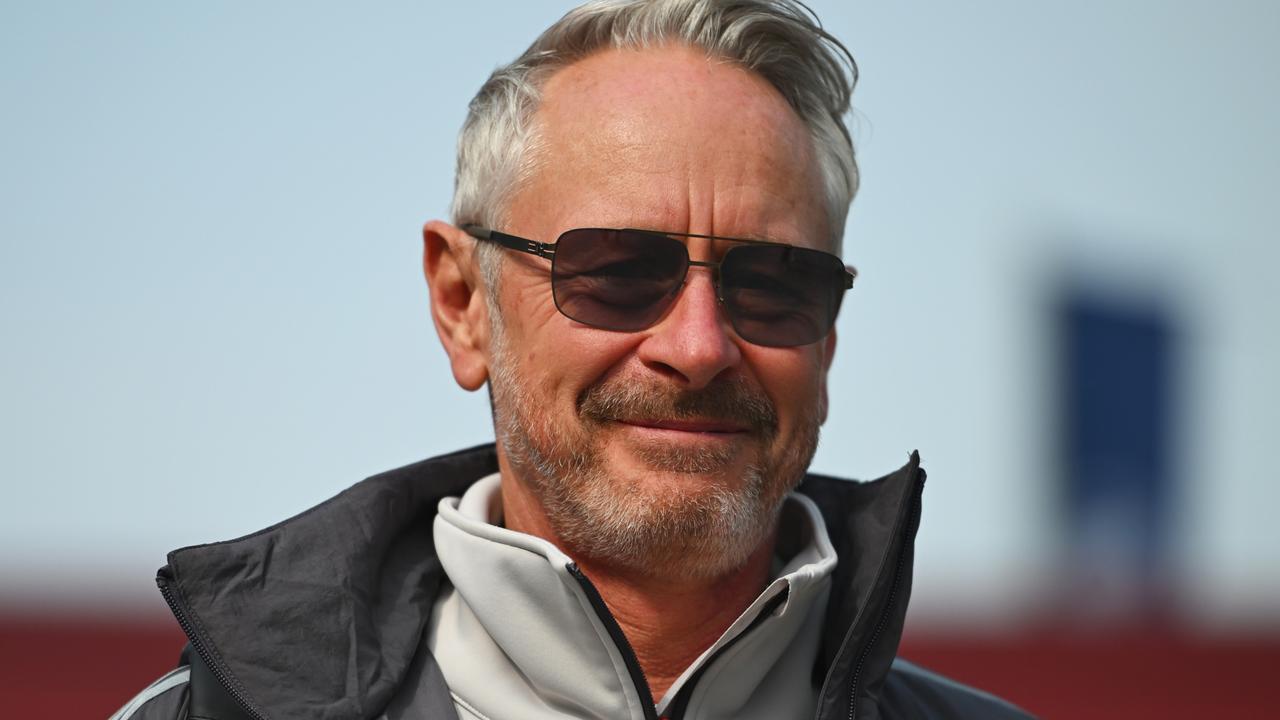
Audi team principal Jonathan Wheatley abandoning his post at the weekend exposes a potentially serious weakness in the German marque’s set-up just two rounds into its official Formula 1 history.
Wheatley joined the team last April in anticipation of the then Sauber squad transitioning into the Audi works team this year.
The British engineer had previously been the Red Bull Racing sporting director, and he served several months of gardening leave to switch outfits.

Fox Sports, available on Kayo Sports, is the only place to watch every practice, qualifying session and race in the 2026 FIA Formula One World Championship™ LIVE in 4K. New to Kayo? Join now and get your first month for just $1.
But Audi announced on Saturday (AEDT) that Wheatley had quit less than a year into the role, with a perfunctory statement thanking him for his brief time at the top.
“Due to personal reasons, Jonathan Wheatley will depart the team with immediate effect,” the statement said. “The team thanks Jonathan for his contribution to the project and wishes him the best for his future endeavours.”
Mattia Binotto, head of the Audi F1 project — formerly titled as the team’s chief operating and chief technical officer — will take over as team principal until a permanent replacement can be found.
Wheatley is heavily rumoured to be contemplating an offer to take up the team principal role at Aston Martin, where Adrian Newey is reportedly set to stand down from the position to focus on his job as managing technical partner with control over the design office.
Aston Martin, however, has responded with a public statement from team owner Lawrence Stroll deflecting responsibility for Wheatley stepping down.
“With the current speculation surrounding Adrian Newey’s role in our team, I want to take this opportunity to set the record straight,” Stroll said.
“As executive chairman and controlling shareholder, I would like to reaffirm that Adrian Newey is my partner and an important shareholder. He is AMR’s managing technical partner, and he and I have a true partnership built on a shared vision of success for the company.
“We do things differently here, and while we don’t currently adopt the traditional team principal role that you see elsewhere — it is by design.
“As the most successful engineer in the history of the sport, Adrian’s primary focus is on the strategic and technical leadership where he excels. He is supported by a highly skilled senior leadership team to deliver on all aspects of the business, both at the campus and trackside.
“We are regularly approached by senior executives of other teams who wish to join Aston Martin, but in keeping with our policy, we do not comment on rumour and speculation.”
Though dressed up as a denial that Wheatley is set to take the reins, it also clearly leaves plenty of wriggle room for that to be the case eventually.
It’s just a matter of timing.
‘Sport at it’s best’ Skaife on feud | 06:00
WHAT DOES THIS MEAN FOR AUDI?
Audi had only one card to play once it became clear that Wheatley was contemplating offers from elsewhere, immediately announcing his departure from the team.
You can’t force someone to continue working for you when their heart’s not in it. Nor is it worth keeping him in place with speculation following him perhaps into this weekend’s Japanese Grand Prix.
There’s also the more philosophical question of requiring a team boss with total buy-in, not one whose head can be turned by a rival.
Nipping it in the bud means it’s now Aston Martin’s problem — and with most reports to the effect that Wheatley is yet to sign for the Silverstone team, the ball is now in Stroll’s court to try to control the narrative, as he attempted to do with his forceful but ultimately inconclusive statement.
Of course that still leaves Audi down a team principal during its critical formative races as a works manufacturer — and it’s not just that it’s missing a key member of staff; it’s missing arguably exactly the right sort of person for the job.
Audi already has Mattia Binotto for the big-picture strategic thinking. Binotto joined the project in 2024 after around 18 months out of the sport following his resignation from the top job at Ferrari, and his principal task was to organise what up until then had been a big-bucks but rudderless entity into something resembling a works outfit.
Wheatley, though, was the inspired hire as the person who could sharpen the race team into a competitive force.
The former Red Bull Racing sporting director was a key pillar in Milton Keynes’s considerable success over the last two decades. He understands intimately what it takes for a team to make it in Formula 1.
As just one anecdotal example, consider how much slicker Sauber — previously a lifer at the back of the midfield — became in pit lane, whether literally with its pit stops or with its trackside operations. Wheatley was credited for those gains, which now belong to Audi.
That organisational discipline at the race team has also played a role in how credible Audi has looked this season relative to expectations after years of it floundering during its meandering takeover of the Sauber team.
That guiding force is lost to the team now, with Binotto running the show in an interim capacity.
Alonso retires with vibration issues | 00:23
WHO WILL REPLACE HIM?
Pinching team bosses is rare in Formula 1. Much more often they’re pushed — or they ‘resign’ — after a string of poor results.
The suddenness of this example — and the lack of tension inside Audi that might have had the team preparing a succession plan — means there’s no obvious replacement for Wheatley ready to go. If there were, the team might have announced one alongside its former man’s exit.
Audi will want someone in the role as soon as possible, but that complicates matters.
Wheatley was lined up as its inaugural team principal more than a year ago. Not only did that mean he could manage the team’s transition from Sauber to Audi, but it also ensured his gardening leave after leaving Red Bull Racing was fully acquitted.
Any other hire of a similar calibre from another team will surely have to be sidelined for many months before they can take over at Audi — just as Wheatley will surely have to do likewise if he’s to join Aston Martin.
Promoting internally would solve that problem, but it would require the team taking a punt on someone with unproven capacity for the position. That doesn’t preclude them from pulling it off, but it won’t be the same as someone arriving from a title-winning team with a clear process ready to be applied.
That’s before confronting some of the other questions arising from Wheatley’s departure.
The former Sauber team has historically had difficulty attracting high-profile staff to its base in Hinwil, outside Zurich, in Switzerland.
Reports suggest Wheatley’s desire to return to England played a role in him entertaining rival offers.
It’s one of only three teams not based in the UK. Meanwhile, seven of the eight British-based teams exist in the so-called motorsport valley, a tiny 1264-square-kilometre parcel of land northeast of London. The furthest drive between any two of them is just 80 kilometres. Switching between these teams is as easy as programming a new work address into your car.
Hinwil, however, with its high cost of living — even if the wages are commensurately high — is a harder sell. And in a country of less than 10 million people and without the mechanical engineering traditional of, say, Italy — where Racing Bulls and Ferrari are based — Sauber needs to draw people from elsewhere.
Audi could become a pull factor in time, but for now, with the works operation still to prove itself and with the team boss walking out after 11 months, it’s a tougher proposition.
Antonelli claims Chinese GP | 02:23
F1’S CHANGING STRUCTURE
Even if Wheatley ultimately succumbed to the go-home factor, it’s still remarkable that he would do so less than a year into the job.
It asks potentially uncomfortable questions about whether the constraints of his role in the Audi structure and beneath Binotto — even if there have been no indications of tensions — are too significant for someone who has long coveted the top job.
But it also speaks to the changing nature of the team principal role in Formula 1.
Long gone are the days of the owner-operators; only Toto Wolff, a part-owner of Mercedes, can claim the role.
Christian Horner had been in a similar position as team principal and CEO at Red Bull Racing prior to the death of Red Bull founder Dietrich Mateschtiz, when he had free rein, but he was subsequently sacked after management changes in large part because he had amassed too much power.
The Williams family was perhaps the modern epitome of that idea until it sold the team during the pandemic in financial distress.
Instead we’re in the era of the technical team boss — an engineer by trade paired with an overarching CEO.
Think Andrea Stella at McLaren, who can run the race team knowing Zak Brown is running the business.
It’s essentially the same set-up Audi has, although Mattia Binotto is also clearly something of a technical CEO given his hands-on F1 experience. Perhaps there wasn’t enough room for Wheatley for fulfil his potential there.
Wheatley had long been said to have coveted Horner’s job at Red Bull Racing, which precipitated his move to Audi. Perhaps the position not having full control played a role in him leaving.
Could he thrive at Aston Martin, where he’ll answer to both Newey, a technical shareholder, and Stroll, the team owner who clearly doesn’t want a background role in the operation?
And will that hinder the team’s ability to find an effective replacement?