
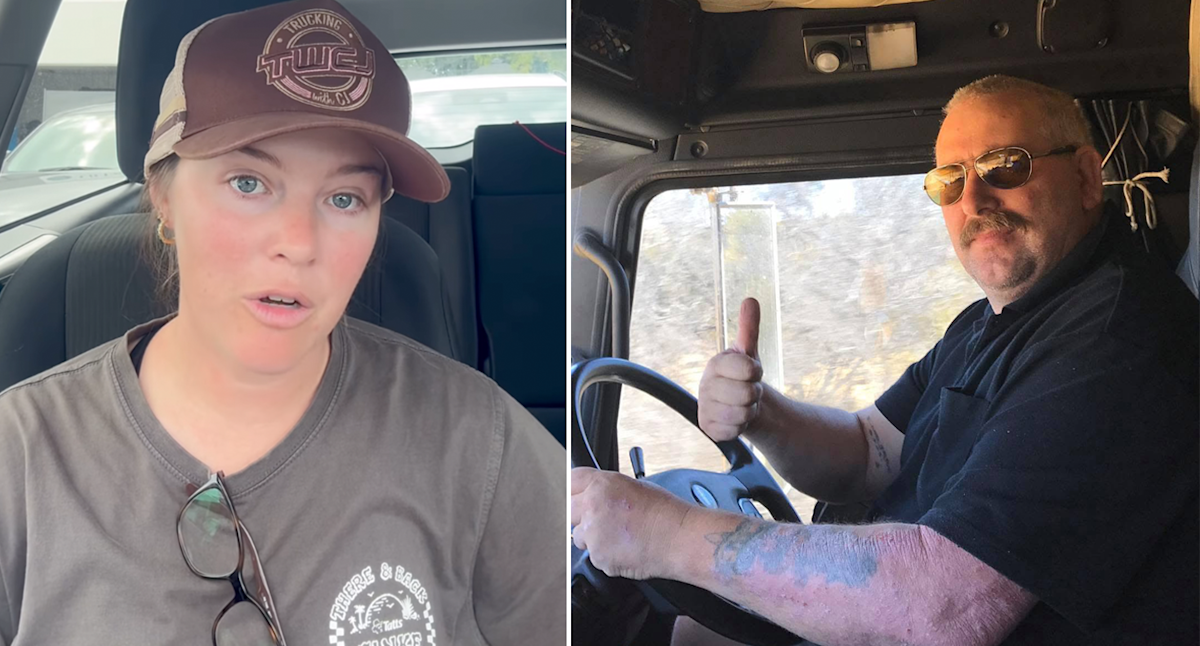
 The CEO of the National Road Transport Association said the government needs to step in to help drivers. (Source: Trucking With CJ/Instagram/Mike Williams/X)
Australia’s road freight industry is approaching breaking point as it calls on the government to intervene to keep operators running and to stave off grim predictions of empty supermarket shelves. As the US president Donald Trump threatens to escalate the war further and bomb energy infrastructure, fuel costs could lead to a “broken freight supply chain” in Australia, the industry is warning.
The largest operators in the freight industry have more sophisticated contracts in place that include fuel levies that can be adjusted to market fluctuations. However many of the smaller owner-operators which make up a large portion of the industry don’t have such contracts and the current cost of fuel means they have become unprofitable.
Trucker Mike Williams is currently on the road heading to Rockhampton in Queensland to pick up a load. “Then I’m going to go home to Sydney for a couple of weeks and see what happens,” he told Yahoo Finance.
RELATED
Williams has been in the industry for 30 years and used to own and operate five trucks. Last week he was in South Australia and said he was speaking to independent drivers who are threatening to throw in the towel.
“They are saying to me that it is just not possible to run at any sort of a profit at the moment, and they’re gonna park their trucks up,” he warned.
That will impact businesses and customers in industries across the nation, he said.
“There are owner operators in every niche market of freight in the country. Doesn’t matter whether it’s timber or refrigerated [products] or waste – every single niche in the country has owner operators in it somewhere,” he said.
On Monday, the CEO of the National Road Transport Association, Warren Clark, said the government needs to step in to avert potential shortages.
“It’s pretty plain to say the industry is in a very difficult position. We need some immediate help from the government, and we need it soon,” he told RN Breakfast this morning.
“Everything that’s been on your table has been on a truck at some stage, so effectively we’re going towards a broken freight supply chain. So you could see prices increase dramatically,” he said.
“Let’s face it, there’s no way that these costs can be absorbed. So there’s only one place that they’re going – and that’s going to be to the consumer.”
 Warren Clark is the CEO of the National Road Transport Association. (Source: Nine)
The higher cost of oil is already causing plastic producers to put their prices up, and prices across industries are expected to rise as the increased cost of transportation flows through the economy.
Economists are now forecasting inflation to again surge above 5 per cent.
On Friday, Woolworths told Yahoo Finance it was not seeing disruptions to its delivery supply chains and was continuing to engage with its transport and delivery providers. But it relies on major transport companies that have more sophisticated contracts and can lock in the price of fuel months in advance.
However at an industry-wide level, disruptions to store shelves could be just around the corner, the NatRoad CEO said.
“We think that probably you’re going to see supermarket shelves without food on them. It’s the only way that people can grasp how bad this situation is – when they go down to their supermarkets and shops and the stuff is just not there to buy,” he told the ABC radio program.
A photo from previous years showing empty shelves in an IGA supermarket. (Source: Facebook)
While truckies do receive a diesel tax rebate, the industry is calling on the government to suspend the road user charge to help “increase the cash flow for trucking businesses” and activate a disaster recovery style measure to help struggling operators and prevent them from simply parking up their vehicles.
“We’ve got members who are considering parking up trucks,” Clark said. “They’re basically carting freight, losing money, and going out of business.”
While the trucking giants like Linfox can weather the storm of higher fuel costs, smaller operators don’t have any leverage in the market.
“I had five trucks back in the day. The best I could do was get a 5 per cent discount on the card from BP … that doesn’t make any difference,” Williams told Yahoo Finance, adding that the margin in the industry is as low as 2 per cent.
“People don’t understand, this trucking business, it’s completely mercenary.”
Williams is mostly retired from the industry and he owns his trucking gear outright so can afford to sit out for a while, but others are facing immense financial hardship if they can’t stay on the road.
“There are guys out there that don’t [own their paid off trucks], and they’re the ones that are really hurting because they’ve got their houses tied up in this,” he said.
Trucker Casuarina Smith has been driving big rigs for years after throwing away her corporate job nearly a decade ago. She has since become one of the most prominent faces in the billion dollar trucking industry.
In a video late last week to her more than 200,000 followers across social media, she said the industry is seriously hurting at the moment.
“We’re one of the only industries where the additional costs are not automatically passed onto the customer,” she said. “Eventually it will be filtered down, but not every company can automatically put those costs forward to the customer.
“Without trucks, Australia stops. Nothing gets anywhere,” she added.
CJ has become an unofficial face of the Aussie trucking industry. (Source: Instagram/truckingwithCJ)
Speaking to Yahoo Finance on Monday, she said it was a nervous time for many in the industry as even those who have the ability to pass on the costs are worried about it impacting their future contracts.
She said it was “already happening” that some drivers were opting off the road.
“They’d rather go broke having their trucks parked up than go broke from trying to be out on the road,” she said.
The aging industry has already been struggling with driver recruitment in recent years, with concerns this latest shock could worsen the issue.
“We already have a massive, massive problem. Every single trucking company is in trouble with drivers – they can’t get them,” she previously told Yahoo.
Get the latest Yahoo Finance news – follow us on Facebook, LinkedIn and Instagram.