
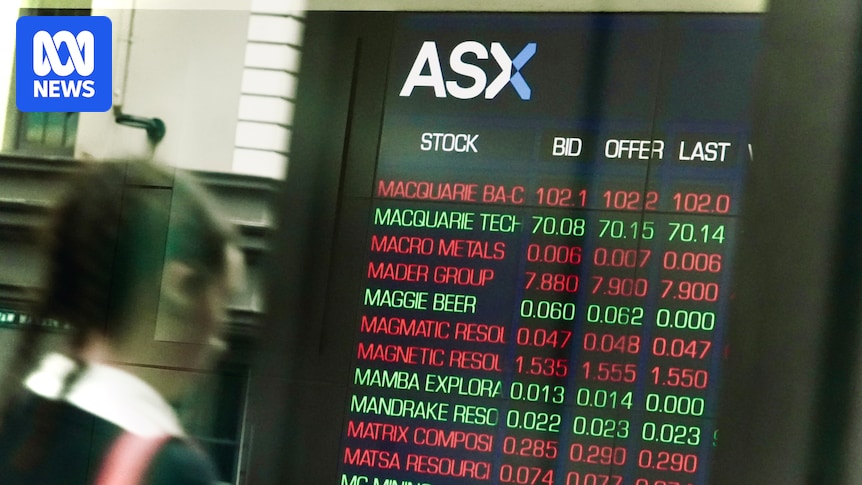
Unlike the 1960s spaghetti western, there is no good on markets today, just the bad and the ugly.
The bad was the Australian share market’s 0.7 per cent fall, leaving the ASX 200 at 8,366 points.
It could have been worse. At one point in the morning, the benchmark index was off about 2 per cent, which briefly took falls this month above 10 per cent — what analysts describe as a “correction”.
Loading…
Perhaps ironically, the bad also included Brent crude oil, which was fairly steady today, albeit after another jump at the end of last week taking it back close to $US113 a barrel.
The ugly was most other markets.
Asian shares were generally clobbered, with Japan’s Nikkei and Hong Kong’s Hang Seng both down about 3.5 per cent at the time Australian trade ended, while the Shanghai composite was off close to 2.5 per cent.
Also ugly were precious metals markets, with silver down close to 2 per cent and gold off 2.6 per cent to $US4,370 an ounce — a long way off peaks early this year of about $US5,400.
In fact, while the ASX is near correction levels, gold is now at crash levels, falling about 20 per cent from its most recent peak.
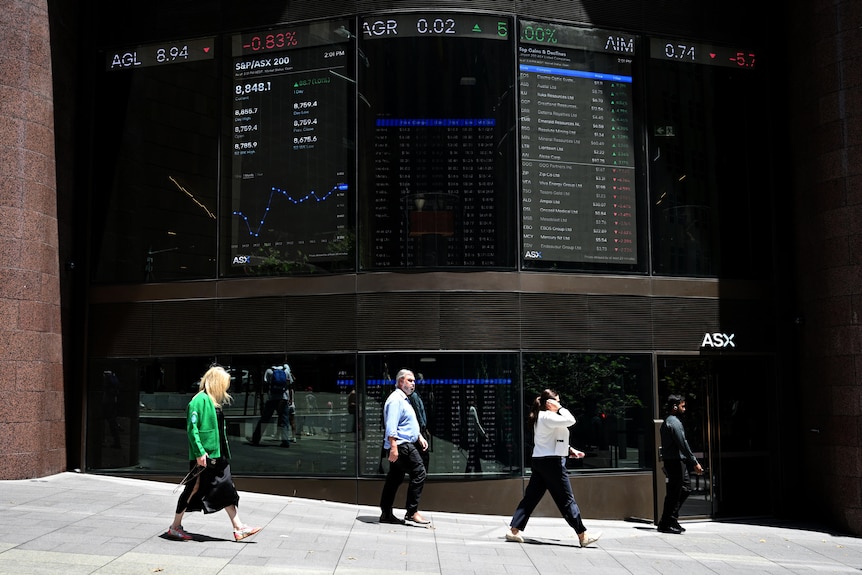
The ASX has taken a hit. (AAP Image: Dean Lewins)
While shares are being pummelled by concerns about energy flows, supply chain disruptions and rising inflation triggering higher interest rates, gold has an additional pressure point.
“Last week’s sell-off was triggered by a raft of hawkish central bank meetings, which has firmly put rate hike expectations on the table in the months ahead,” says Tony Sycamore from IG.
“On top of this, there are reports circulating that make a lot of sense that GCC [Gulf Cooperation Council] countries are selling their gold holdings to increase liquidity as the conflict in the Middle East crimps their energy cash flow.”
Traders start to choke on their TACOS
A couple of weeks ago, when markets started melting down, I warned that traders betting that Trump Always Chickens Out (TACO) risked choking.
RBA governor warns of the recession we might have to have
But, since then, markets haven’t fallen too much further.
AMP’s chief economist Shane Oliver says that’s because traders are still buying TACO.
“By declaring that the war would be over ‘very soon’ on 9 March and that he was considering ‘winding down’ the war on 20 March, both after sharp oil price rises, Trump has signalled he can’t bear the full economic and political costs of the war,” Oliver says.
“So, just like his TACO back down on tariffs last year, many assume he will do the same this time, which is why the rise in oil prices and fall in shares has so far been relatively mild.
“For example, global oil prices are up ‘just’ 90 per cent from their January low [compared to three or fourfold increases in the 1970s oil shocks, which were arguably smaller].”
Loading
But Oliver is quick to warn that, as highlighted by today’s global market sell-down, that doesn’t mean things can’t get a whole lot worse.
“Past oil price shocks unfolded over months as the impact became clearer — four months in 1973-74 when oil prices rose fourfold and over more than a year in 1979-80 when oil prices rose threefold,” he says.
“So, it’s still early days.”
Indeed, Rabobank’s Benjamin Picton believes there are limited off-ramps for either Donald Trump or the Iranian regime to back down without suffering mortal wounds.
“It takes two to TACO,” he says.
“Even if the US were to lay down arms, there is no guarantee that Iran would respond by allowing the Strait of Hormuz to reopen.
“That means that the US would risk its own Suez moment as it effectively loses the war while failing to secure the flow of energy to global markets.”
Picton is referring to the ill-fated British and French adventure to regain control of the Suez Canal in 1956, where the collapse of their previous colonial might was exposed, signalling the end of any remaining claims either country had to global power status.
There is no end in sight to the impacts arising from the war in Iran. (ABC News: John Gunn)
Obviously, the US is highly unlikely to willingly expose its weaknesses, especially with a self-styled strongman like Trump in the White House.
However, if the conflict drags on and the Strait of Hormuz remains effectively (if selectively) closed, oil and gas prices will continue climbing and commodities markets will remain volatile.
If the US takes its threatened “escalate to de-escalate approach” and Iran is able to carry through its retaliatory threats to its neighbours’ oil, gas, electricity and water infrastructure, market volatility could easily turn into panic.
“Destruction of oil and gas infrastructure takes us closer along the spectrum towards worst-case scenarios where energy and other commodity supplies remain throttled indefinitely,” Picton says.
Given that it’s not just the so-called physical economy that remains powered by energy, but now also the world of artificial intelligence, the globe remains hostage to an Iranian crisis decades in the making, with no end yet clearly in sight.