
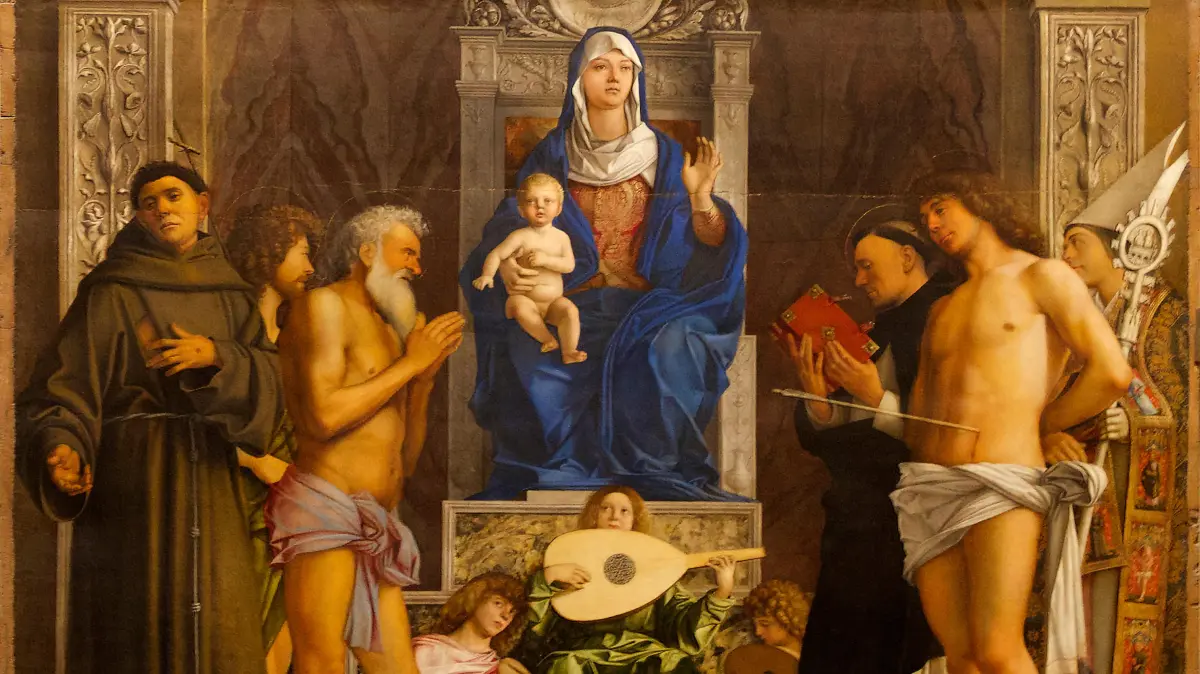
Towards the end of the 15th century, as Venice’s San Giobbe church was taking form, Giovanni Bellini toiled on an enormous bespoke altarpiece while its future home was still a building site.
The work was completed in the 1480s and set into an elaborate stone frame specially built into the newly consecrated church’s walls. The vast depiction of the Virgin and Child surrounded by saints was unlike anything the lagoon republic had ever seen.
By 1815, when Venice had been defeated by Napoleon and was under Austrian rule, the painting had deteriorated in the damp church. It was relocated to the Gallerie dell’Accademia, now a museum in the city. The work depicts the Madonna and baby Jesus on a throne flanked by saints, including Sebastian and Francis, with angel musicians at their feet. Measuring 4.7m by 2.5m, it remains one of the museum’s biggest draws.
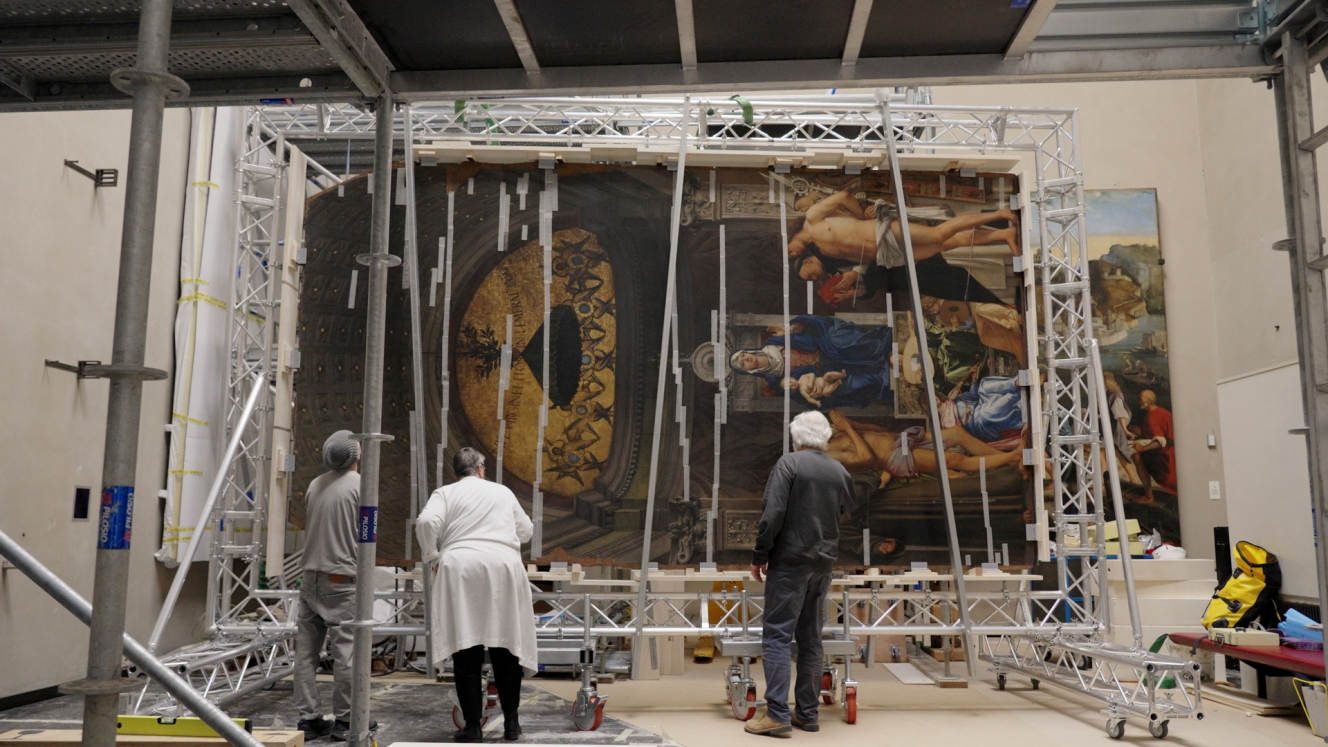 Restorers have begun stabilising the painting’s wooden support and carrying out analysis
“It is a work of immense importance, not only [for] Venetian art but for all of Italian art,” Giulio Manieri Elia, the museum’s director, told The Times. “It represents that pivotal moment in the Renaissance when the polyptych made with multiple panels transitioned to monumental single altarpieces.”
Now the altarpiece is being given its most comprehensive restoration in more than 500 years, the museum has announced, after small movements in its wooden support made from 13 horizontal poplar planks created long cracks on its discoloured surface.
As the painting is too fragile to move far, part of its display room has been turned into a temporary laboratory. Visitors will be able to see restorers at work through a window.
Daily Briefing newsletter
Get our top stories and exclusive analysis sent straight to your inbox every morning.
Sign up with one click
“Showcasing a restoration project is not only an act of transparency but also one of accessibility, providing information and insights that the public can see,” said Manieri Elia, who is leading the expected two-year project. “We don’t have to hide one of the collection’s absolute masterpieces from view.”
The restoration has been budgeted at €500,000 (£430,000). Venetian Heritage, a non-profit organisation, will provide almost €268,000 and Italy’s culture ministry will cover the rest. Venetian Heritage’s portion was provided by Roger Thomas, an American interior designer known for his work on Las Vegas luxury hotels and casinos, and his husband, Arthur Libera. The couple previously provided part of €7 million raised by Venetian Heritage for a continuing renovation of the spectacular 15th-century Ca D’Oro building on the Grand Canal.
Venetian Heritage has worked with the Gallerie dell’Accademia before, funding the refurbishment of four exhibition rooms and the restoration of Giovanni Battista Tiepolo’s 14m-long canvas frieze Scourge of the Serpents (c 1732–34), part of the museum’s collection. “We restore masterpieces, but we also do the air-conditioning, the lighting, and the floors,” said Toto Bergamo Rossi, the company’s director.
Experts restoring the Giobbe altarpiece have started stabilising the painting’s wooden support. Meanwhile, they are carrying out diagnostic analysis using ultraviolet fluorescence imaging, infrared reflectography and radiography, to learn more about Bellini’s technique and what changes were made during previous restorations.
Later, they will clean the surface, plaster over gaps and retouch paint before varnishing. Manieri Elia said it was “without doubt” the biggest restoration of the altarpiece ever carried out.
Once ready, the painting will be relocated to a former church that forms part of the museum’s permanent exhibition, Bergamo Rossi said. “That will give it more breathing space,” he said. “It will look even more glorious.”