
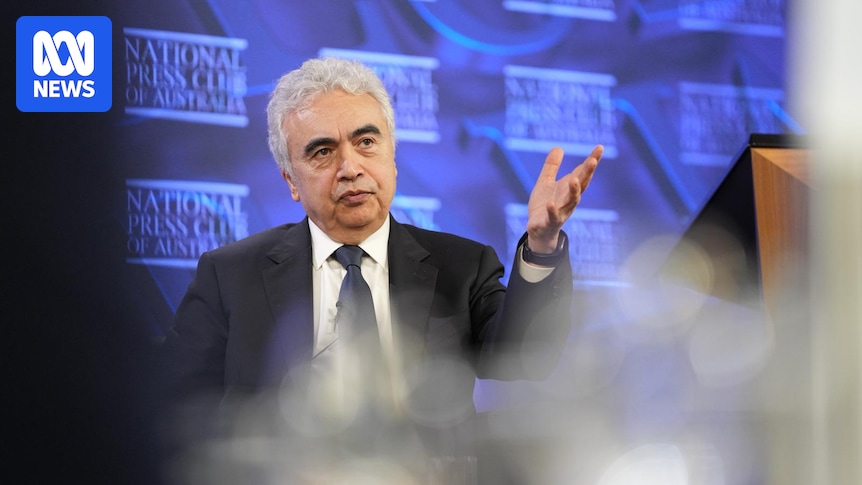
World leaders have failed to grasp the depth of the energy crisis created by the Iran war, the head of the International Energy Agency has warned.
There have now been 40 energy assets damaged or destroyed in the Middle East as a result of the ongoing conflict.
The International Energy Agency’s (IEA) executive director, Fatih Birol, said the resulting fuel shortage problems had already far surpassed previous crises.
“The situation is very severe,” he said in an address to the National Press Club on Monday.
Iran war live updates: For all the latest news on the war in the Middle East, read our blog.
Even if peace was reached immediately, Dr Birol said the amount of damage meant there would be ongoing energy pain.
“It will take some time to come back to the normal days we had before the war was started,” he said.
‘More than two major oil shocks put together’
The current crisis has already dwarfed the fuel crises of the 1970s, Dr Birol told the press club.
“At that time, at each of the crises, the world lost about 5 million barrels per day,” he said of 1973 and 1979.
“As of today, we’ve lost 11 million barrels per day, so more than two major oil shocks put together.”
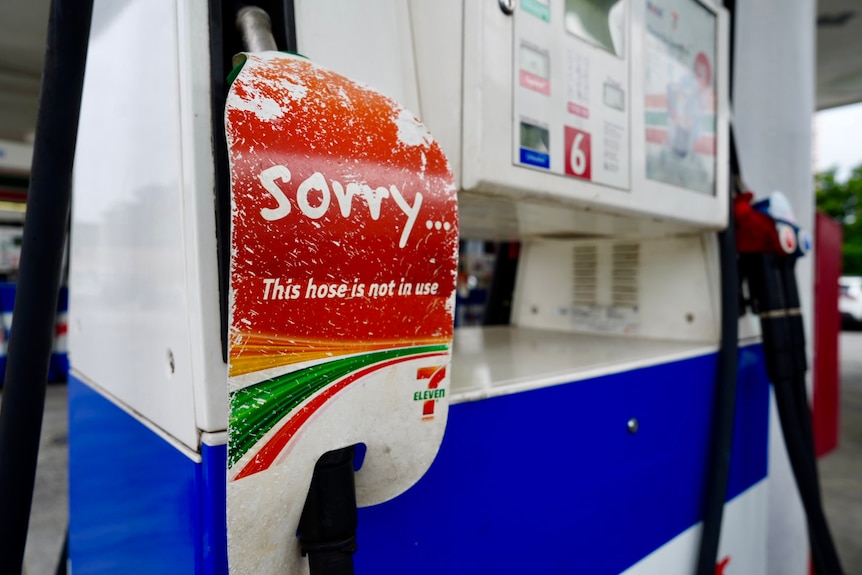
The International Energy Agency has described the fuel crisis as the largest oil supply disruption in history. (ABC News: Warwick Ford)
Supply problems were also hitting other resources, including fertilisers, petrochemicals and helium, he said, with the gas market also suffering significantly.
“After the Russian invasion of Ukraine, the gas markets, especially in Europe, we lost 75 billion cubic metres. Now as a result of this crisis we lost about 140 billion cubic metres,” he said.
“This crisis, as [it] stands now, is two oil crises and one gas crisis put all together.”
The Strait of Hormuz shipping lane usually carries about 20 per cent of the global oil supply and has been effectively shut down due to the Iran conflict.
On Sunday, Energy Minster Chris Bowen confirmed six shipments of fuel due to arrive in Australia from the middle of next month had been cancelled or delayed.
He said there would be some “bumps” in supply as a result, but he said some of the shipments had already been replaced by importers and refiners.
Earlier this month the agency’s member countries agreed to release 400 million barrels of oil from emergency reserves.
Dr Birol said fuel prices dropped after that announcement, but quickly rebounded.
The battle over the Strait of Hormuz
He said pumping more emergency crude oil and fuel into the market was being considered, but he said it would be a decision made in conjunction with world leaders.
“If it is necessary, of course we will do it, but we will look at the conditions, we will analyse, assess the market, discuss with our member countries,” Dr Birol said.
He warned releasing more emergency reserves was not a solution to the crisis, but he said it would relieve some price and supply pain.
Stable free-trade world is gone, PM warns
It comes as Prime Minister Anthony Albanese warned that the days of stable, “ever-expanding free trade” were over and that even if the conflict ended immediately there would be long-lasting economic impacts.
Speaking at the annual Australian Minerals Industry Dinner, which was attended by Dr Birol, the prime minister said the mining industry was crucial to Australia weathering that global uncertainty.
“The disruption we are already seeing in the global economy is not due to arbitrary trade barriers, or sanctions tied to strategic competition. It goes much deeper than that,” Mr Albanese said.
“This is about ongoing threats to the safety of global shipping routes and the physical destruction of oil and gas infrastructure across the Middle East.
“All of this underlines a very simple reality — the stable, predictable world of ever-expanding free trade is gone and it will not be returning any time soon.”
PM, Singapore issue joint statement
Earlier on Monday, during Question Time, Mr Albanese confirmed he had spoken to Singapore’s Prime Minister Laurence Wong.
The two leaders issued a joint statement on energy security noting “deep concern” over the situation in the Middle East, and its impact on supply chains.
“We are committed to working together to strengthen energy supply chain resilience, including by deepening regional cooperation, accelerating renewable energy transition, addressing unjustified import and export restrictions, and maintaining open trade flows,” the statement said.
It also outlined a commitment to speed up negotiations on a trade agreement for “essential supplies”.
Loading
Dr Birol said Asian leaders and markets had a better understanding of the significance of the damage being wrought on international fuel supplies.
“In Europe the effects of the crisis are not well understood yet, but Asia is at the forefront,” he said.
The energy analyst said Asia had a strong reliance on the Strait of Hormuz.
While urging government and individual action to cut down on fuel use, Dr Birol urged caution when it came to introducing new taxes or charges as a kneejerk reaction.
“Energy investors are like butterflies: when they are scared, they fly away,” he warned.
Dr Birol was optimistic companies would not react to the fuel crisis with greed, and instead would “move in the direction of supporting the efforts of their governments”.
He said it was important for investment frameworks to be predictable, but he said it was also important to make sure a fair share of profits went to citizens, or the “the real owners of the resource endowment”.
Loading…