
The reputation of the last day of the football league precedes the championship jeopardy of recent years and the twilight zone of life on the cusp of Divisions Two and Three.
There had, for a while, been a keen interest in the unvarnished outcomes of qualifying for the league final and avoiding relegation.
It is fair to date it back to the turn of this century, not because of some cosmic millennial force but because of two innovations from that period. These were the introduction of the qualifiers, which brought the championship format into 3D, and the implementation of the calendar year.
The changes created more of a season for football, a continuum from January to September – for those lucky enough to make it that far. Teams had to be prepared for more matches and form was easier to carry from spring to summer than to discover by chance or keep wrapped up for the championship.
Jack O’Connor is the avatar for this new age. This is illustrated by his longevity – three appointments as Kerry manager this century – and track record of following up all five league titles with All-Irelands.
On Sunday, for the first time in his three reins spanning 12 years, O’Connor’s Kerry reached the league final the season after winning an All-Ireland.
Why, people have wondered, did they not do it previously given the exceptional outcomes of starting the year well. O’Connor talked all of this down in his reaction, insisting his ambition for the league was simply to find new players and not get relegated.
There was however, a glint in the Kerry manager’s eye after his team had drawn in Armagh and reached the final against Donegal. “You never turn down a game in Croke Park. That’s for sure and we look forward to that.” He went on to add it wasn’t “a massive priority”.
 Kerry manager Jack O’Connor at the Athletic Grounds in Armagh on Sunday, where his team played out a thrilling draw against Armagh in Division One of the National Football League. Photograph: Tom O’Hanlon/Inpho
Plenty of league finals over the years have had zero consequences for the subsequent championship. Next weekend will be only the third time in 40 years that the previous year’s All-Ireland finalists have returned to Croke Park to contest a league final. Both of the current finalists have had a say in this regard.
In 1993, Dublin overturned their historic defeat by Donegal from the previous September whereas 10 years ago, Kerry were unable to do so against Dublin.
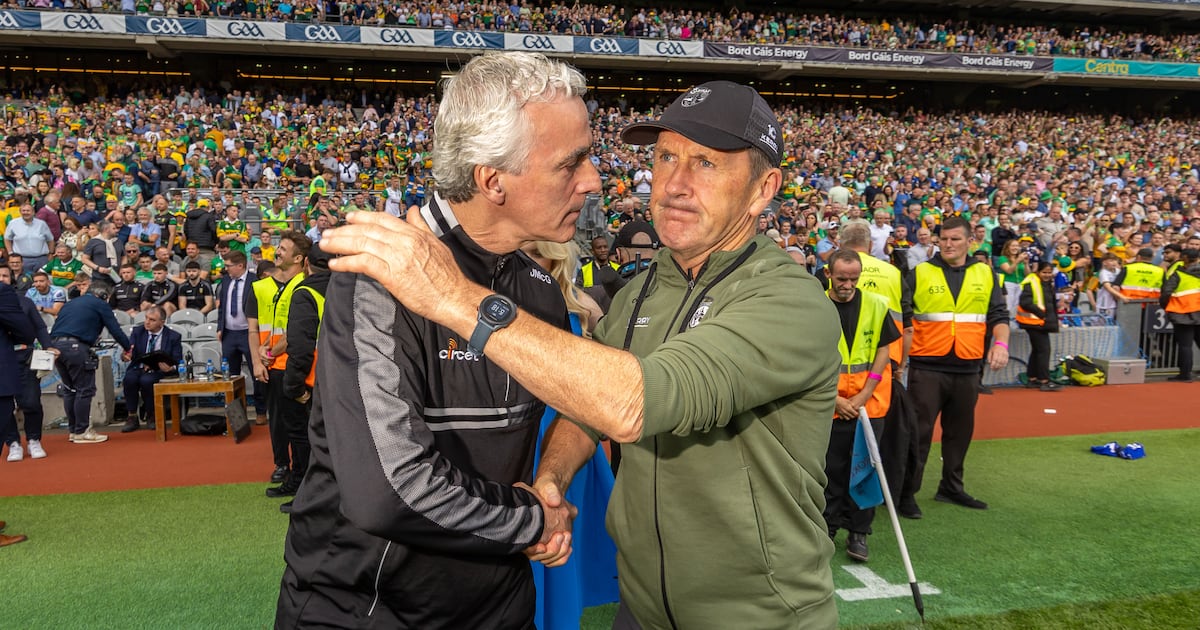
Some of Donegal manager Jim McGuinness’s utterances on the league have made O’Connor’s sound like unabashed enthusiasm, but now that they are there, he might as well make the best of it.
Division Two has been significant for the rehabilitation of two big counties. Meath were arguably already progressing in that direction, having reached last year’s All-Ireland semi-finals. However, apart from a one-season sojourn six years ago, have not been a regular in the top flight since the league was restructured in 2008.
Cork were relegated 10 years ago and hadn’t really threatened promotion at any stage since. In fact, at various stages they suffered the indignity of being rated third in Munster, to Tipperary in championship and Clare in the league.
For both counties to achieve restoration to Division One was a major achievement in a year when Derry and Tyrone were expected to return immediately to the top tier.
Another reflection on the rising fortunes of Cork and Meath is that within recent years, they were haunted by the prospect of being claimed by the Tailteann Cup. Meath actually succumbed in 2023 when their sixth place in the division – technically a ranking of 14th in the top 16 – couldn’t save them from the coastal erosion of lopsided provincial draws.
There aren’t many of these in the coming championship, which is good news for whoever wins the Division Three final next weekend.
Although the top two counties in that division are ranked 15th and 16th, respectively, they are at risk of a Tailteann Cup winner from the previous year needing to displace a top-16 team in order to exercise their right to contest Sam Maguire.
Kildare, last season’s Tailteann winners, were relegated on Sunday and therefore no longer form part of the top 16. It means that the runners-up in the Division Three final between Down and Wexford will not spend their championship with the big boys.
In general, it’s a good idea for the promoted teams in the division not to get their hopes up. Of the six counties to claim that status since the current system was introduced in 2023, only Westmeath in 2024 weren’t gazumped by a lower-ranked county.
Down impacted on last year’s championship with some high-scoring displays. A return to the Tailteann, which they won in 2024, would be fairly depressing whereas Wexford must be dizzy after shooting up two divisions in as many years.
Sunday’s late deliverance against Westmeath was a brilliant reflection of the progress made under John Hegarty and they will be mindful that the Division Three final doesn’t always go the way it’s expected to.