
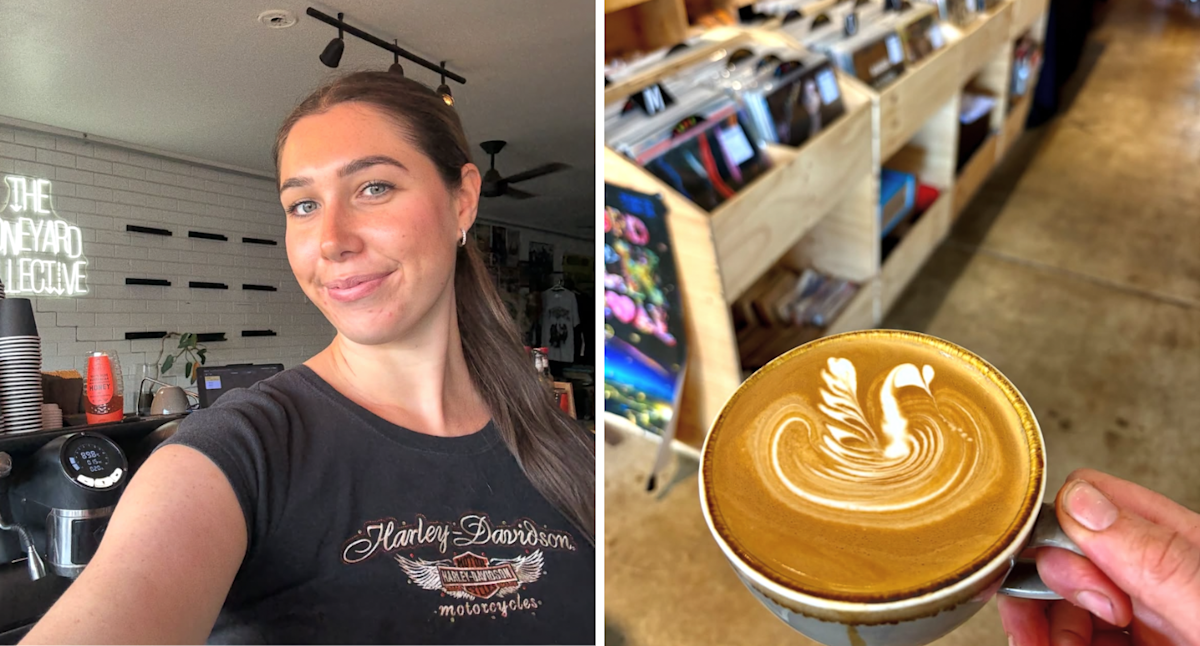
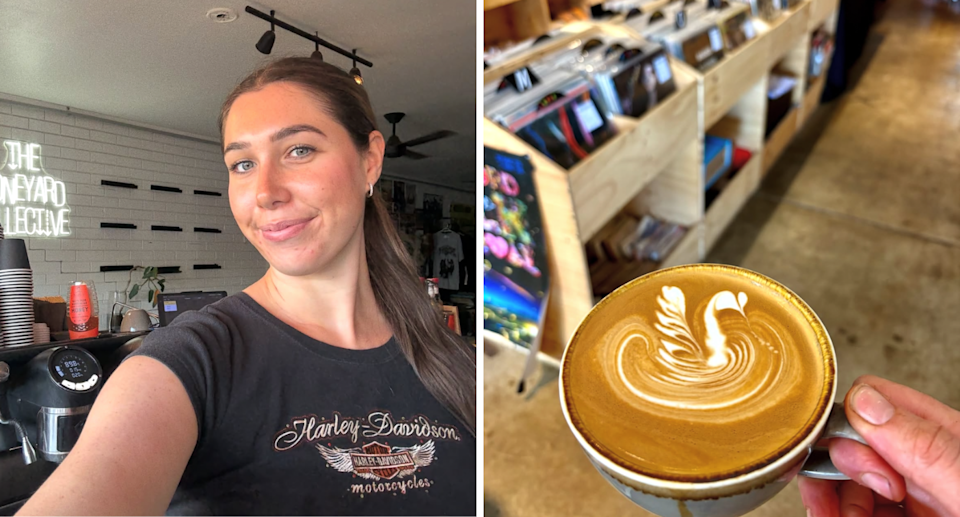
 Ruby Rule says she had to raise coffee prices after hitting ‘breaking point’ with costs. (Source: Ruby Rule/Boneyard Espresso/Instagram)
An Aussie cafe owner has shared the “horrible” experience she had with a regular customer who was apparently outraged after she recently raised coffee prices. Cafes are juggling higher wages, rents and operating costs, but many are worried they will lose customers if they put their prices up.
Ruby Rule owns three cafes in Queensland and made the decision to increase coffee prices across all of her venues a few weeks ago. The 26-year-old business owner hadn’t increased prices in nearly three years, but found she could no longer keep absorbing price rises.
“We were trying to negotiate with our suppliers. We were just trying to do whatever we could to keep the costs low. Then, just over a year ago, we had to move locations for one of our spaces and we’re now paying three times the amount of rent,” Rule told Yahoo Finance.
“It just got to a point where my partner and I were having to work for little to no money and just having to absorb everything. It’s just no way to run a business, so we just got to a breaking point.”
RELATED
Rule decided to keep the price of their 8oz coffee unchanged at $5. The medium 12oz was increased from $5.50 to $6.30, while a large 16oz was increased from $6 to $6.80. They also increased the cost of add-ons like alternative milk from 50 to 75 cents.
“We get a lot of pensioners come in with their $5 note clutched in their hand and that’s their outing for the day. I felt really uncomfortable with the idea of taking that away from them. I just couldn’t do it, so we kept the small the same,” she said.
“Then we did an 80-cent rise on the other two, which I do think is steep, but I think with how affordable it was, you still get a medium for $6.30, which is pretty standard, and your large is less than $7.”
Do you have a story to share? Contact tamika.seeto@yahooinc.com
Like many cafe owners, Rule said she was worried customers wouldn’t return if she put up her prices or they would think she was being “greedy”.
Rule found most customers took the price increase well, with some even telling her she should have raised prices earlier.
But there were a couple of customers who were unhappy with the jump, including one regular who started “laying into” her.
He usually comes in every day and gets a medium flat white in a keep cup, which gives him a discount.
Story continues
“He was super unhappy. His coffee has gone from $5 to $5.80, which he says is completely unacceptable,” Rule shared in a video about the interaction, which left her “shaking”.
She said the man “lectured” her about inflation and took issue with the fact that coffee prices increased by 16 per cent.
Rule said she explained the additional costs her businesses were facing and that the price increase needed to happen so she could be paid.
But the man argued what she was paid was “irrelevant”.
Global coffee bean prices have started to ease following weather-related supply shocks. Coffee bean prices have jumped 200 per cent over two years, according to recent Commonwealth Bank analysis, with a drought in Brazil leading to a 86 per cent spike in Arabica bean futures.
But the cost of coffee itself only makes up 56 cents – or 11.5 per cent – of a cup of coffee that costs $4.88, according to calculations by Sydney coffee roaster Pablo & Rusty’s.
About $1.76 of a cup of coffee (or 36 per cent) goes to wages, while $1.30 (or 26 per cent) goes to other costs like rent, equipment and operating expenses like utilities, repairs, insurance and merchant fees. Other costs include milk, cups and lids, and GST.
Pablo & Rusty’s CEO Abdullah Ramay told Yahoo Finance cafe owners who were charging under $5 for a coffee were “more likely than not, losing money”.
He believes $5.50 is the minimum cafes should charge for a small coffee to remain viable and has encouraged cafes to review prices every six to 12 months.
 The cost of a $4.88 coffee isn’t just about the price of coffee and milk, it’s everything that keeps the cafe running. (Source: Yahoo Finance)
It comes as recent CreditorWatch data shows 10.4 per cent of food service businesses had closed over the past year, which was the highest rate of any industry and double the economy-wide average.
Rule employs 20 staff members and said wages were one of her biggest costs, along with overheads like commercial waste management, packaging and the cost of milk and coffee beans.
Rule is planning to review prices more regularly moving forward as costs evolve. Even recently, she noted she has been slapped with fuel levy charges for suppliers of between $1 to $4 due to the war in the Middle East.
Rule hopes to show Aussies that cafe owners aren’t raising prices to be “greedy”, but because they have to.
“None of the hospitality small business owners I’ve ever made myself acquainted with are in it to rip people off or get super rich,” she said.
“Most of us are just in it for the community and to be able to work for ourselves. We’re just doing the best that we can to be able to pay our bills.”
Overall, Rule said she hadn’t seen a downtick in the number of transactions at her cafes since they increased prices. She’s actually been busier in recent weeks, but thinks this is likely a coincidence.
“I think it shows we’re not losing people or scaring people away because of our pricing. That was a big relief because that first week I was so anxious,” she said.
As for the unhappy customer, Rule said that despite his initial outrage, he still comes in every day as usual for his cup of coffee.
Get the latest Yahoo Finance news – follow us on Facebook, LinkedIn and Instagram.