
Iranian parliament speaker accuses Trump of ‘fake news’ over US-Iran talks
Iran’s parliament speaker Mohammad Bagher Ghalibaf said on Monday that “no negotiations” were held with the United States after US president Donald Trump announced talks were ongoing.
“No negotiations have been held with the US, and fakenews is used to manipulate the financial and oil markets and escape the quagmire in which the US and Israel are trapped,” Ghalibaf said in a post on X.
It came as US president Trump announced “very good” talks on Monday with an unidentified Iranian official after abruptly shelving plans to attack the Islamic republic’s power plants.
The Axios new site, citing an unnamed Israeli official, named Trump’s interlocutor as Ghalibaf.
Iranian foreign ministry spokesman Esmaeil Baqaei indicated that messages had been received from “some friendly countries indicating a US request for negotiations aimed at ending the war,” according to the official IRNA news agency.
Key events
Show key events only
Please turn on JavaScript to use this feature
Analysis: Trump’s ‘very good’ talks with Iran buy him time with oil and energy markets Andrew Roth
There have been so many abortive rounds of diplomacy between the US and Iran that it was hardly a surprise Donald Trump’s claims of “very good” talks with Tehran initially provoked disbelief, especially after Iran denied that any negotiations were taking place at all.
Nonetheless, standing beside Air Force One, Trump did his best to sell the sudden detente with little detail as a US ultimatum to bomb Iran’s power plants loomed unless Tehran opened up the strait of Hormuz.
It was lost on few that the sudden about-face came just hours before US markets were to open for what promised to be another punishing round of trading on Monday.
Any US-Iran negotiations face an uphill battle, but the latest appear to be led by Pakistan after Washington burned through many other regional mediators.
See the full analysis here:
Updated at 20.19 EDT
The Israeli military has sent rescue teams to a damaged building in northern Israel after two rounds of Iranian missile fire early on Tuesday.
After the first launch, the military said it had sent “search and rescue forces to operate at a scene in northern Israel where reports of an impact have been received”.
The Magen David Adom emergency services released video of a damaged building, with a smashed area on an upper floor and rubble spread across the ground, AFP is reporting.
The medics said they were providing treatment to a man in his 30s who suffered mild injuries after stepping on shrapnel, but there were no other casualty reports.
A loud explosion was heard in Jerusalem minutes after the second missile alert, as just mentioned. But the military said people were now cleared to leave their shelters and medics reported no casualties.
Missiles fired from Iran towards Israel are seen in the skies over the West Bank city of Hebron early on Tuesday. Photograph: Anadolu/Getty ImagesShare
Updated at 19.59 EDT
A loud explosion rang out over Jerusalem early on Tuesday after the Israeli military said it had detected another Iranian missile launch – the second of the day.
AFP reporters in the city heard the blast minutes after the military said it had detected missile launches from Iran and was working to intercept the threat.
ShareIsraeli military says it has captured two Hezbollah fighters
The Israeli military claims to have captured two members of Hezbollah in southern Lebanon, while it struck Beirut’s southern suburbs on Monday in the first attack on the Iran-backed militia’s stronghold in days.
An earlier Israeli strike had hit the predominantly Christian area of Hazmieh near Beirut, with Israel saying it targeted a member of the Iranian Revolutionary Guards’ foreign operations arm, Agence France-Presse is reporting.
AFPTV’s live broadcast showed a cloud of smoke over the capital’s southern suburbs, and Lebanon’s state-run National News Agency reported at least five strikes on the area.
The Israeli military also announced it was “striking Hezbollah infrastructure in Beirut” after having called on residents to leave the southern suburbs beforehand.
Smoke rises from the site of an Israeli airstrike in Beirut’s southern suburbs on Tuesday. Photograph: Ibrahim Amro/AFP/Getty Images
The Israeli army said in a statement on Monday that “during an activity to locate weapons in southern Lebanon, [Israeli] troops identified several armed Hezbollah Radwan Force terrorists who were planning to fire an anti-tank missile”, referring to the group’s commando force.
double quotation markAfter being identified, the terrorists surrendered. They were apprehended by the troops and transferred to Israeli territory for further questioning.
The Israeli military told AFP two Hezbollah members were captured.
Hezbollah, meanwhile, announced more than 50 attacks targeting Israeli troops and bases in northern Israel and southern Lebanon, particularly in the border coastal town of Naqura.
Updated at 20.05 EDT
Airstrikes have targeted an Iraqi military base used by the Iran-aligned Popular Mobilisation Forces (PMF) in the western province of Anbar, Al Jazeera and Reuters are reporting.
According to Reuters, there have been two fighters killed and five wounded.
It comes shortly after Al Jazeera reported an attack on a military base used by the PMF in Babil province, south of Baghdad, which reportedly wounded four people.
ShareTrump administration eyeing Iran’s parliament speaker as US-backed leader – report
Coral Murphy Marcos
Donald Trump’s administration is quietly weighing Iran’s parliament speaker, Mohammad Bagher Ghalibaf, as a potential partner, and even a future leader, Politico reported on Monday, citing two administration officials.
“He’s a hot option,” one administration official told Politico. “He’s one of the highest … But we got to test them, and we can’t rush into it.”
Some officials in the White House see Ghalibaf as a workable partner who could lead Iran and negotiate with the Trump administration in the war’s next phase, according to the report.
Ghalibaf denied any negotiations with the US in a post on Monday, but administration officials who spoke with Politico dismissed his comments as internal posturing.
“We’re in the testing phase of really trying to figure out who can rise, who wants to rise, who tries to rise,” the first official said. “And then as people rise, we’ll do a quick test, and if they’re radical, we’ll take them out.”
Updated at 18.31 EDT
Israeli minister calls for annexation of southern Lebanon
Israel should emerge from this conflict with a “new” border with Lebanon starting from the Litani River, the far-right Israeli finance minister has said, in the most explicit public call yet from a senior Israeli cabinet member for seizing Lebanese territory.
Bezalel Smotrich said in an interview on Israeli radio on Monday that Israel’s bombardment of Lebanon “needs to end with a different reality entirely”, which includes a “change of Israel’s borders”.
double quotation markI say here definitively … in every room and in every discussion too: The new Israeli border must be the Litani.
The Litani River is a crucial waterway that cuts through southern Lebanon, around 15-20 miles from the current border with Israel.
Israel claims that its strikes and incursion are targeting Hezbollah, after the armed group launched rockets towards Israeli territory to avenge the assassination of Iran’s supreme leader in the initial strikes that kicked off the US-Israeli war on Iran on 28 February.
But along with its continued bombardment of Beirut’s densely populated southern suburbs, the IDF has destroyed bridges, demolished homes and attacked other civilian infrastructure in its ground assault on southern Lebanon, displacing over 1.2 million Lebanese and killing at least 1,039 – including at least 118 children.
Lebanese officials have raised concerns that Israel’s recent attacks on critical bridges appear to be part of a deliberate campaign aimed at isolating the south from Beirut and other parts of the country, and depopulating the area – as well as suggesting that the Israeli military is preparing for intensified ground operations.
Israel’s deadly attacks on residential buildings and other civilian infrastructure may amount to war crimes, the UN has said.
The Qasmiya Bridge, one of the main transit points connecting the southern and northern parts of Lebanon, after an Israeli airstrike. The bridge linked the city of Tyre in southern Lebanon to Sidon and Beirut. Photograph: Anadolu/Getty ImagesShare
Updated at 18.37 EDT
The day so far
Donald Trump said the threatened US strikes on Iranian power plants had been postponed after “very good and productive” discussions with Iran about a “complete and total resolution of our hostilities” in the Middle East. After hitting a four-year high, the price of oil fell dramatically following Trump’s comments.
Iran, however, flatly denies that any such talks have taken place, with the country’s parliamentary speaker Mohammad Bagher Ghalibaf saying “fake news” was being used to “manipulate” the oil markets. Iran’s foreign ministry also denied that any talks with the US have taken place during the past 24 days.
Benjamin Netanyahu, meanwhile, said he had spoken with Trump, who saw a chance of an agreement with Iran, but added that Israel would continue its strikes against Iran and Lebanon. Trump believed there was a possibility of “leveraging the mighty achievements obtained by the IDF and the US military, in order to realize the goals of the war in a deal – a deal that will preserve our vital interests,” the Israeli PM claimed in a video statement released by his office.
Israel said it had launched “wide-scale” strikes on Iran on Monday morning, while Tehran continued to fire missiles at the UAE and Saudi Arabia. The IDF also claimed to have hit struck the main security headquarters of Iran’s Islamic Revolutionary Guard Corps (IRGC) as part of a “wave of strikes that was completed a short while ago in the heart of Tehran”.
An Israeli strike also hit Beirut’s southern suburbs on Monday, state media reported according to Agence France-Presse, hours after the Israeli army issued an order for residents of the area to evacuate. An AFPTV live broadcast showed a cloud of smoke over the densely populated southern suburbs, which are considered a Hezbollah stronghold and have not been hit since Friday night.
British destroyer HMS Dragon arrived in the eastern Mediterranean, three weeks after an Iranian-made drone hit the British base of RAF Akrotiri in Cyprus, the UK’s defence secretary said. The British government has faced criticism for the slowness to deploy a warship to the region, after moves by Greece and France to send extra naval support to Cyprus after the attack.
Slovenia became the first EU member state to introduce fuel rationing in a bid to tackle disruptions caused by the US-Israeli war on Iran and Tehran’s retaliation on their allies in the Gulf.
Saudi Arabia’s defence ministry said it has intercepted and destroyed at least five drones over the kingdom’s eastern region.
The US embassy in Muscat lifted its shelter in place guidance for the city, but the guidance remains in place for the rest of Oman, the embassy said in a post on X. It had earlier issued a security alert for the whole country because of “ongoing activity”, without elaborating further.
In a series of updates on X over the last hour, Saudi Arabia’s defence ministry has said it has intercepted and destroyed at least five drones over the kingdom’s eastern region.
ShareSlovenia becomes first EU country to implement fuel rationing
Slovenia has become the first EU member state to introduce fuel rationing in a bid to tackle disruptions caused by the US-Israeli war on Iran and Tehran’s retaliation on their allies in the Gulf, the BBC reports.
In Slovenia, the steep hike in fuel prices has resulted in “fuel tourism”, as drivers from neighbouring countries like Austria take advantage of the lower, regulated prices. Under the new measures Slovenia is implementing, private motorists will be restricted to a maximum purchase of 50 litres of fuel per day. Businesses and farmers, meanwhile, will have a more generous allowance of 200 litres.
The US embassy in Muscat has lifted its shelter in place guidance for the city, but the guidance remains in place for the rest of Oman, the embassy said in a post on X.
It had earlier issued a security alert for the whole country because of “ongoing activity”, without elaborating further.
ShareAnalysis: Surprise US talks with Iran’s fractured leadership offer uncertain path out of conflict Patrick Wintour
The backchannel talks between Donald Trump’s special envoy, Steve Witkoff, and the Iranian foreign minister, Abbas Araghchi, were not a secret in the sense that the Egyptian foreign ministry had tweeted that conversations were under way on Sunday, 24 hours before Trump’s late Monday deadline to start blowing up Iran’s energy infrastructure.
But such is the chaos surrounding the process that the discussions – thought to be well short of negotiations – may have lasted longer than Sunday, with more than one mediator, as is often the case, jostling for the title of peacemaker-in-chief.
Pakistan’s army chief, Asim Munir, for instance, spoke with Trump on Sunday, while Pakistani prime minister, Muhammad Shehbaz Sharif, held talks with Iranian president, Masoud Pezeshkian, on Monday. It is possible Pakistan could become the venue for further talks that this time would include JD Vance, the vice-president, a private sceptic about the war. Keir Starmer, the UK prime minister, was right to warn not to bank on an early end to the conflict.
Trump insists it was the Iranians who requested to talk, and their minds had been concentrated by Trump’s threat of destroying a $10bn power plant. Tehran initially denied any talks had happened either directly or indirectly, saying:
double quotation markThere is no negotiation whatsoever between Tehran and Washington. The statements of the president of the United States are within the framework of an attempt to lower energy prices and buy time for the implementation of his military plans.
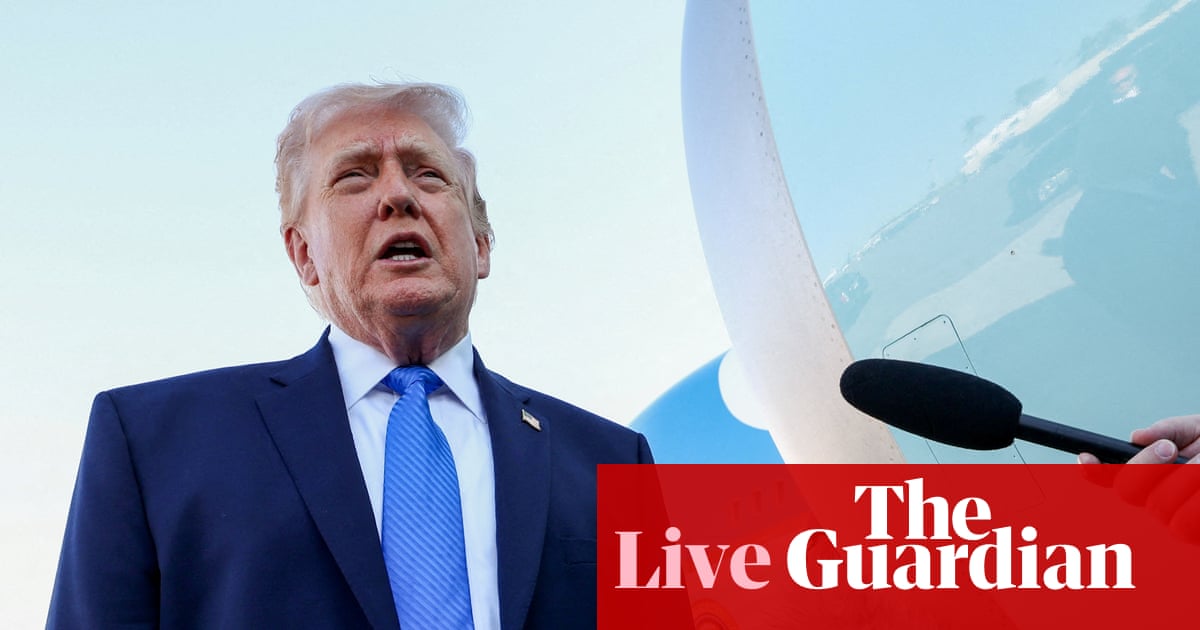
Donald Trump speaks to the media before departing West Palm Beach aboard Air Force One, Florida. Photograph: Kevin Lamarque/Reuters
Iran’s lines of political authority have been in a state of chaos due to damage wreaked by the Israeli assassination campaign. Among the survivors, Pezeshkian has his strengths as a unifying figure of integrity, but is out of his depth in nuclear talks, and not fully trusted by the military. Ali Larijani, the former secretary of the supreme national security council and Iran’s political glue in the past 12 months, had just been buried. The new supreme leader was possibly in a coma, and definitely invisible. That largely left in terms of politics Mohammad-Bagher Ghalibaf, the speaker of the parliament, and a staunch supporter of the Islamic Revolutionary Guards Corps.
But Ghalibaf put out a partial denial by saying no negotiations with the US have taken place, a formula that left other options open short of direct negotiations with the US. He wrote:
double quotation markOur people demand the complete and humiliating punishment of the aggressors. All officials stand firmly behind their Leader and people until this goal is achieved. No negotiations with America have taken place. Fake news is intended to manipulate financial and oil markets and to escape the quagmire in which America and Israel are trapped.
Yet gradually, the Iranian foreign ministry spokesman Esmail Baghaei opened up. The spokesman said:
double quotation markOver the past few days, messages arrived through some friendly countries indicating America’s request for negotiations to end the war, which were responded to appropriately and in accordance with the country’s principled positions – Iran’s stance regarding the strait of Hormuz and the conditions for ending the imposed war has not changed.
You can read Patrick’s full analysis here:
Pakistan stands ready to host US talks with Iran, a foreign office spokesperson has told CNN, after Tehran said Donald Trump’s claims that the regime wanted to make a deal to end hostilities “fake news”.
The broadcaster quotes Tahir Hussain Andrabi saying on Monday that “if both sides agree, Pakistan is always ready to host talks”.
His comments came after contradictory statements from the US president and Iranian leadership earlier in the day.
Trump claimed there have been talks between the United States and Iran over the past day in which the two sides had “major points of agreement”, appearing to avert a potentially severe escalation of the conflict.
Tehran has denied the claim, in which Trump also speculated that a deal could soon be done to end the war. Iran’s foreign ministry spokesperson said no talks had been held with the US since the bombing campaign began 24 days ago.
ShareBritish destroyer HMS Dragon arrives in eastern Mediterranean Jessica Elgot
HMS Dragon has arrived in the eastern Mediterranean, three weeks after an Iranian-made drone hit the British base of RAF Akrotiri in Cyprus, the UK’s defence secretary has said.
The Type 45 destroyer will begin “operational integration into Cyprus’s defence” from Monday night, John Healey told MPs.
The British government has faced criticism for the slowness to deploy a warship to the region, after moves by Greece and France to send extra naval support to Cyprus after the attack.
The Cypriot government has also expressed concern that the drone was able to hit the base, suggesting that the presence of the British base on the island should now be reviewed.
Updated at 17.00 EDT
Israel carries out further strikes on Beirut suburbs
An Israeli strike hit Beirut’s southern suburbs on Monday, state media reported according to Agence France-Presse, hours after the Israeli army issued an order for residents of the area to evacuate.
An AFPTV live broadcast showed a cloud of smoke over the densely populated southern suburbs, which are considered a Hezbollah stronghold and have not been hit since Friday night.
Smoke rises from the site of an Israeli airstrike in Dahiyeh, Beirut’s southern suburbs, on Monday night. Photograph: Hassan Ammar/APShare
Updated at 16.01 EDT
While Israel’s prime minister Benjamin Netanyahu said US president Donald Trump saw a chance of an agreement with Iran, he also said Israel would continue its strikes against Iran and Lebanon.
Netanyahu said in a video statement on Monday: “We will protect our vital interests under any circumstances,” he said, adding: “At the same time, we continue to strike both in Iran and in Lebanon.”
Updated at 15.47 EDT
Netanyahu says Trump sees chance of deal with Iran
Israel’s prime minister Benjamin Netanyahu said on Monday that he spoke with Donald Trump, who saw a chance of reaching a deal with Iran.
Trump believed there was a possibility of “leveraging the mighty achievements obtained by the IDF (Israel Defence Forces) and the US military, in order to realize the goals of the war in a deal – a deal that will preserve our vital interests,” Netanyahu claimed in a video statement released by his office.
I’ll bring you more on this shortly.
ShareIsraeli military claims to have struck Iranian IRGC security HQ
The Israel Defence Forces has claimed it had struck the main security headquarters of Iran’s Islamic Revolutionary Guard Corps (IRGC) as part of a “wave of strikes that was completed a short while ago in the heart of Tehran”.
“The headquarter was used by the IRGC to synchronize unit activities and to conduct situational assessments. It was also responsible for directing the Basij Battalions,” the IDF claimed in a statement.
In addition, it claimed: “Prior to the strike, steps were taken to mitigate harm to civilians, including the use of precise munitions, aerial surveillance, and additional intelligence.”
The attack hasn’t been independently verified.