
Nervousness has crept back into financial markets trading.
Australia’s benchmark share index, the S&P/ASX 200, closed up by just 0.1 per cent today to 8,379.
And the Australian dollar lost 0.7 per cent to 69.6 US cents at 4pm AEDT.
Iran war live updates: For all the latest news on the war in the Middle East, read our blog.
Brent crude is up 4 per cent to near $US104 a barrel.
Meanwhile, Australia’s 10-year treasury bond, the “risk-free rate”, remains above 5 per cent — the highest it has been since 2011, pointing to concerns about rising inflation.
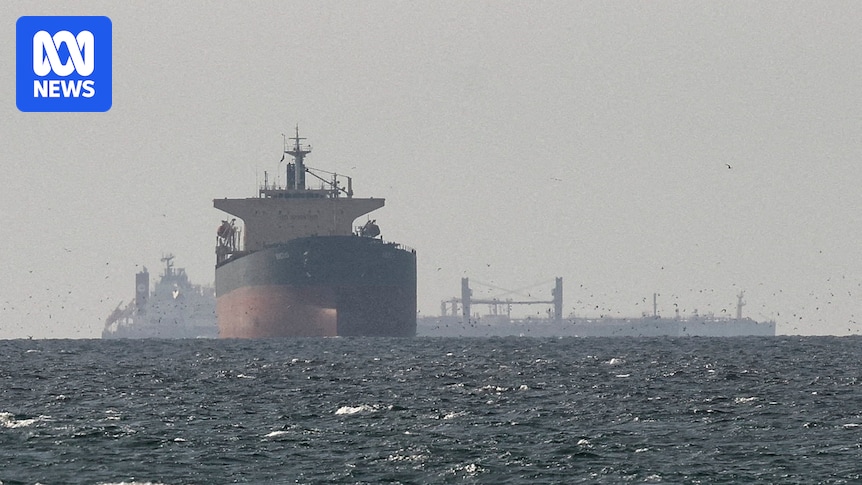
A key fact for shares, bonds, commodities and currencies remains consistently unchanged: the Strait of Hormuz is still effectively closed.
Whipsaw whiplash on financial markets
It has been an extraordinary 24 hours on global financial markets.
Loading…
West Texas Intermediate crude oil dived 10.36 per cent about 10pm AEDT yesterday, closing at $US88.13.
It had fallen as low as $84.73.
“The heavy selling [in the oil market] was triggered by president Donald Trump’s announcement of a five-day delay on potential US strikes against Iran’s energy infrastructure,” IG market analyst Tony Sycamore said.
“Trump called recent talks with Iranian leaders ‘very good and productive’, effectively taking the immediate 48-hour ultimatum off the table.”
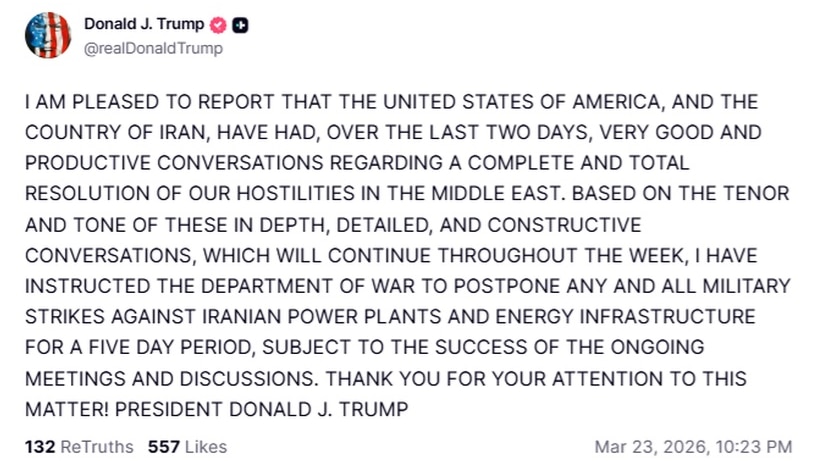
Donald Trump posted an update on social media about the military strikes. (Truth Social: Donald Trump)
Shortly after the Truth Social post a bout the delay, Iran denied any talks with the US had taken place.
Social media posts pointed out that the intense selling in the oil market happened before Mr Trump posted on Truth Social.
Indeed, five minutes before Mr Trump’s announcement, several X posts noted that $1.5 billion in S&P 500 (ES) futures was bought, while $192 million in oil (CL) futures was sold.
There is speculation some market participants knew the post from Mr Trump was coming ahead of time.
AMP head of investment strategy Shane Oliver told the ABC there was no way of confirming this without an official investigation.

Shane Oliver says the US is looking for an “off-ramp” out of the Iran war.
(ABC News: Daniel Irvine)
Confusion around war diplomacy
Earlier today, Mr Trump announced there had been talks with a top Iranian official about bringing the war to an end.
He said there was a 15-point plan and that they might meet in person soon.
Shortly after the announcement, Iranian authorities denied the claims and said it was all fake news to bring oil prices down.
CBS News then said a senior Iranian foreign ministry official had told the broadcaster exclusively that they had received points from the US through mediators, adding that they were being reviewed.
Dr Oliver said Mr Trump’s Truth Social post was evidence the US was looking for an “off-ramp” out of the Iran war.
“President Trump is clearly looking for an off-ramp from the war, which is causing major damage to the global and US economies,” Dr Oliver said.
“The trouble is that his frequent semi-regular comments and posts suggesting that the war may soon be over — usually in response to oil price spikes and share market falls as we saw yesterday — will lose credibility if they are not backed up with clear evidence that progress towards peace is being made, and particularly that the Strait of Hormuz is being reopened.”
Markets fear US has lost control of war
Capital Economics head of markets Thomas Matthews said global financial markets wanted evidence the war was, as Mr Trump put it, “winding down”.
He said there was no hard evidence of that yet.
Loading
“Much has been made of the Trump administration’s apparent willingness to back down from its preferred courses of action when the market reaction became too painful to bear, and at face value it looks as though this may have happened again [overnight],” he said.
“But an important question that’s been hanging over markets lately is whether a unilateral climb-down — which the administration arguably executed around Greenland and, partly, the ‘liberation day’ tariffs — is possible now, given that Iran still seems to have the willingness and ability to disrupt traffic in the Strait of Hormuz.”
The point about whether the war is still under the control of the US president and his administration is the key question many analysts are now posing.
“We have seen the off-ramp,” Marcus Today senior portfolio manager Henry Jennings said.
“Now we need to take it.”
Mr Jennings added that while Iran clearly called Mr Trump’s bluff on the 48-hour deadline to open the Strait of Hormuz, “It takes two or even three to end this war”.
“No-one is that convinced [the war is winding down, so] we’re back to where we were last Friday basically,” he said.
But Capital Economics said the financial markets’ reaction to Mr Trump’s social media post was evidence the US still had some control over the timing of the war.
“The positive reaction [from Wall Street] to the news, though, and investors’ lack of concern about Iranian officials’ comments, suggests that the ball is still seen as widely in the US’s court,” Mr Matthews said.
“The next few days may be a big test of that view, though, especially if there’s little tangible progress on reopening the strait.”
Mr Trump’s new deadline for Iran to open all access to the Strait of Hormuz has now been moved to Friday.
IG’s Mr Sycamore said the “underlying situation remains incredibly fragile”.
Loading…