

A new algorithm for determining how much aged care support people can receive to remain living at home is being blamed for reducing care for older Australians.
Peter Willcocks, who was on a Department of Health aged care panel, likens the new Integrated Assessment Tool (IAT) system to the Robodebt fiasco because clinical assessors cannot override its algorithm — even if they think the person deserves a higher level of care.
Early communications from the department advised assessors they would have the power to “override” the algorithm, but that option was later removed.
New Department of Health figures show that 800 older Australians have requested reviews of their assessments since the algorithm’s introduction on November 1 last year.
Before the change, there were 178 review requests in the past financial year.
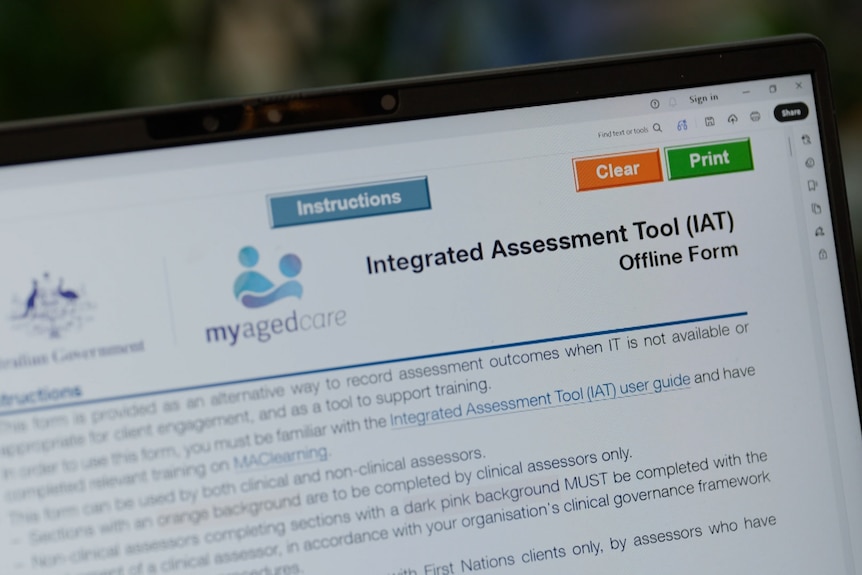
An algorithm determines a person’s level of funding based on information entered in the Integrated Assessment Tool. (ABC News: Sissy Reyes)
Mr Willcocks represented consumers on an advisory group on the aged care Integrated Assessment Tool.
Assessors use the tool to collect information on an elderly person, and that data is fed into an algorithm that determines the level of funding.
He fears that the way questions are posed will mean more people will end up without the care they need.
“So many people are going to be missed, and they’re going to end up in hospitals rather than get the care that they need at home to stay at home and in the community,” he said.
The ABC is investigating aged care again and we want to hear from you
He is convinced that the principal aim of the assessment tool and associated algorithm is to reduce government spending by cutting care and services.
“The ranking of the questions and the way the algorithm looked at it was definitely designed to reduce services,” he said.
He says the fact assessors cannot override the outcome has prompted some to refer to it as “robo aged care”.
“They’re doing exactly the same thing — only this time it’s with people’s needs and health,” Mr Willcocks said.
Department wanted working group to rubber-stamp reforms, advocate says
The federal government says the new system — which is part of its “once-in-a-generation” aged care reforms — produces faster and more consistent funding decisions.
Mr Willcocks believes the Department of Health, Disability and Ageing wanted the advisory group he was part of — comprising clinicians, assessors and providers — to rubber-stamp the new assessment process rather than provide feedback.
“It was not what we were led to believe, which was this wonderful, imaginative, co-design,” said Mr Willcocks, who represented older Australians on the panel.
“That didn’t happen.
“We were given what I believe was almost a completely finished product, and it’s like getting some consulting in at the last minute and saying, ‘How are we going to spin this so it looks good?'”

The Minister for Aged Care and Seniors, Sam Rae. (ABC News: Matt Roberts)
The Minister for Aged Care and Seniors, Sam Rae, rejected the claims that the algorithm was designed to cut services and that the department wanted the group to rubber-stamp the assessment tool.
“There were 20,000 assessments that were used to build the Integrated Assessment Tool,” he said.
“The system of assessment has to be equitable, it has to be fair, it has to be efficient, and it has to be accurate.”‘Like Russian roulette’
More than 100,000 people are waiting for an assessment to receive funding on the aged care Support at Home program.
Last year, the government partially privatised the assessment system, taking much of the work from clinicians in the state public system and awarding more than $1.2 billion in contracts to private companies and not-for-profits to do the job.
The ABC has spoken to multiple clinical assessors who say they are angry and frustrated by their inability to change funding decisions made by the algorithm.
Mark Aitken, a registered nurse with almost 40 years’ experience who resigned as an assessor late last year due to concerns about the system, said assessors could never predict how the algorithm would rule.
“It often felt like Russian roulette,” Mr Aitken said.
“We’d spin the wheel, and somebody might get a level two … when we had felt that they really needed to get a six.”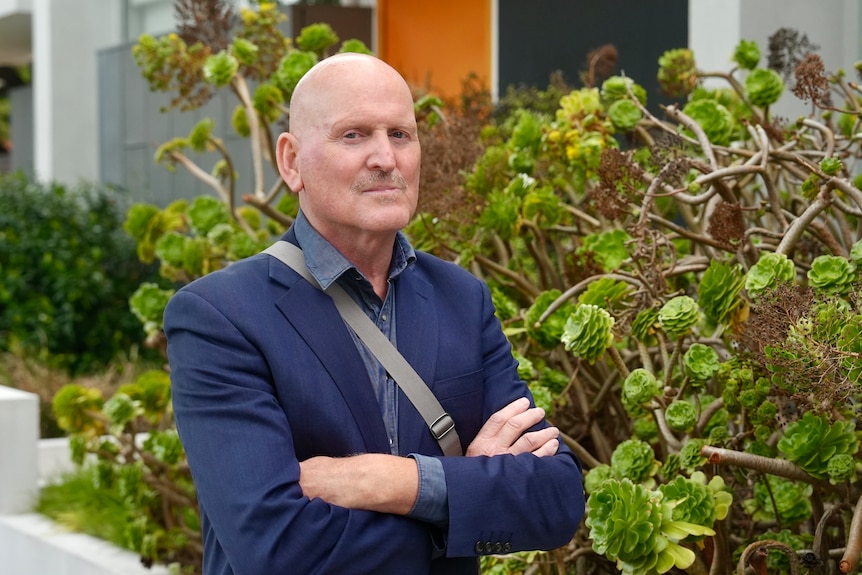
Mark Aitken resigned as an assessor late last year due to concerns about the new system. (ABC News: Kyle Harley)
Mr Aitken said the assessment tool included a specific “override” function, but assessors were repeatedly told they were not permitted to use it.
However, the Department of Health, Disability and Ageing initially advised clinical assessors that they would have the power to override the algorithm.
A departmental guide circulated in May last year — about six months before the reforms took effect — stated that “assessors will have the option to accept or override the IAT outcome”.
But on November 1, the day the new system was introduced, the department published a manual which said that, while the tool has the “functionality” to override the algorithm and assign a different level of support, assessors “must not” do so.
Mr Rae said assessors could not override the algorithm but said humans were involved in every step of the assessment process.
“They cannot override the rules. They apply equitably to everyone across the spectrum,” the minister said.
“A human being conducts the clinical assessment, and the rules are then applied.
“There’s another human being that then signs off on the allocation, and if the person wants a review, they can apply for a review.”
Asked if he would change the rules and allow assessors to override the algorithm, Mr Rae said funds had been over-allocated in the past.
“We had some significant issues in that we had $4 billion of aged care service budgets that were not being spent because of over-allocation,” he said.
“The new system provides a much more transparent, equitable, and fair approach to ensuring that aged care services are apportioned accordingly.
‘It felt very impersonal’
Last year, Natalie Taylor made an application for a higher level of support for her mother, Katherine, who lives with vascular dementia.
Katherine, 78, already receives a government-funded home care package, which pays for carers who visit three times a week to help her shower.
As Katherine’s condition worsened, Natalie hoped additional funding would mean her mother could have a shower every day.
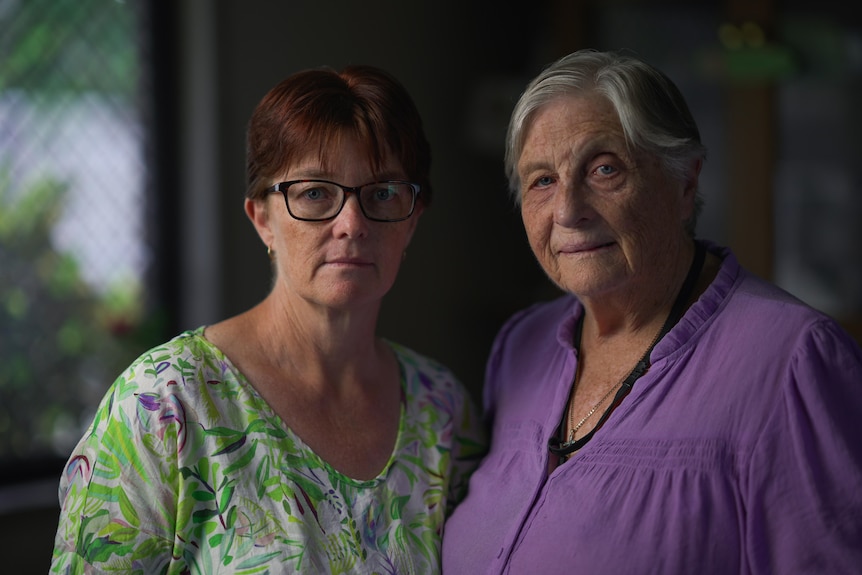
Natalie Taylor and her mother Katherine. (ABC News: Ben Cocklin)
Katherine was among the first to be re-assessed under the new system, and her daughter said the process was very different to the original assessment.
“It felt very impersonal,” she said.
“It felt like it was just a tick-and-flick, tick-a-box kind of assessment.”
“The assessor sits there with a laptop answering the questions and entering everything into the computer.”
The application for more funding was rejected, with a letter from My Aged Care saying that, under the new Aged Care Act, there was a “lack of evidence that [Katherine] has an impairment.”
“It just astounds me that somebody who has a diagnosis can then be found to have no impairment,” Ms Taylor said.
Natalie Taylor was one of 800 people who applied for a review of the algorithm’s outcomes.
This month, the Taylors received a preliminary response stating the department planned to stand by the algorithm’s decision to reject the application.
It said that although Katherine had “significant and ongoing care needs” due to her dementia, she did not meet the threshold for a higher level of care.
“Mum has been a taxpayer and carer all her life, so to think her needs will not be met is a bitter pill to swallow,” her daughter said.
Algorithm recommends lower level of care
Adrian Morgan, a general manager at Flexi Care, Katherine Taylor’s home care provider and responsible for overseeing her aged care services, says other clients have also been knocked back.
“Well over a third have now been rejected, and these are people who previously would have been approved,” Mr Morgan said.

Adrian Morgan fears the changes will mean people will be pushed out of their homes and into residential care or hospital. (ABC News: Ben Cocklin)
“We only put people forward for reassessment and upgrade when we think there’s a strong case.”
In some cases, the algorithm even recommended that clients receive a lower level of care than their existing care plans provided.
“The irony of this is that the aim of [the home care packages program] Support at Home is so that people can live well at home,” Mr Morgan said.
“By introducing something like this, they’ll end up with the exact opposite, where people will be pushed unnecessarily towards residential care or a hospital.”
In Question Time last month, Aged Care Minister Sam Rae said the department will “continue to monitor the operation of the algorithm, and we intend to refine it regularly”.
Officials from the Department of Health, Disability and Ageing told Senate Estimates, “the tools have been independently clinically verified and the algorithms have been extensively trialled”.
“This was the culmination of years of work,” they said.
Loading…