

UK manufacturers hit by biggest surge in cost inflation since Black Wednesday
Newsflash: UK manufacturers have been hit by the biggest jump in cost inflation since Black Wednesday more than 30 years ago, as the Iran war drives up prices and hits growth.
Data firm S&P Gobal reports there was a “marked slowdown” in business activity growth during March as the war in the Middle East hit customer demand, pushed up input prices and disrupted supply chains.
Its latest poll of purchasing managers has also found that growth across the UK private sector has fallen to a six-month low this month.
Business optimism has fallen to the lowest level since June 2025, as firms are hit by rising cost pressures due to higher costs for fuel, transportation and energy-intensive raw materials.
This pulled the Flash UK PMI Composite Output Index down to 51.0, from 53.7. in February. That’s the lowest since September 2025, and close to the 50-point mark showing stagnation.
Manufacturers reported the biggest month-on-month acceleration in input price inflation since October 1992. That’s the month after Black Wednesday when currency speculators beat the Bank of England, forcing the UK out of the European exchange rate mechanism and triggering a slump in the value of the pound (making imports more expensive).
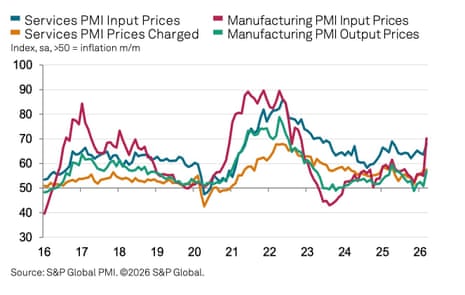 A chart showing how input costs for UK firms hace changed Photograph: S&P Global
Chris Williamson, chief business economist at S&P Global Market Intelligence, says:
double quotation mark“The war in the Middle East has hit the UK economy in March, stalling growth while driving inflation sharply higher.
Output growth across manufacturing and services has slowed to a crawl as companies blamed lost business directly on the events in the Middle East, whether through heightened risk aversion among customers, surging price pressures, higher interest rates, or via travel and supply chain disruptions.
Inflationary pressures have surged higher on the back of rising energy prices and fractured supply chains. The acceleration in cost growth in the manufacturing sector was especially severe, being the sharpest since the depreciation of sterling following Black Wednesday in 1992.
The full impact on inflation and economic growth depends not just on the duration of the war but also the length of disruptions to energy markets and shipping, though March’s PMI numbers clearly underscore how downside growth risks and upside inflation risks have already materialised.
Updated at 05.56 EDT
Key events
Show key events only
Please turn on JavaScript to use this feature
Wall Street drops at the openThe New York Stock Exchange in the Financial District of Manhattan. Photograph: Jimin Kim/SOPA Images/Shutterstock
Stocks have opened lower on Wall Street, as yesterday’s relief rally rather peters out.
The Dow Jones industrial average has dropped by 329 points, or 0.7%, to 45,879 points.
The broader S&P 500 index is down 0.4%.
Stocks had rallied yesterday after Donald Trump claimed that the US and Iran had held productive talks – which Tehran has denied.
ShareEuropean markets now in the redThe stock exchange in Frankfurt today Photograph: Reuters
European stock markets have now moved lower, as investors await the open of Wall Street in a few minutes time.
With anxiety over the Middle East conflict still high, shares are lower in London, Paris and Frankfurt.
UK’s FTSE 100: down 0.35%
Germany’s DAX: down 1.25%
France’s CAC 40: down 0.7%
Markets remain “sceptical and headline driven”, according to Fawad Razaqzada, market analyst at Forex.com, who explains:
double quotation markMarkets remain firmly at the mercy of geopolitical headlines, and Trump’s constant social posts delivering mixed messages.
The US dollar, stock indices, gold and crude oil are all continuing to swing on every update tied to the Middle East conflict. Traders are hanging on any signals around whether ceasefire talks are even remotely on the table. Until there’s something concrete, it’s hard to see risk appetite improving in any meaningful way.
Updated at 09.24 EDT
UK nuclear power plant to face extra scrutiny over safety standards
Jillian Ambrose
Hartlepool power station. Photograph: Owen Humphreys/PA
A 42-year-old nuclear power plant in Hartlepool will face extra scrutiny from the industry’s regulator after it failed to meet a safety improvement plan.
The Office for Nuclear Regulation (ONR) said the site had been placed into the “significantly-enhanced regulatory attention” category which will mean extra site visits and inspections to ensure it is meeting safety standards.
The ONR said the EDF-owned plant remained safe to continue to operate, but the decision to increase scrutiny was taken after visits “identified areas where safety improvements are required”.
A spokesperson for EDF declined to comment on the specific incidents which have prompted the nuclear regulator to tighten its oversight of the facility, which has generated electricity since August 1983.
The ONR said its concerns relate to “conventional health and safety, the number of site incidents and in the delivery of agreed performance improvements”.
Dan Hasted, an ONR director, said:
double quotation mark“EDF is committed to delivering a range of improvements at Hartlepool, and we are overseeing this.”
The regulator agreed an improvement plan with EDF last year but the ONR is understood to want a more focused attention on the site’s efforts to improve its safety performance.
An EDF spokesperson said:
double quotation mark“What this change means is that the regulator will visit the site more regularly and carry out additional inspections. We are committed to working with the regulator to ensure it is content that improvements required are being implemented.”
“Hartlepool power station has been a vital part of the Teesside community for more than 40 years and it is important to note the ONR has been clear that the site continues to be safe to operate.”
Details of the increased scrutiny emerged as it was reported that EDF will face an EU investigation into a state aid package for building six nuclear power plants.
The European Commission – the EU competition enforcer – is expected to open an investigation next month over concerns the support will reinforce the state-owned French utility’s market dominance, according to the Reuters news agency.
The scheme, worth tens of billions of euros, is central to France’s plan to renew its ageing nuclear fleet, and would add about 10 gigawatts of capacity, with the first reactor due to be commissioned in 2038. A lengthy EU investigation would risk delaying that timeline.
Back in parliament, Rachel Reeves has told MPs that contingency planning was under way for energy bill support “for those who need it most”, and warned that the economic challenges from the Iran war may be “significant”.
No details about what support might be delivered, but the chancellor did criticise the price cap implemented in 2022 for cutting bills for everyone, including the wealthiest.
Reeves also told MPs she will hold meetings with supermarkets and banks to discuss how they can support their customers, and was giving the Competition and Markets Authority new powers to deal with price gouging.
Politics Live has more details:
Precious metal prices are dropping, as the US dollar strengthens.
Spot gold is down 0.8% at $4,371 an ounce, on track for its lowest close since the start of the year.
Platinum is down over 3% at $1,389 an ounce.
ShareReeves giving economic update on Middle East
Over in parliament, chancellor Rachel Reeves is starting to give an economic update on the crisis in the Middle East.
She’s expected to outline what the government is doing, and may do in future, in response to the soaring global energy prices caused by the Iran war.
Reeves starts by paying tribute to the armed forces, before telling MPs that the price of oil and gas have remained high since she last addressed the House of Commons. She also cites the Bank of England’s forecast, last week, that inflation could rise to 3.5% later this year.
Our Politics Live blog has all the details:
The markets are dubious about Donald Trump’s latest “TACO helping”, reports Chris Beauchamp, chief analyst at IG Group.
After a morning of modest rises on many European stock markets (but losses in Germany), Beauchamp says:
double quotation mark“Donald Trump has managed to swerve disaster multiple times during his presidential terms, but investors aren’t sure he can get away with it this time.
The 5-day pause seems designed purely to allow new US forces to arrive in theatre, and reports of an attack on gas infrastructure in Iran overnight remind us that the war is still going. Hormuz is still closed of course, piling on more pressure both on the US president and the global economy. And there is no guarantee that any talks will lead to progress. For the moment it looks like most are just standing aside to see what happens, or doesn’t happen, next.”
This morning’s UK PMI report is an early sign of the economic damage the Iran war is causing, says Matt Swannell, chief economic advisor to the EY ITEM Club:
The conflict in the Middle East will weigh on the UK’s growth outlook, with March’s flash Purchasing Managers’ Index (PMI) already showing the first signs of the impact on business sentiment. Squeezed real incomes, supply side disruption and tighter financial conditions will all prove headwinds to growth over the coming year.
Businesses are already reporting a sharp rise in input prices, justifying the Monetary Policy Committee’s (MPC) shift to a ‘wait and see’ approach to setting interest rates at its March meeting. With disruption expected to be prolonged, a sustained hold in Bank Rate appears likely.
ShareUK retail sales tumble in March by most since Covid lockdown in 2020
Another blow! British retail sales have tumbled this month by the most since April 2020, when the economy was locked down in the Covid-19 pandemic.
The CBI’s latest ‘distributive trades’ survey has found that retail sales volumes dropped at a rapid pace in the year to March, the fastest rate in almost six years.
The survey found that 66% of retailers surveyed reported a fall in sales volumes this month, with just 13% reporting a rise, showing the biggest drop in sales volumes since April 2020.
Sales are expected to decline at a broadly similar pace next month, according to the poll which was conducted between 25 February and 13 March.
Retail sales volumes dropped at a rapid pace in the year to March, marking the quickest decline in nearly six years, according to the latest CBI Distributive Trades Survey. The decline is set to continue at a similarly sharp rate next month. pic.twitter.com/VrCuv62Rxp
— CBI Economics (@CBI_Economics) March 24, 2026
Retailers judged March’s sales to be “poor” for the time of year, to a greater extent than last month. April’s sales are set to fall short of seasonal norms, though to a slightly lesser degree. pic.twitter.com/4OD8Dilk2K
— CBI Economics (@CBI_Economics) March 24, 2026
The CBI also found:
Martin Sartorius, lead economist at the CBI, says:
double quotation mark“Momentum in the retail sector remained poor in March, with annual sales volumes falling sharply and no signs of an imminent recovery. Retailers report that weak economic conditions continue to weigh on household spending, with subdued activity also evident across the broader distribution sector.
“Steps taken by the government last week to address youth unemployment challenges – including launching foundation apprenticeships in hospitality and retail – are welcome moves to mitigate rising employment costs. However, more must be done to lower the cost of doing business, including securing workable outcomes on the Employment Rights Act and delivering a simpler, more competitive tax system. The conflict in the Middle East – which risks fuelling price pressures and squeezing household budgets – underscores the need for the government to take further action to lower the cost of doing business for distribution firms.”
Updated at 07.37 EDT
UK sells 10-year gilt with highest yield since 2008
The UK has successfully sold more than £2bn of government bonds this morning, but it paid a high price due to the turmoil from the Iran war.
Britain sold £2.25bn of 10-year government bonds today; the auction saw strong demand, with investors submitting bids for 3.5 times as much debt as was available.
But despite that demand, the debt was sold at an average yield of 4.911%, the highest rate for any 10-year bond since 2008.
That follows the jump in UK bond yields in the markets this month, where 10-year gilt yields hit the highest level since 008 yesterday, as investors buy and sell debt from each other.