
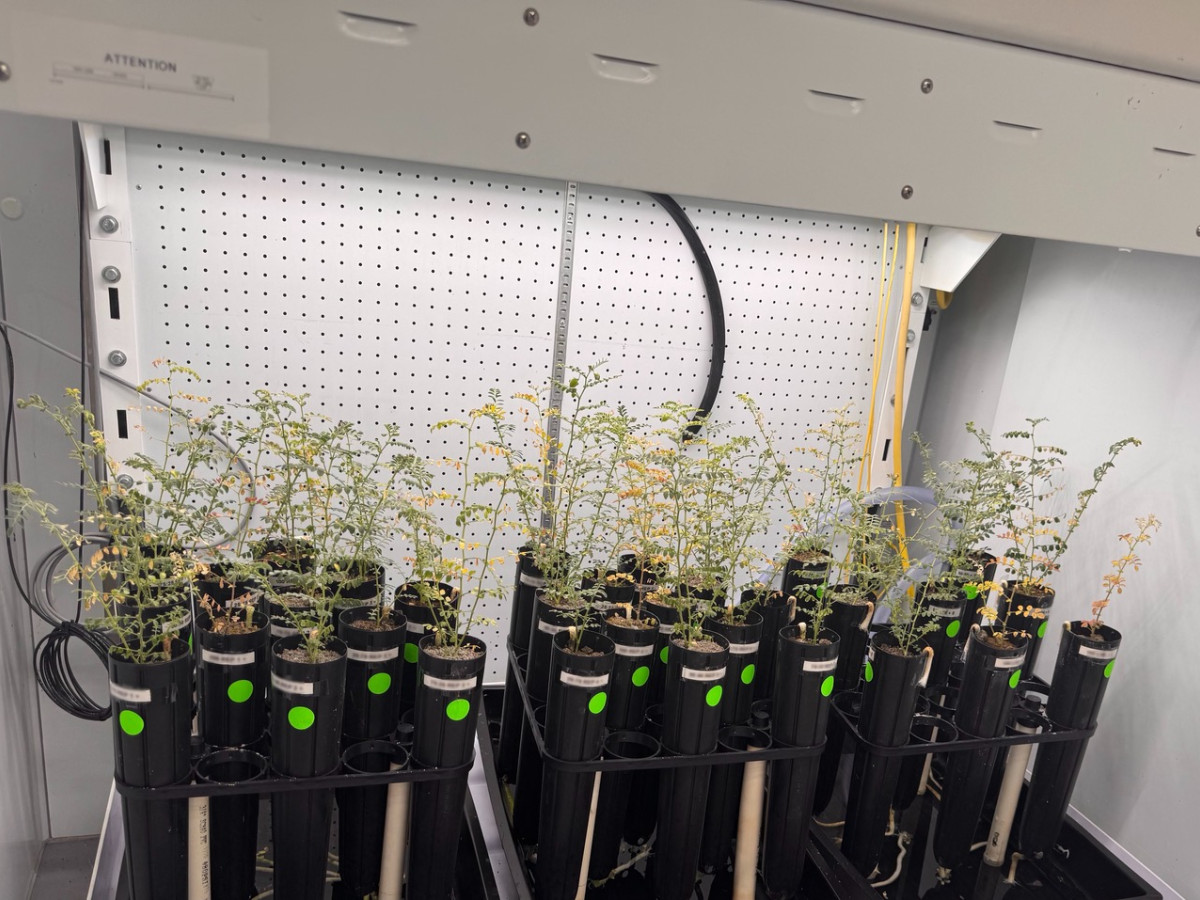
Let’s say that we find long term life on the Moon to be an appealing prospect; one of the essentials we’re going to need is food. So could we grow it there? Would Moon soil – lunar regolith – prove to be fertile ground to grow crops? You might think we’re getting ahead of ourselves here, but scientists in the United States are already working on this, recreating Lunar soil, and seeing what they can grow. So far, the diet looks a bit monotonous – you have to be a fan of chickpeas – but this is just the beginning, because it does seem to work. Speaking with Chris Smith, the would-be Moon farmers are Sara Santos at the University of Texas Institute for Geophysics, and before her, Jess Atkin at Texas A&M University…
Jess – We wanted to see if we could use any of the material that was already on the Moon and perhaps repurpose it to grow plants in, because sending something to the Moon is really expensive, and we wanted to have some fail-safes to have some food already sourced.
Chris – Do we have any idea what the soil is like up there?
Jess – To have a soil on Earth, you have to have two major things. You have to have organic material, which is made from decomposing things that were once alive, and you have to have microorganisms. And together, those things help plants grow. But when you get to the Moon, we don’t have any organic matter or any microorganisms. What we have instead is basically very fine, sharp, crushed-up rock, but it does have many of the essential nutrients necessary for plant growth.
Chris – How are you going to get around what you haven’t got, then, Sara? How do you actually do this?
Sara – First of all, one of the things that we won’t have, that the Moon doesn’t have right now, is nitrogen. And what we’ve done here is we’ve introduced these two things that are lacking, the organic matter and the microorganisms. So our methods are that we use a derivative of warm poop called vermicompost, and we use a special fungus called our arbuscular mycorrhizal fungus. This fungi actually supports over 80% of land plants. So it’s something that’s all around us. We decided to use those two helpers, and they do a lot of work with the soil to support the plant.
Chris – Did you use real Moon dust that Jess was talking about, or did you, because we know what it is and what its composition is, did you basically make up a facsimile of it and then mix it with your mycorrhizal fungus and the other bits and pieces you’re going to put in there to make a kind of facsimile of Moon soil?
Sara – Yes, we use the facsimile, which is regularly called the simulant for lunar dust, because it’s so difficult to get the genuine material. Some of it was brought back to Earth from the Apollo missions, but it’s very difficult to get. So there’s a few companies that actually specialised in making these mixtures to match the properties of certain regions of the Moon, and we use the one that matches the properties of lunar highlands, because that is our predicted landing spot.
Chris – Jess, before you tell us what actually happened when you’re trying to do this, are there not nasties in there as well? Because I’m just thinking the Moon material is basically like Earth crust material, but there are some other things up there that we might not want, if it were on Earth, to grow crops in. Is there not a danger we’re going to get contamination here?
Jess – There are some things that we do worry about. While I did state that we do have some of the things necessary, we also have some things we don’t want, and those are largely heavy metals. There’s a high percentage of aluminium and a high percentage of iron, and although plants do need iron for healthy growth, both of those things are present in levels that could be considered toxic to plants and then potentially to astronauts eating the seed. But one of the superpowers that this fungi has is it actually exudes a protein from the fungi that can trap or reduce the metals from being uptaken into the plant.
Chris – Neat. So basically, that sequesters the nasties, while at the same time providing all the supporting functions, the microbiome functions that the soil would give to a growing plant, then. So does this work? If you make this soil, will things grow in it?
Jess – Yes, we have seen that we are able to grow chickpeas to the reproductive stage. And we are currently testing, are these chickpeas safe to eat? And did the fungi do the job that we hoped it would?
Chris – How do you know if they’re safe to eat? Do you end up with a bunch of dead scientists if you get it wrong?
Jess – We send them off, and they’re tested through mass spectrometry, which is really cool. And it’ll tell us, are the metals present? In what quantity? But we are also taking it a step further and seeing how nutritious are they? How much protein do they have? Are they going to be a feasible food source for astronauts?
Chris – Did you recreate the rest of the conditions then, Sara? Did you zap them with the kind of radiation they’re going to get from space and neutrons streaming in and that kind of thing? The moon is a horrible place, isn’t it really? I mean, or did you give them a slightly cushier ride by screening a lot of that stuff out?
Sara – They definitely have a more comfortable ride than that. There are a lot of hazards when we think about the Moon: radiation, the lack of atmosphere. The regolith itself, the lunar dust, is super sharp, which creates micro tears in the roots, which is also very dangerous. So we isolated one of those major issues, which was using lunar dust to grow crops. But there’s going to be a lot of work still to be done in understanding how plants are going to react when we add all these factors in.