
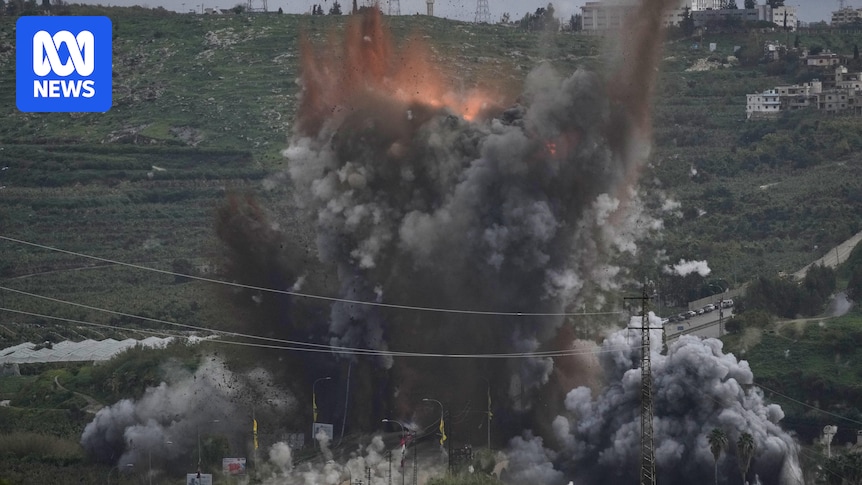
Israel’s defence minister has announced plans for his country’s military to take control of southern Lebanon, from the Israeli border, known as the Blue Line, to the Litani River.
Residents of southern Lebanon have been fearing Israel’s recent military action against the Iranian-backed militant group Hezbollah could be the precursor to a period of ongoing occupation, similar to Israel’s occupation from 1982 to 2000.
Iran war live updates: For all the latest news on the war in the Middle East, read our blog.
Intense Israeli bombardment of claimed Hezbollah targets in southern Lebanon, and the southern suburbs of Beirut, has so far killed more than 1,000 people. More than 100 children are among them.
The United Nations has said more than 1 million people are also displaced as a result of the conflict, putting immense strain on Lebanon’s limited and at times non-existent support services.
Defence Minister Israel Katz has described the move as the creation of a “security zone”.
During a briefing in Tel Aviv, Mr Katz said the Israeli military had destroyed five bridges over the Litani River that they claimed Hezbollah had been using, adding Israel would seek to control all other river crossings.
“Hundreds of thousands of residents of southern Lebanon who evacuated north will not return south of the Litani River until security is guaranteed for residents of the north,” he said.
“The principle is clear: there is terror and missiles, there will be no homes and residents — and the IDF will be inside.
“We will not allow a return to the situation of October 7. We promised to bring security to residents of the north, and that is exactly what we will do.”
Loading
Israel has faced criticism for the destruction of bridges in the south, accused of wilfully destroying civilian infrastructure and isolating small communities.
Hezbollah would fight to prevent Israeli troops from occupying southern Lebanon, one of the group’s top lawmakers Hassan Fadlallah told Reuters, saying such an occupation would pose an “existential threat” to Lebanon as a state.
Villages to be demolished
It has been three weeks since Hezbollah dragged Lebanon into the broader regional war, firing upon Israel in solidarity with the Iranian regime in Tehran.
Many towns and cities in the south have been hit by attacks, and the Hezbollah stronghold suburb of Dahiyeh in Beirut’s south has also been repeatedly hit.
US Ambassador to Lebanon Michel Issa had said last week that the United States had asked Israel to spare Christian communities in the south.
Lebanon’s justice minister told the ABC the militant group, considered a terrorist organisation under Australian law, had effectively given Israel an excuse to attack Lebanon and pursue its territorial ambitions north of its current borders.
The announcement comes less than a day after Israel’s far-right finance minister, Bezalel Smotrich, called for the annexation of southern Lebanon.
Mr Katz repeated his plans to demolish houses and villages on the Lebanese side of the border, citing a similar approach during Israel’s war against Hamas in Gaza.
“The IDF is manoeuvring into Lebanese territory to seize a forward line of defence, eliminating Hezbollah terrorists and destroying the terror infrastructure built there, as well as the houses in the Lebanese contact villages near the border, which serve as actual terror outposts — following the model of Rafah and Beit Hanoun in Gaza — in order to create a defence space and remove the threat from our communities,” he said.
Australia ‘concerned’
Before Mr Katz’s declaration, there were tense scenes in the Australian Senate as Foreign Minister Penny Wong was questioned about Australia’s position on the conflict by the Greens.
“I have been very clear that we are gravely concerned about the expansion of the conflict into Lebanon,” Senator Wong said.
“We are deeply concerned about the loss of life, the displacement of more than million citizens, including over 200,000 children.
“A major Israeli ground offensive into Lebanon will only exacerbate the worsening humanitarian situation in the country.”
Hours after those remarks, Israeli Foreign Minister Gideon Sa’ar revealed he had spoken with Senator Wong on the phone.
Mr Sa’ar posted on social media platform X about the discussion, saying he emphasised to his Australian counterpart the “massive scale of missile, rocket, and drone attacks” against Israel from Lebanon.
“Israel is acting to defend its communities and citizens. I described the reality of life these days in our northern communities, to which residents returned after over a year in which they didn’t live in their homes,” he posted.
“Most international media outlets are currently portraying the situation on only one side of the border.
“Unfortunately, the Lebanese government is not taking practical steps against Hezbollah, neither to stop the attacks on Israeli civilians, nor in other contexts.”
Rocket fire from Lebanon forced people in communities in Israel’s Upper Galilee to seek shelter repeatedly on Monday, including shortly after Israeli President Isaac Herzog visited the area.
On Sunday, a man was killed near the community of Misgav Am — a few hundred metres from the Israeli border.
Initially, Israel blamed Hezbollah for the death. The military conceded a day later that the man’s vehicle was actually hit by Israeli artillery fire.
Loading…