
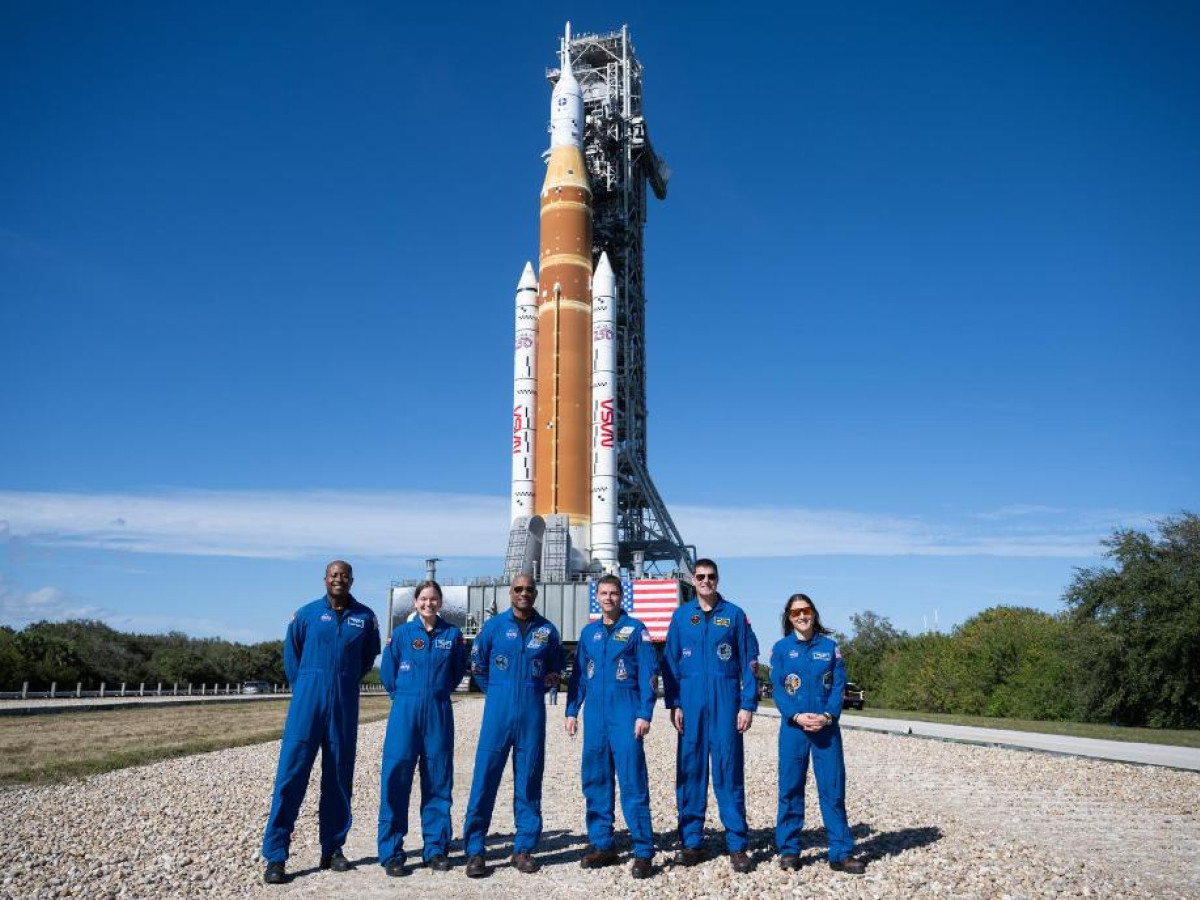
There are many reasons why the Moon is back on the radar, scientifically and politically, but that poses the obvious question of how to get there. The NASA-led Artemis programme is the new moonshot. Artemis I launched in 2022 to test the core rocket technology; the crewed Artemis II mission, now earmarked for April 1st, should have already flown earlier this year to take humans around the back of the Moon and farther from Earth than we’ve ever ventured before, and then after another test, missions IV and V in 2028, aiming for the Lunar South Pole, should see new human footprints on the Moon for the first time in nearly 60 years. But with Artemis II beset by difficulties – including engineering problems, spiralling financial costs, and collaboration with US tech billionaires – NASA has China snapping at its heels hoping to pip them to the post and fly their own mission, landing not far from where Neil Armstrong touched down many moons ago. So what’s going to happen? Here with Chris Smith is the space author and former BBC science expert, David Whitehouse…
David – The problem they’ve had with this launch was the same as they had with the first launch of the Space Launch System and the Orion capsule, and that is a problem they should never have had. It’s a refuelling problem. It’s loading the hydrogen on and also flushing out the rocket engines with helium, which is what they need to do to make sure that the hydrogen is no longer there in certain circumstances, because, as you know, the reason hydrogen is there is because it’s a rocket fuel. This should have been sorted out a long time ago, but it’s indicative of a problem with this hugely complicated Space Launch System that they’re using, based on old Space Shuttle technology revamped, that the project that’s been going on for 15 years now, that has had one launch, and is outrageously expensive per launch. So they are stuck with this legacy project, which they’ve built into their return to the Moon, which they’ve tried to fit into all the other ideas they’ve got. So if this doesn’t work, then nothing else really works in their current architecture of sending people back to the Moon.
Chris – When you say outrageously expensive, well, how big a price tag are we looking at? And how does that stack up against what rival outfits are doing, the commercial but also international rivals?
David – The Space Launch System is the most expensive low-flight-rate rocket project in the history of space travel. You’re probably talking about at least three to four billion dollars per launch. That and the difficulty of getting it to work really shows something wrong at the heart of America’s return to the Moon, because you cannot have any degree of a flight rate to achieve anything and to make incremental progress on each mission when it takes so long to launch, and it costs so much to launch. So there is a limit to how many Space Launch System launches there is going to be. And the new boss of NASA, Jared Isaacman, has come along and has reshaped the architecture, partly to get out of this problem, because not only does the Space Launch System have to launch the Orion capsule with its service module, with the four crew inside, but in order to land on the Moon, Elon Musk has to launch his Starship, which is not anywhere near ready. It has to refuel itself in Earth’s orbit many times, which has never been done. Then it has to go to the Moon, dock with the Orion capsule, and then the Starship goes to the surface and comes back. Very much a tall order, and people have been realising now for years that this is just taking too long. This is too much of a stretch. The Starship, it could be brilliant, but it’s not ready, and it’s not a good fit to go back to the Moon. So this is what the problems they’ve been wrestling with. The legacy Space Launch Programme, the Elon Musk system, with his futuristic-looking spacecraft. Jeff Bezos, who’s also in on the contract and designing a Lunar lander. How do you fix all these things together to have something that works to go to the Moon? Because when Apollo went to the Moon, it was a relatively straightforward, simple system. You go to the Moon, you undock your craft, you land on the Moon, you come back, and then you return to Earth. That is the best way to do it energetically. You add in all these components that have got a future, like the Starship going to Mars, and it just makes the whole thing expensive, long, and complicated.
Chris – The current scheduled launch for the 1st of April, though, hopefully not April Fool’s Day, this isn’t going to land on the Moon, but it will take people further away from the Earth and beyond the Moon than we’ve ever gone before. Is that part of this mission? Is that informing some aspects of the mission, nevertheless? So it’s a step, it’s a small step for mankind, but it’s not far enough yet. Is that the purpose of this current scheduled launch?
David – Principally, one of the main tests is of the heat shield, because when you come back from the Moon, it’s not like returning from Earth orbit. You’re travelling much, much faster, and therefore you need a very brilliant, upgraded heat shield compared to what you use if you come back from the Space Station. This is one of the principal tests of this high-velocity Earth return during this mission, and they’ve had problems with the Orion heat shield in the past. They haven’t been happy with it, so that’s going to be an important test of that. But you have to get this working, and alongside the Starship, or more likely now Jeff Bezos’ Blue Moon lander, which is much more conventional, these have to be working at the same time so that sometime next year you can put all these things together and have an uncrewed test. And what Isaacman has done with his new timetable is say, look, the problem is we’re not launching often enough. If you launch every few years, you can’t make any progress. Go back to the 60s with the Gemini project. They launched every three months, and they understood the progress they were making. So they’ve got to get back into the frequent launch, rapid progress. He’s put in an extra mission so that when they do land on the Moon in a few years’ time, once they get all this architecture sorted out, there’ll actually be two landings within a few months of each other, so that they can make this progress. And this really is, I think, the last roll of the dice with this particular combination of systems to see if they can get back to the Moon.
Chris – And where do they want to land?
David – This is a dilemma which the Chinese have sorted out. It’s a tall order to land anything at the South Pole. We expected the Chinese to do that with their first crewed mission, but now they’re going to the equator, to a very interesting volcanic deposit, which is what Apollo did. Much more easy to land on that region. So they’re saying for their first landing, they’re going where it’s easy, and America’s now under pressure to say, well, that’s actually a good idea, not to land at the South Pole as your first crewed landing, because you’re adding in the complications, you’re adding in extra danger, when all you want to do is to get there and test the system. And it could be another example where America has to change its plan in the future, particularly if the Starship is not available, because Jeff Bezos’s craft looks as though it could be much more capable and available sooner. So if I could make a prediction, it would be that America would say, OK, the South Pole is great, that’s for the future. We’re even perhaps going to land back at Tranquillity, not far from where Apollo 11 landed, just to say we are back. We were there once. This is us returning to the Moon and the South Pole’s subsequent missions.