

As big tech companies sack staff and say AI will pick up the slack, workers are left to grapple with what’s really going on.
Andrew Hamilton’s job was meant to be safe.
He came of age in a golden era for programmers, with the demand for code greatly outstripping the pace at which people could write it.
But now, AI tools are threatening an end to the good times. Even as a self-described “early adopter” of AI tools, Hamilton was caught up in a wave of AI-related job cuts sweeping the industry.
He was laid off last month, along with 4,000 of his ex-colleagues at Block — the company behind Square, Afterpay and Cash App.
The company cut 40 per cent of its workforce, citing improvements in AI for why it needed fewer staff.
Several other large tech companies have made similar cuts and given the same reason. Atlassian slashed 10 per cent of its staff. Meta is reportedly planning lay-offs of 20 per cent. Amazon cut 16,000 workers in January. For WiseTech, it was 2,000.
It’s enough to send a shiver down the spine of any white-collar worker. If AI really is behind the cuts at tech companies, could they be next?
But as the lay-offs keep coming, a divide has opened up about what is really driving them. Many remain sceptical of AI’s ability to replace workers, while others think we’re seeing the end of knowledge work as we know it.
Those right at the centre of the cuts at Block — employees past and present — are no different. They also have wildly diverging views about exactly what’s going on.
“I don’t really think AI was part of it,” says one programmer who was recently laid off.
This former employee believes that while these tools are getting better at writing code, they’re not at the stage where they “can replace 4,000 people who have knowledge of how [Block’s] business works”.
“Frankly, I think in a couple of years, they’re going to be looking to hire back a lot of people to fix the mess,” they said.
Hamilton, the ex-Block engineer, is cautiously optimistic about the future for AI-assisted coding. He believes “if someone is using AI daily, they can get through programming tasks a lot quicker”.
But he also expects there to be a rocky period of readjustment ahead.
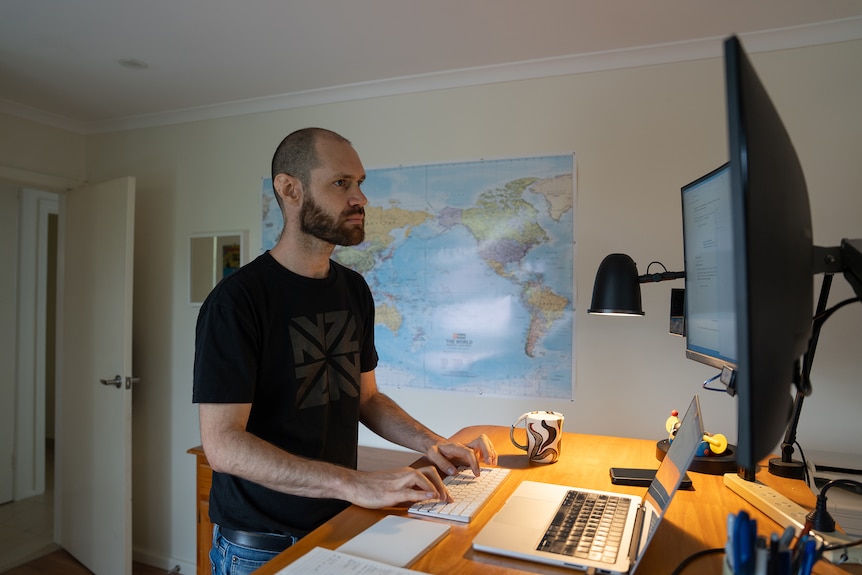 Software engineer Andrew Hamilton is a former employee of Block, Inc.(ABC News: Margie Burin)
“I think it’s going to be six months of extra stress for [Block’s remaining engineers] until they can work out how to delegate as much of the workload as possible to AI tooling,” he said.
And then there are people like Zach Stanford, who was part of the company’s effort to build the AI tools that are now replacing his colleagues.
He is convinced these tools are coming for everyone’s jobs, and feels responsible for the cuts at Block.
“The underlying capabilities [of AI tools] are accelerating week over week,” he wrote on his personal blog following the announcement. If people are led to believe that “AI is still hype”, he wrote, “it creates a false sense of security.”
“The thought had occasionally crossed my mind: ‘Are we building tools to replace ourselves?’ But I’d convinced myself we were just automating the mundane to free everyone up for more strategic work.
“That narrative came crashing down when thousands of colleagues no longer had jobs.”
All of these people write code for a living. They’ve each spent the last few years adopting the latest AI tools, experimenting with them, adding them to their daily workflows. They’ve now seen their workplace cut virtually in half.
And still, they can’t agree on whether these tools are good enough to replace workers wholesale.
One explanation for the disagreement could be a gap between how useful the technology is and how it feels to use it.
In early 2025, researchers at Model Evaluation and Threat Research (METR), a lab dedicated to understanding AI models, went looking for evidence that such a gap existed.
To do so, they measured how long it took programmers to complete a set of 246 realistic tasks, both with and without AI, and then compared the results. “When developers use AI tools, they take 19 per cent longer than without [them],” the researchers found.
It was a relatively small study, with only 16 participants, which is why METR stressed that it didn’t “represent a majority or plurality of software development work”.
However, even with the modest sample size, there was an outcome that did carry weight: even though tools had slowed them down, the programmers felt like they were making them faster.
When asked to estimate their own productivity — both during and after the study — the participating programmers estimated AI tools had increased their productivity by over 20 per cent.
These findings hint at the existence of a sort of halo effect, where the extraordinary abilities of AI coding assistants can blind their users to the reality of their usefulness.
The radical pace of improvement for AI tools — for programming tasks, in particular — means that even studies from last year are now seen as outdated.
A few days after the lay-offs at Block were announced, the company’s chief executive Jack Dorsey gave an interview to Wired, where he explained that “something really shifted in December in the sophistication of [AI] tools”.
Released in November 2025, Anthropic’s Opus 4.5 was immediately recognised as a dramatic step up in quality compared to past models. Soon, OpenAI also released a model with comparable performance.
When researchers at METR tried to repeat their study using the latest models, they ran into some serious problems.
Even though they were paid for their participation, some developers were unwilling to write code without AI.
“My head’s going to explode if I try to do too much the old-fashioned way,” said one participant. “It’s like trying to get across the city walking when all of a sudden I was more used to taking an Uber.”
In a frustrated blog post, the METR researchers reported that many participants were being more selective on which tasks they would take on. “Wider adoption of AI has made it more difficult to measure task-level productivity,” they wrote.
The researchers said their findings were “unreliable”, but indicated the latest tools offer “modest” increases to productivity.
Few would disagree with the claim that these tools can be helpful, and that they write decent code in the right circumstances.
The real tension lies in what this means for jobs — just because a tool is useful doesn’t mean it can replace workers in an ongoing way.
So far, there is little evidence of that happening at scale.
The effect of AI on the labour market is “largely speculative”, found a 2026 Yale Budget Lab study. “Most datasets find little evidence of economy-wide job loss or wage decline,” concluded a 2026 review of the interactions between US labour markets and AI.
Anthropic, a major AI lab, also found “limited evidence that AI has affected employment to date“.
It’s plausible, given the rapid improvements in these tools’ capabilities, that countless jobs across the tech world will soon be affected, and that it’s just too early for this to show up in the employment data.
Whether this comes to pass is not entirely about the tools themselves — it’s down to how executives perceive them.
“I don’t want to sound like a doomer,” says Manik Surtani, Block’s head of open source.
“But the value of human labour is going to trend to zero.”
 Manik Surtani co-founded an AI-focused foundation including Block, OpenAI, Anthropic, Google, and Microsoft.(Supplied: Manik Surtani)
The more relevant question, in his view, is how close we are to that in 2026.
“I don’t think the industry is at the stage where you can completely replace this entire department or replace this entire person,” he says.
“But everyone’s getting more efficient because they can offload at least some of their work, and companies can do more with fewer people.”
Surtani says he “wasn’t privy to any of the decisions that Block made regarding lay-offs,” though he believes they were “principled and carefully done”. He agreed to talk to the ABC in a personal capacity.
He cites his own experiences of offloading work to AI — coding tasks at work, and a hobby project involving financial modelling — as examples of how radical the possibilities are right now.
These “solitary” tasks can be easily replaced, but he warns that we shouldn’t extrapolate that too far to other types of work.
“Decision-making is much harder, taking ownership of things is much harder, communicating in a network is much harder.”
It is tempting to think that if AI can do the thing you’re good at, then everybody else’s jobs can be replaced by it as well.
Especially if you’re the boss.
“Your perspective changes when you’re off the tools,” says one former Block engineer. “A lot of [Dorsey’s] apparent perceptions of how software development works just aren’t right.”
This engineer isn’t wrong in suggesting that many executives aren’t plugged into the day-to-day enough to know if their workers can be replaced by AI.
A survey of 5,000 white-collar workers — across the United States, the United Kingdom and Canada — found a huge divide between how useful executives think AI is and how their staff feel.
Two-thirds of workers said they saved “less than two hours a week or no time at all” with AI. Only 7 per cent of executives said the same.
White-collar workers at Amazon told The Guardian that executives have been pushing AI tools on them, even when they made their work slower.
These studies and anecdotes point to a disconnect between the vision executives project and the reality on the ground at their companies.
“It’s just gravity,” says George Double, a Sydney-based recruiter who has been working with several engineers who were laid off from Block.
Block and Atlassian — another company that cited AI as justification for heavy lay-offs — were “bloated”, he says, and needed to downsize regardless of the impacts of AI.
Both companies were paying well above-average salaries for engineers and hired heavily during the COVID years.
“Yes, we over-hired during COVID,” Dorsey posted on X in response to criticism over the recent cuts, “but this misses all the complexity we took on … we have and do run an efficient company.”
His company has already been through several rounds of lay-offs since 2024 to correct for these earlier excesses.
Block has seen its share price falling in the last few years. As had Atlassian’s.
Some have speculated that — given these companies’ struggles — the latest wave of cuts are being “AI washed” by executives.
“Block’s latest reorganisation,” wrote a former employee, “reads like standard prioritisation and cost management, not an AI-driven reinvention.”
AI is “a convenient cover story“, wrote one commentator. Another called it “pure theatre“.
Investors seemed to like the story all the same. On the day of the lay-offs, Block’s share price rose 22 per cent.
As critics have pointed out, it’s a story with some gaping plot holes. Even if AI is making engineers more productive, that’s not necessarily a reason to fire thousands of them.
At a $95 million party that Block threw in California last year, Dorsey said that every staff member would be running “an army of AI employees”, according to two former employees who attended the event.
“He framed it as a boost,” recalled one former employee. “He explicitly stated that they were not planning to lay people off because of AI.”
Block declined to respond to the ABC’s questions about the role of AI in the cuts.
As her colleagues were being laid off, Naoko Takeda, a data scientist at Block, was offered a “retention package” that included a 75 per cent pay increase.
She quit the next day. “I saw my company discard half of my peers and double my pay,” she wrote on LinkedIn. “That’s not an honour. It feels shameful and dehumanising.”
One former employee said their team was reduced from 10 engineers to two. Other teams have been similarly hard hit, they said.
Hamilton, the former Block engineer, predicts a challenging period of readjustment. “Larger organisations — like banks — have decades of legacy products that need to be maintained,” he pointed out.
“If you let go of your engineers, you risk losing people with the context to be able to make changes safely, or help to recover quickly when things fail”.
Even with the latest tools at their fingertips, the remaining engineers will be left with more responsibility — and more pressure to deliver quickly.
Almost every Block worker we spoke to agreed that while new tools may be able to help them to pump out more code, there are plenty of other things that businesses need their workers to do.
“In my experience, inefficiencies in big businesses are less about individual pieces of work taking too long and more about working on the wrong thing,” said one former Block engineer who has also worked at Atlassian.
“I’m not sure how much AI will help with that.”
Credits
Reporter: Julian FellDesigner: Teresa TanDeveloper: Joshua ByrdEditor: Matt Liddy