
March 25, 2026 — 5:01am
Save
You have reached your maximum number of saved items.
Remove items from your saved list to add more.
Save this article for later
Add articles to your saved list and come back to them anytime.
Got it
AAA
My 15-year-old son has just started his first casual job. I’ve heard that if he makes voluntary contributions to super, there may be a government co-contribution. I’ve also heard about a scheme where voluntary super contributions can later be used for a first home deposit. Could you explain the main options available to a young casual worker starting to contribute to super, and whether these schemes can both apply?
It’s excellent that your son is thinking about super so early because time is the biggest advantage an investor can have. Even modest contributions made in the teenage years can grow substantially over decades through the power of compounding.
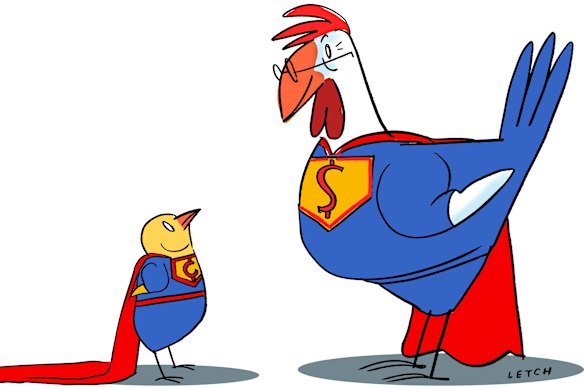 Starting to contribute extra to your super when you’re young is a great way to boost your retirement savings.Simon Letch
The first incentive is the government co-contribution scheme. If a low-income earner makes an after-tax contribution to super, the government may contribute 50¢ for every dollar, up to a maximum of $500.
In practice, contributing $1000 could produce the full $500 co-contribution provided his income is below the relevant threshold, and he lodges a tax return. For young people earning modest casual income, this can be a very effective way to boost early super savings.
The second initiative is the First Home Super Saver Scheme. This allows people to make voluntary contributions to super and later withdraw those contributions, plus associated earnings, to help buy their first home. Currently up to $15,000 of contributions per year can count toward the scheme, with a lifetime withdrawal limit of $50,000.
However, there are two important restrictions. Although your son can make voluntary contributions now, money cannot be withdrawn under the First Home Super Saver Scheme until he is at least 18.
In addition, any super that is not withdrawn under that scheme will remain preserved and generally cannot be accessed until retirement age, usually around 60.
I am a single age pensioner with a small share portfolio valued at around $70,000. I am 80 and would like to transfer these shares to my only granddaughter, who is 26, during my lifetime, to make things simpler for my executors, who are my children. Is this possible, and how I would go about it?
You can certainly transfer the shares to your granddaughter, but in practice it is usually simpler to sell the shares and give her the cash. At the age of 26 she may well prefer money that could be used for something practical, such as a house deposit, rather than receiving a small share portfolio.
Before selling, you should check the capital gains tax position. However, with a portfolio of this size, and depending on how long the shares have been held, it is quite possible that little or no capital gains tax would be payable.
Related Article
The main issue to consider is the Centrelink gifting rules. These allow you to give away up to $10,000 in any financial year, with a maximum of $30,000 over a rolling five-year period, without affecting your pension assessment.
Any gifts above these limits are treated as “deprived assets”. This means Centrelink will continue to assess the excess amount as if you still owned it for five years, even though you have given it away.
A simple strategy would be to gift $10,000 immediately and another $10,000 after July 1, which would remove $20,000 from the means test straight away. The remaining $50,000 could then be gifted at that time as well. Although that amount would still be counted under the gifting rules, it would cease to be assessed for age pension purposes after five years.
I plan to take out an interest-only loan to invest. Will the interest be tax-deductible if the loan is used to buy ETFs?
The term ETF stands for exchange-traded fund, but it actually covers a wide range of different investments. Some ETFs hold shares and pay regular distributions, while others track commodities such as gold, or are structured mainly for capital growth.
The key rule for tax deductibility is not the name of the investment but the purpose of the borrowing. For interest on an investment loan to be tax-deductible, the borrowed money must be used to purchase an asset that is expected to produce assessable income.
This means that if you use the loan to buy an ETF that pays distributions – such as dividends or interest – the loan interest would normally be deductible against that income. However, if the ETF is structured purely for capital growth and does not produce income, the interest may not be deductible because there is no assessable income being generated.
I am a recently widowed pensioner and my pension is asset tested. As my late partner’s assets are progressively transferred into my name, my assets are increasing and my pension is being reduced.
I have already prepaid my funeral, and I am trying to do some maintenance work on my unit. I am wondering what spending is considered acceptable in this situation. For example, is it reasonable to prepay my private health insurance for a year? And would it be acceptable to occasionally take my children out for dinner when we go out together? I would appreciate any guidance on sensible ways to manage my finances without causing problems with my pension.
Editor’s pick
The purpose of the Centrelink deprivation rules is to stop people giving away large sums of money to qualify for the pension. They are not aimed at normal day-to-day spending.
The kinds of expenses you mention are perfectly reasonable. Prepaying your funeral is fine, as is spending money improving or maintaining your home because your principal residence is exempt from the assets test.
Prepaying private health insurance for a year is simply paying a legitimate expense in advance and should not cause any problems. Travel in Australia or overseas, and other normal lifestyle spending, are also perfectly acceptable.
I’m sure if you occasionally take your family out to dinner, that should not be an issue at all. Just enjoy your remaining years secure in the knowledge that every $10,000 of assets you spend will increase your pension by $780 a year.
Noel Whittaker is author of Retirement Made Simple and other books on personal finance. Questions to: noel@noelwhittaker.com.au
Advice given in this article is general in nature and is not intended to influence readers’ decisions about investing or financial products. They should always seek their own professional advice that takes into account their own personal circumstances before making any financial decisions.
Expert tips on how to save, invest and make the most of your money delivered to your inbox every Sunday. Sign up for our Real Money newsletter.
Save
You have reached your maximum number of saved items.
Remove items from your saved list to add more.
 Noel Whittaker, AM, is the author of Making Money Made Simple and numerous other books on personal finance.Connect via X or email.From our partners