
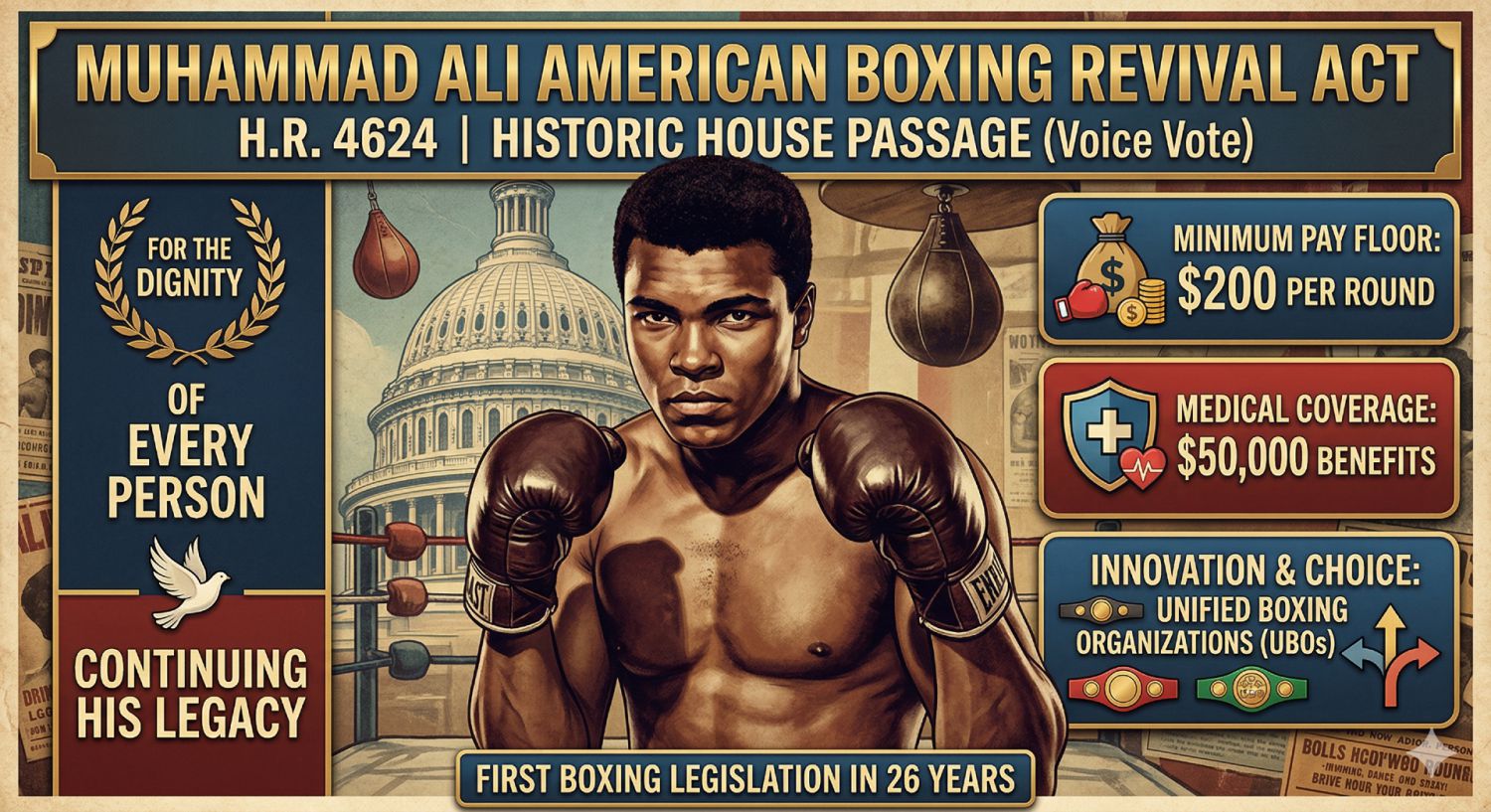
WASHINGTON, D.C. — The United States House of Representatives has passed the Muhammad Ali American Boxing Revival Act (H.R. 4624) by voice vote, marking the first time in 26 years that Congress has advanced major boxing legislation.
Introduced by Congressman Brian Jack alongside Congresswoman Sharice Davids, the bipartisan bill aims to modernize the sport by strengthening safety protocols, ensuring fair compensation, and opening the door for new business models in professional boxing.
“The House of Representatives made history today by passing landmark legislation that will revive one of America’s greatest sports in the name of one of America’s greatest athletes,” said Congressman Jack. “Ambiguity in current law has adversely affected boxers and stifled investment for over a quarter century. This Act establishes a framework for innovation to flourish while protecting the athletes.”
The legislation builds upon the Professional Boxing Safety Act of 1996 and the original Muhammad Ali Boxing Reform Act of 2000. Key provisions include:
A National Pay Floor: Establishes a minimum payment of $200 per round to protect up-and-coming fighters from exploitation.
Mandatory Health Coverage: Requires a first-time national minimum of $50,000 in health insurance coverage for bout-related injuries.
Unified Boxing Organizations (UBOs): Allows for the creation of independent UBOs to operate alongside existing sanctioning bodies, giving fighters the freedom to choose the system that offers them the best protections and opportunities.
Lonnie Ali, wife of the late Muhammad Ali and co-founder of the Muhammad Ali Center, testified in support of the bill.
“Muhammad dedicated his life to fighting—not just in the ring, but for the dignity of every person,” Ali said. “My support for this bill is centered on ensuring fighters achieve real safety, genuine economic protections, and fair compensation. I look forward to working with the Senate to ensure this bill becomes the very best it can be for the overall welfare and dignity of boxers.”
The legislation moves next to the United States Senate for consideration. It carries heavy industry backing, including endorsements from the Association of Boxing Commissions, Mike Tyson, the International Brotherhood of Teamsters, and major arena operators like Madison Square Garden Entertainment Corp. and MGM Resorts International.
About The Bill
1. A Crackdown on “Junk” Titles
One Champion Per Weight Class: The bill mandates that sanctioning organizations and UBOs can only award one championship title per weight class.
Strict Limits on Interim Titles: Interim titles can now only be awarded for legitimate reasons (e.g., the reigning champ is injured, ill, or legally unable to travel/defend the title).
2. Strict Medicals for Older Fighters (40+)
Any boxer aged 40 or older must undergo rigorous annual testing, including a chest X-ray, comprehensive metabolic blood panels, urinalysis, an MRI of the brain, and a heart stress test to be cleared to fight.
3. Anti-Doping and Drug Testing
50% Testing Rule: At least half of the boxers participating in a UBO event must be drug tested in-competition.
Title Bouts: Drug tests are mandatory for all title bouts.
No-Notice Testing: Fighters under UBO contracts are subject to random, no-advance-notice testing.
4. Guaranteed Activity & Contract Limits
Maximum Contract Length: A UBO cannot lock a fighter into a contract for more than 6 years.
Guaranteed Fights or Pay: Contracts must guarantee a fighter gets at least one match every 6 months. If the UBO can’t get them a fight, they still have to pay the fighter 10 times the minimum round rate (so, at least $2,000) for that period.
5. Anti-Betting and Conflict of Interest Rules
Fighters, their coaches, trainers, medical staff, and anyone living in their household are strictly prohibited from betting on the match.
They are also barred from sharing “non-public information” (like an undisclosed injury in training camp) with third parties to help them place bets.
6. Beefed-Up Ringside Medicals
Events must have at least two ambulances on site (the original 1996 law required one; this adds an additional one).
Events must have an additional licensed physician continuously present at ringside.