
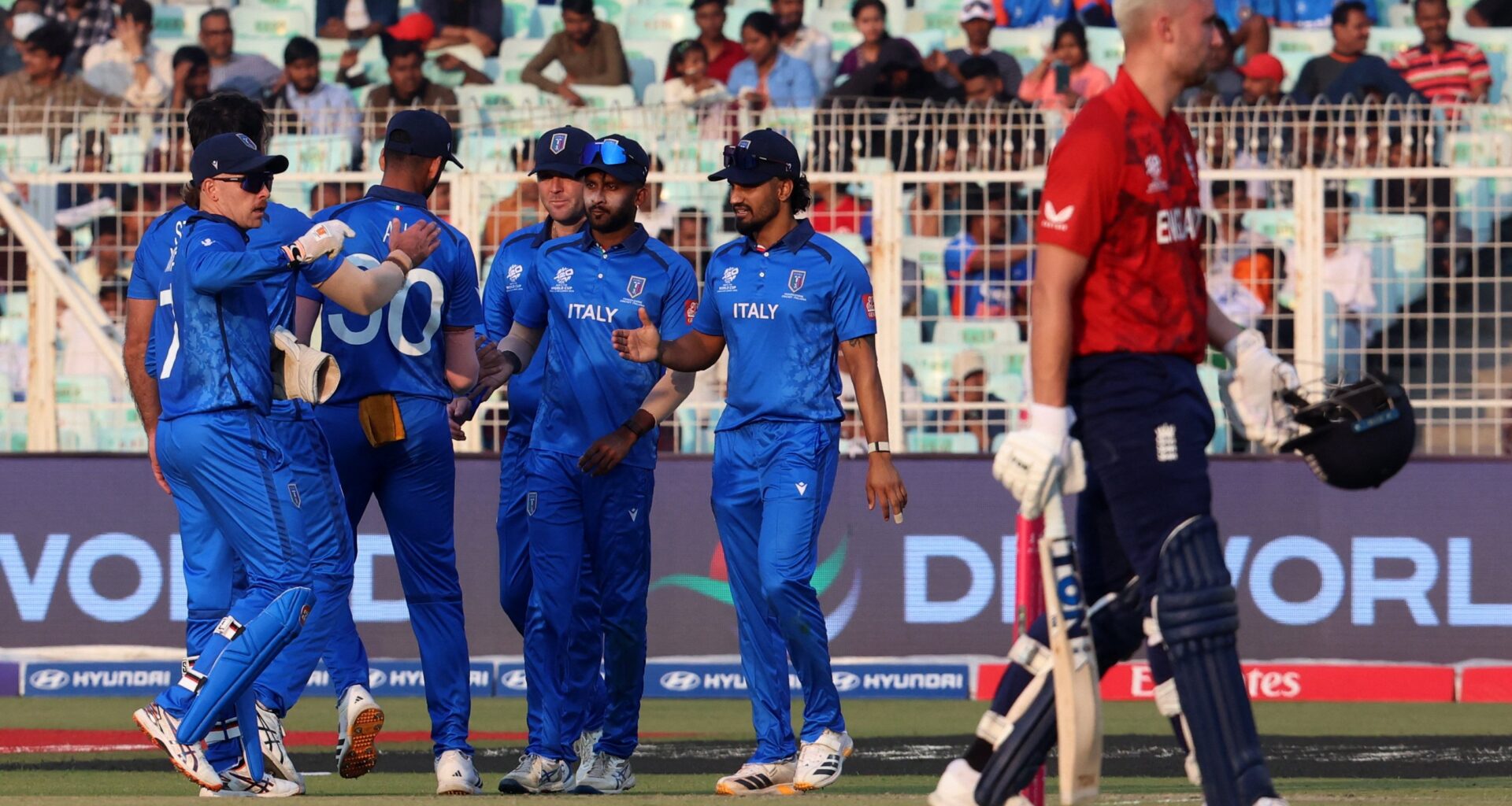
Twenty-five years ago, the Italian cricket team pulled out of World Cup qualifiers because the ICC ruled their four foreign-based players ineligible. This year, Italy made global headlines by winning their first ever T20 Cricket World Cup match—with a multicultural motley crew.
“While they believed and understood that we were Italian citizens by law, they suggested that we weren’t because we didn’t live in Italy,” said Peter Di Venuto, the Italian national team’s current manager and chairman of selectors—and one of the players ruled out in 2001.
Despite the ICC costing him a few caps and a chance at qualifying for cricket’s biggest stage, Di Venuto says there’s no hard feelings.
“There’s no resentment at all,” he said, “I can’t control what an international body would choose to do, but what I can control is how we respond to that.
“And ultimately, I’m proud that we went through that because that was the battle that we lost, but it was the war that we won.
“Every player now across the globe that has Italian citizenship … has the ability to play cricket in Italy and … represent the national side if they’re good enough to do so.”
This year, at the T20 World Cup held in India and Sri Lanka, Italy got their first ever victory on the big stage—a 10 wicket win over Nepal, before going toe-to-toe with England in the next match, losing by just 24 runs.
“The World Cup campaign was fantastic,” Di Venuto said, “Italy were brave; it was fantastic to see the players just embrace the tournament.
“I think that it was fantastic that the guys, outside of the first game [where] we may have been maybe a little bit overawed by the by the occasion … played exciting cricket.
“We took the game on, we took it up to our opponents, irrespective who they were, and we made our games very watchable for anyone that decided that they wanted to watch Italy.”
Di Venuto, whose grandparents migrated to Australia from Friuli, says the goal for this team was always to leave a legacy that would push the sport to greater heights in Italy. For him, the next step requires investment in facilities—no small task, given Italy doesn’t have a single turf wicket anywhere in the country.
“The group of coaches and players are very much mindful of what can be achieved to help the growth of the game in Italy,” he said.
“Has (Ali Hasan), who opened the bowling in the World Cup, eight months prior we had to buy him a pair of spikes, because he had never worn a pair of spikes.
“We were playing in the in the qualifying tournament in the Netherlands. If you pause on that and reflect on that for a moment, here he is eight months later and he’s on the world’s biggest stage for a T20 tournament, and he’s only been bowling in spikes for eight months.
“It’s not really fathomable to those in cricket environments around the world, but that’s kind of where we’re at.”
With cricket returning to the Olympics in 2028 for the first time since 1900, Italian cricket will now be under the umbrella of the Italian Olympic Committee (CONI).
“As a result of that, it will bring about opportunities of increased funding and hopefully a national high-performance centre and ground turf facility that will enable the development of the game and the players in Italy,” said Di Venuto, who added he had high hopes for the future.
“If I had a crystal ball, I think that in 20 years’ time we would have ovals in the north, in the middle and down south that can be used—certainly down south—12 months of the year.
“[We’ll have] nearly an Academy set up structured for young Italian boys and girls to be able to be coached in developing their game within great facilities and for us to continue competing on the global stage in tournaments such as the T20 World Cup.”
For a sport that’s given very little airtime, Di Venuto believes the Italian media “most definitely” have a role to play when it comes to promoting cricket domestically.
“We had media from Italy that came to India; how ironic that the Italian Cricket federation basically had to almost pay them to be there. Well, they did pay them to be there,” he clarified.
“Newspapers weren’t prepared to pay them to go to the World Cup. ‘What’s this game?’ [they would ask]—it wasn’t, for them, any form of interest.”
For Di Venuto, the hope is that a symbiotic relationship can emerge between ‘brand Italy’ and the second most popular sport in the world.
“For the ICC, Italy is a brand,” he said, “And it’s a brand that as Italians, we’re obviously very proud of.
“Everything that comes out of Italy globally, in terms of the global brands, are unbelievable. The ICC, they recognise the power and impact that Italy would have at the World Cup once they qualified.
“And now, our hits on our socials … in the space of the first 12 days of February, there was 27 million hits on our sites.
“That’s the power that cricket has in a global sense, particularly a tournament that’s in India.
“But the reality is that not only has the Italian Cricket Federation not [yet seen] the full impact … of competing at a T20 World Cup, and what it can do for your game and home, it’s in the interest of potential sponsors to get in at ground zero and to be involved in the growth of the Italian game.
“People know it’s ground zero, people know that there’s such an enormous opportunity, and for some companies that are quite shrewd, their being involved is something that will hold them in very good status as the game progresses.”
Finally, Di Venuto says he feels indebted to his grandparents and views his work with the Italian cricket team as a way to honour their sacrifices.
“Our grandparents left Italy post-World War II, where the country was obviously torn apart by the war, and jumped on a boat to go to a place that they had no idea of what they were going to, to courageously start a life for their family…,” he shared.
“We all now feel an obligation as a group of players and coaching staff to say, ‘What can we do to help say thank you for what our grandparents did 50-60 years ago?’”
It’s fair to say the team has done Italy and their Italian ancestors proud, but if Di Venuto has his way, the 2026 T20 Cricket World Cup will just have been the start—and a catalyst for Italy’s new favourite summer sport.