
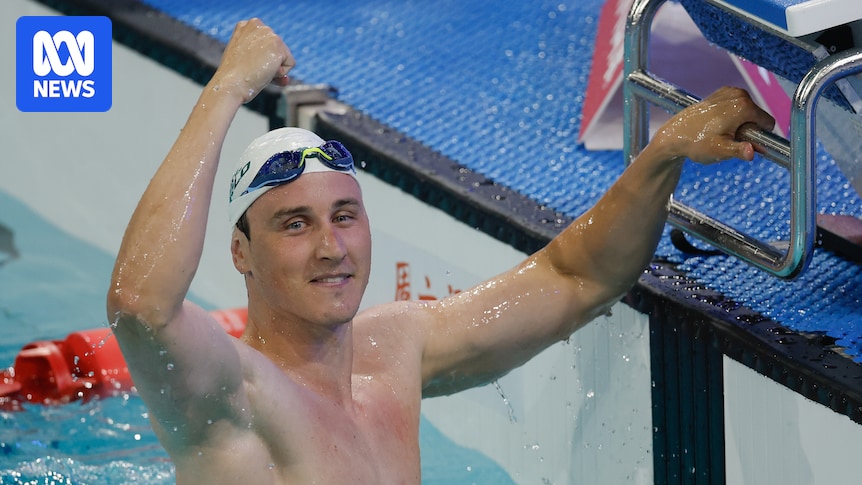
Cam McEvoy says breaking the 50-metre freestyle world record was “the realisation of a childhood dream,” but bemoaned the “ludicrous” situation where doped athletes could earn huge quantities of money for breaking the record illegally.
McEvoy broke Brazilian sprinter César Cielo’s 16-year-old world record — the longest-standing world record in swimming — at the China Open in Shenzhen on Friday.
The record was the final reminder of the so-called super suit era that, between 2008 and 2009, saw over 200 records fall as swimsuit manufacturers explored the use of water-resistant polyurethane.
However, given the China Open was a meet not organised by World Aquatics, there was no world record bonus to be made for beating the mark.
World Aquatics does pay out for world records broken in competitions run by the global governing body.
The same feat during a World Cup meet can see a swimmer take home a $US10,000 ($14,340) bonus, while Léon Marchand took home a record-breaking $US30,000 as the sole individual to break a world record at the 2025 World Championships in Singapore.
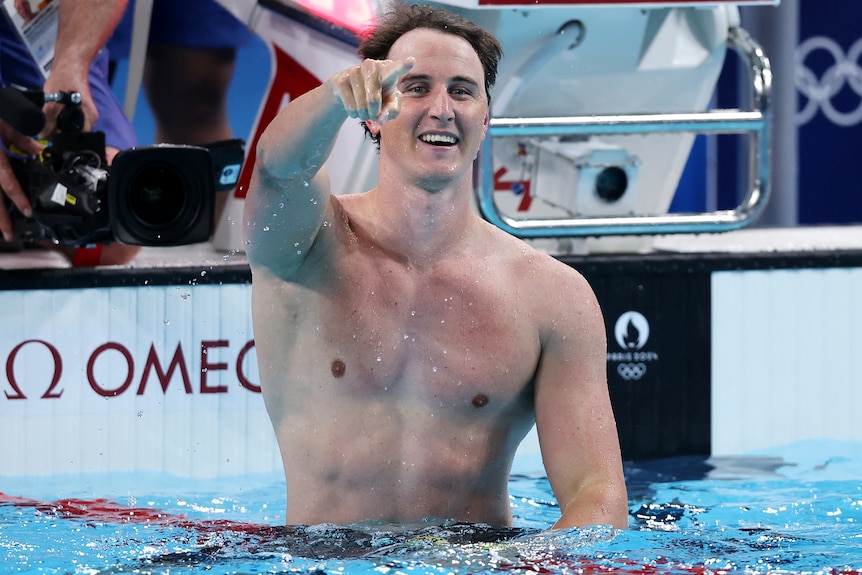
Cameron McEvoy has won the last three major global titles in the 50 metres freestyle, including gold in Paris. (Getty Images: Maddie Meyer)
Additionally, Australian swimmers who break a world record at the Olympics or Commonwealth Games earn a bonus courtesy of swimming benefactor Gina Rinehart.
“So this competition at the China Open had no world record incentive … so, yeah, with this world record, I got $0 for that,” McEvoy said.
By comparison, there are enormous financial incentives on offer at the controversial Enhanced Games, where athletes are promised $US1 million to break an existing world record.
“It’s crazy to think that to get a world record without a suit and without any performance-enhancing drugs, as a clean athlete, the bonus is $0, whereas if I went an easier route … you get not only a $US1 million bonus — $1.5 million Australian — but there’s also $US250,000 prize money for first place, which you would get on top of the world record,” McEvoy explained.
“The stark contrast is massive — we’re talking on the order of $2 million plus compared to $0. And the $0 pathway is the much harder pathway to do something like this as well.
“It’s pretty ludicrous. It’s a bit unfortunate that this pathway has $0, and the value placed on something like this then is something that is, at least deemed from that perspective, worth nothing in that respect.
“So, yeah, I’m dumbfounded in terms of the stark contrast that exists currently in the landscape of sport in swimming.”
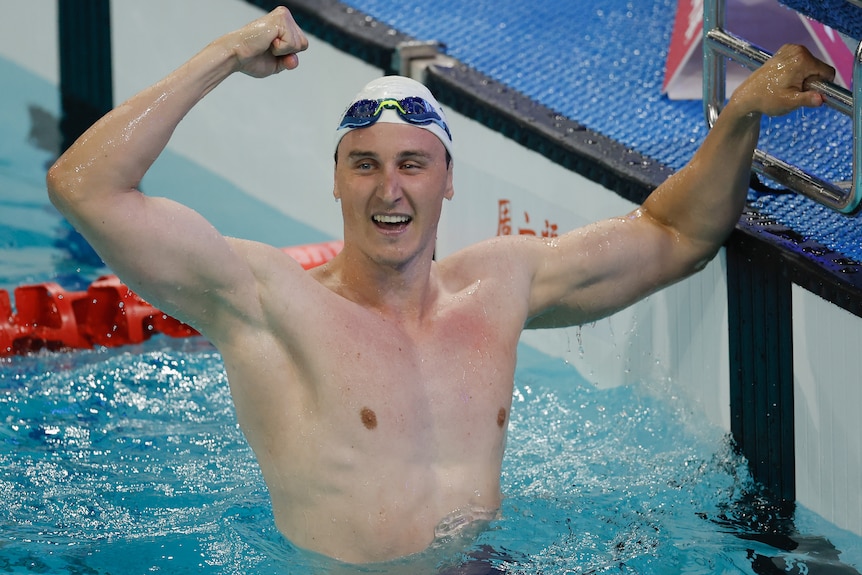
Cameron McEvoy broke the longest-standing world record in the book at the China Open. (Getty Images: Lintao Zhang)
The first Enhanced Games is set to take place in Las Vegas in May this year, but the controversial competition has already claimed success in the pool, with Greek swimmer Kristian Gkolomeev reported to have swum a length in 20.89 seconds — wearing a now-banned super suit — as part of a time trial in North Carolina in February last year.
The four-time Olympian also reportedly swam 21.03 in World Aquatics legal textile ‘jammer’ shorts last April — at that stage the fastest-ever swim in a now-race legal suit.
“The Enhanced Games gave me the resources and the team to unlock a new level of performance — and now the whole world can see what’s possible,” Gkolomeev said.
“On the second attempt, I was on a full two-month [drug-taking] cycle.
“I had an extra 10lbs of lean muscle — we did a pretty good job with my coach in that short amount of time to get used to my new strength and weight in the water. It was a very good result.”
In a sobering slap in the face for the disgraced Greek swimmer, though, McEvoy’s new record was still faster than Gkolomeev managed.
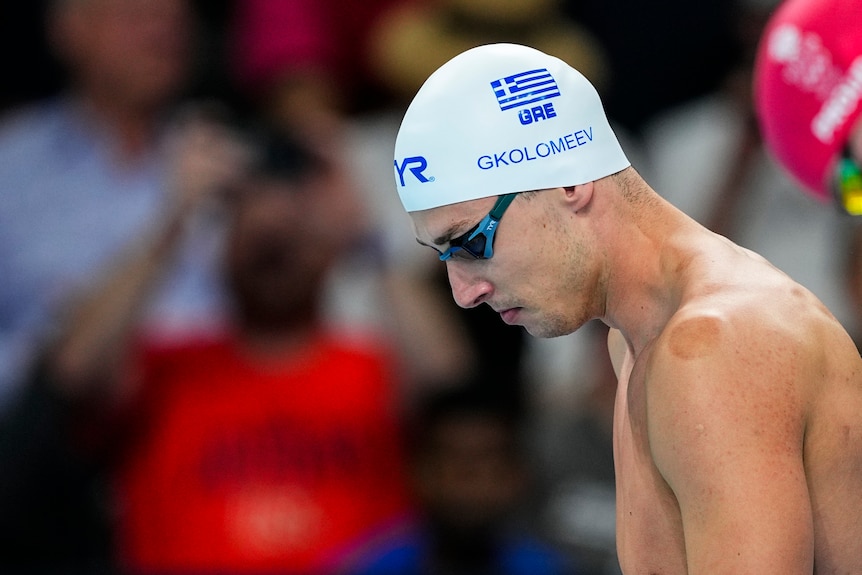
Disgraced Greek swimmer Kristian Gkolomeev claimed to have broken the world record last year, while wearing an illegal suit and using doping products. (Getty Images: Europa Press/Oscar J. Barroso)
That was despite Gkolomeev’s doping program and the fact that he raced in one of the banned polyurethane suits of the super suit era.
There are 15 swimmers listed on the Enhanced Games website as having committed to the program, led by two-time Australian Olympian and former Auburn head coach, Brett Hawke.
Those athletes include Australian James Magnussen and British Olympic silver medallist from Paris, Ben Proud, who finished 0.05 seconds behind McEvoy at the Paris La Défense Arena.
World Aquatics, in a statement provided to the BBC, said the Enhanced Games were “a circus”. Travis Tygart, chief executive of the US Anti-Doping Agency, called it a “clown show”.
Needless to say, World Aquatics refused to ratify the record.
McEvoy, for his part, was pleasingly dismissive that anything that comes from the Enhanced Games is worth talking about, noting it was essentially a gimmick.
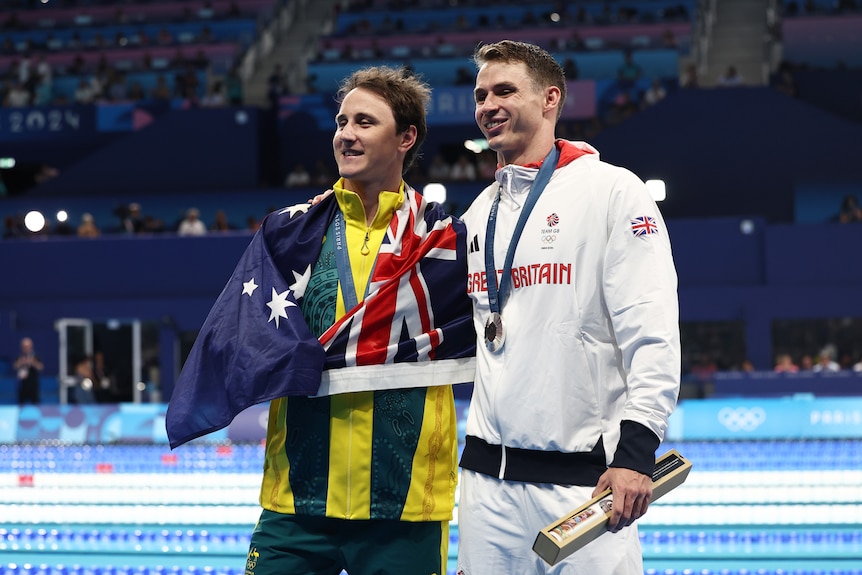
Cam McEvoy (left) pipped Ben Proud (right) to gold in the 50m free in Paris. (Getty Images: VCG)
“It didn’t really hold much credibility to begin with, in the sense where the public opinion and the public reception of it wasn’t very good, particularly in the realm of sport,” McEvoy said of the Enhanced Games record claims.
“It was definitely looked down upon and not seen as something that really held any weight anyway.
“It was more kind of like an exhibition swim type of thing, similar to if someone put a giant pair of fins on and did a 50 freestyle and went at a particular time. It’s in that realm.
“I think [me] doing this time probably reinforces that.
“It just remains as something that is more of an exhibition on the outskirts and is something that is not in any relation to the traditional sporting pathway.”
Back to reality, and McEvoy said breaking the record was “really special” and validates his new approach.
“I’m still processing it,” McEvoy said.
“That was more of a target for the end of the season, so to have hit it in March is really special.
“It’s also been definitely a long-term thing, so to finally hit it, I’m still pinching myself.
“I’ve always been asked, like the age-old question is: do you want an Olympic gold medal or world record? I always said, world record, and this was the one I didn’t have. So, yeah, to finally have that is very special.”
The men’s 50m freestyle world record progression — or, until last week, the lack thereof — acted as the last reminder of swimming’s most controversial era.
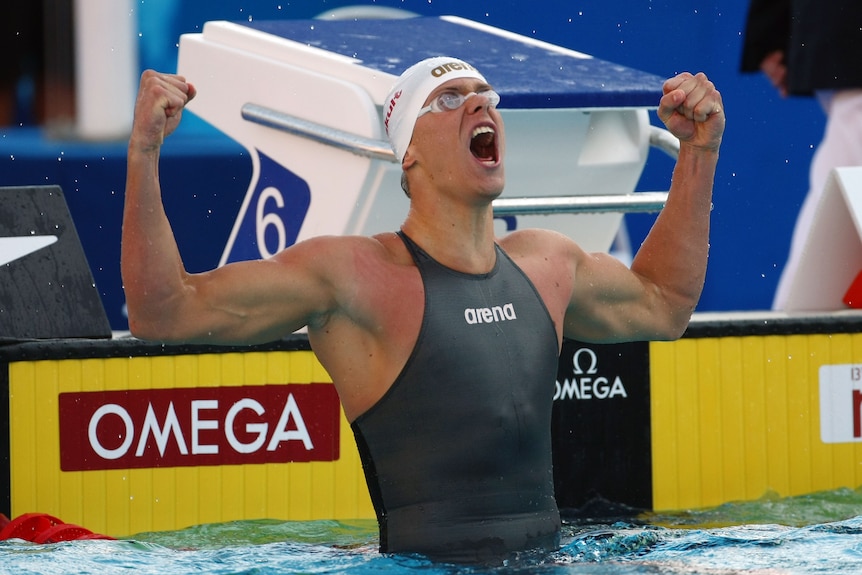
The torso-covering suits worn by César Cielo are now banned. (Getty Images: Clive Rose)
Since Matt Biondi set a mark of 22.14 at the Seoul Olympics in 1988, the men’s 50m world record was beaten just four times over the next 19 years, three times by Tom Jager and once by Russia’s Alexander Popov in a time trial at the Russian Championships in 2000.
But from February 17, 2008 — when Australian Eamon Sullivan set his record of 21.56 at Homebush in the Australian Championships — to Cielo’s monstrous blast in São Paulo 23 months later, the record had been bettered five times.
All those records were set by swimmers wearing the since-banned polyurethane suits that covered their torsos and extended down to their ankles.
Once those suits were banned on January 1, 2010, the progression halted, encased within the technological limitations imposed on the athletes.
But not any more.
Cielo was among the first to congratulate McEvoy on finally wiping the super suit era from the record book, hailing the Aussies’ “incredible” effort as a “lightning fast swim” and praising his approach.
“I saw a phrase a while ago that perfectly captures what you’ve been doing,” the 39-year-old Brazilian wrote.
“‘You never change things by fighting the existing reality.
“‘To change something, build a new model that makes the existing model obsolete.'”
McEvoy’s new program is not so new any more.
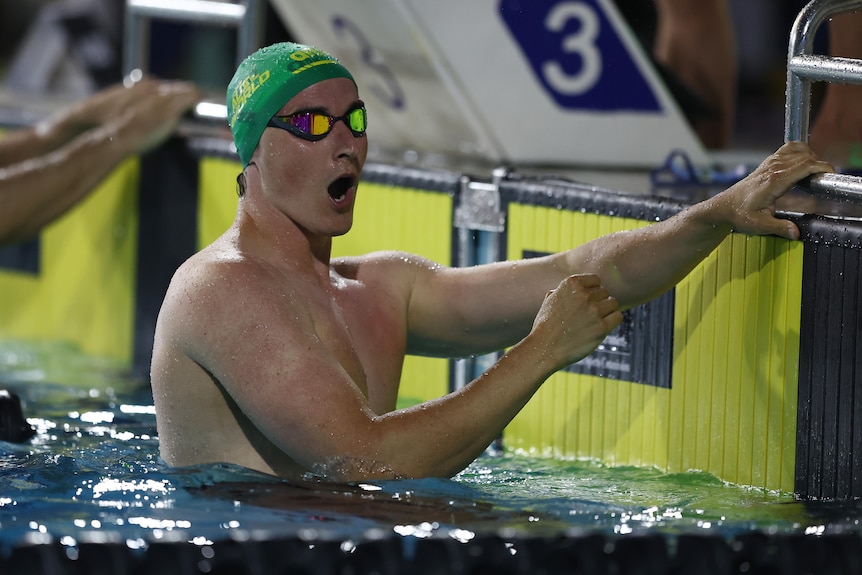
Cameron McEvoy is constantly pushing new barriers. (Getty Images: Chris Hyde)
An emphasis on technique and studiously analysing every possible factor that could improve his speed has seen McEvoy claim Olympic gold in Paris and back-to-back world championship titles in Fukuoka and Singapore in 2023 and 2025, respectively.
Breaking the longest-standing world record in the books was the only thing that his move away from the traditional, lane-ploughing model of swim training had yet to achieve.
But he is not done yet.
“The way I split this season up was I had an off-season, which was mainly strength development, and I’ve barely done much swimming since the world champs last year up until this comp.
“This comp was meant to be the transition going into more of a sprint-focused regime.
“But because I got the world record and I’ve made steps, the idea is kind of just to double down on this and not change it, see how far this can actually take me, and then go from there.
“It is, surprisingly, a little bit more leaning into the extreme side of things, even with respect to what I’ve already been doing.
“I’m going to lean into continuing the strength of development in the gym and not really increasing the amount of sprinting I do in the water, whereas in the past, this time of year, I’d be upping that type of volume.
“I’m pretty excited to see where that goes.”