
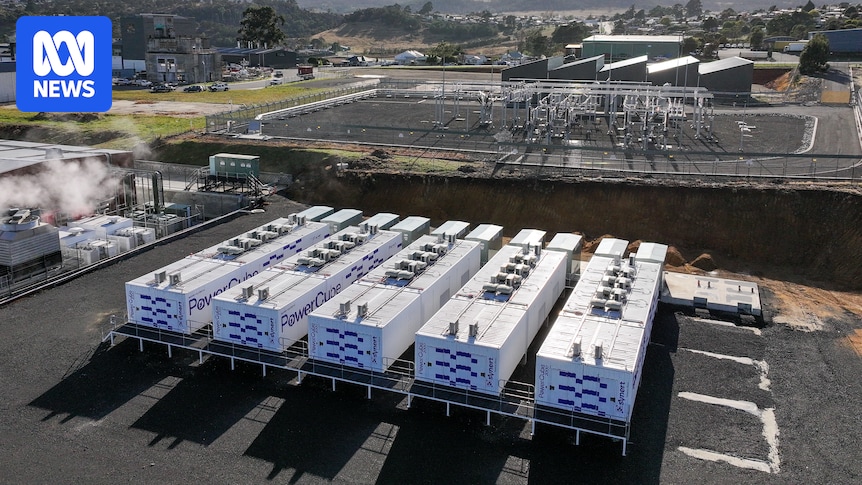
Questions remain about the deal struck to supply power to an AI company in Tasmania’s north, less than a year after a request to supply another manufacturer was rejected.
Earlier this week Oliver Curtis from AI company Firmus told ABC Hobart Mornings that the St Leonards facility, which would “produce AI tokens” that are “consumed globally” in the use of artificial intelligence technologies, would be operational this year.
Mr Curtis confirmed Firmus had secured the supply of 104 megawatts with energy retailer Aurora for power from Hydro, the state-owned hydro-electric generator, for the project’s initial stages, with plans to scale up.
In June last year, the ABC reported Hydro had informed the Boyer Paper Mill it could not supply it with enough power to successfully transition from coal-fired burners to electric.
The Boyer mill is one of the state’s largest power consumers, using around 100 megawatts — the electric boilers would require another 45 megawatts.
Premier deflects questions about deal
On Wednesday, Greens MP Tabatha Badger told state parliament that “such arrangements will have far-reaching consequences for Tasmania’s energy grid”.
“Tasmanians deserve to know more about the Firmus arrangement and what may be promised to other AI facilities and data centres,” she said.
“Given other major customers have been told there is not enough energy for their needs, what can you tell us about the power deal with Firmus, and can you tell us how many data centre projects are in the pipeline presently and what is the total energy and water needs to support them?”
Premier Jeremy Rockliff referred to “commercial-in-confidence arrangements” before chiding the Greens for being “anti-renewables”.
“AI is the future, we cannot stop it. We need to embrace the opportunity of a new industry, a clean industry coming to Tasmania,” Mr Rockliff said.
“This is why I get confused with respect to the Greens’ policy agenda, when it’s all about a clean environment, when [they’re] against renewable energy, against wind farms for the last 50 years.”
After Question Time, Ms Badger returned to the topic, telling the parliament: “This is one of the most important, crucial conversations we as elected members are going to be having.
“So it was disappointing to see the premier couldn’t give clear answers and instead chose to politically attack us.”
Madeleine Ogilvie, the Minister for Innovation, Science and the Digital Economy, said Tasmania wanted to “grasp the economic opportunity” offered by the AI industry.
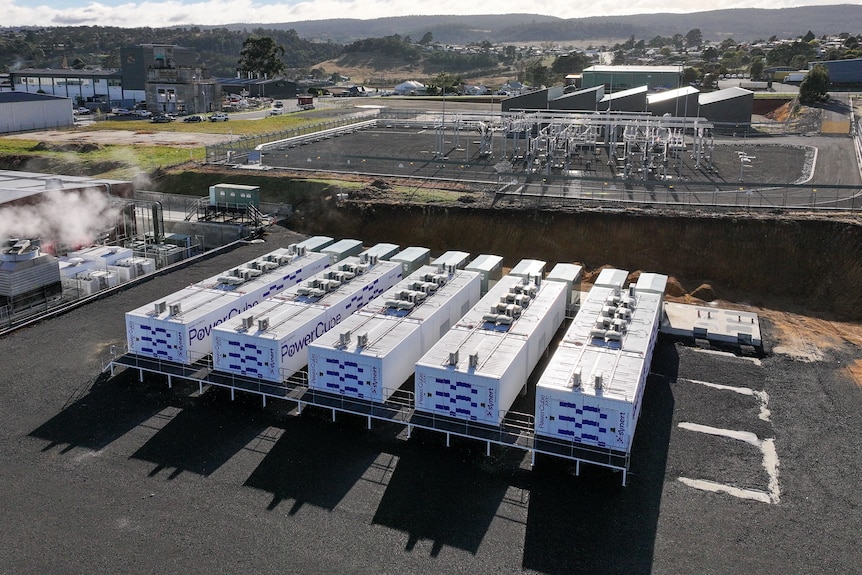
The Firmus Technologies site in St Leonards, showing the backup batteries and electricity substation. (Supplied: Tasmanian government)
Labor shadow treasurer Dean Winter also called for more clarity on “what the government has agreed to” with Firmus.
“To my knowledge, we have not had any announcement about this,” he said.
“You’ve got Boyer, who wants to turn off the coal and transition to electricity and was told ‘we cannot supply you’.”
Mr Winter also referred to Andrew “Twiggy” Forrest’s plan to establish a 250-megawatt green hydrogen plant capable of producing 250,000 tonnes of green ammonia per year, which was abandoned after he was told there was not enough power.
“Instead of hearing an announcement by the government, we had the CEO of Firmus, a Singapore-based company, announcing for Tasmanians, essentially, a new energy policy.
“From Hydro saying there is no power available and they wanted to move away from providing baseline power, they are now saying ‘here is 100 [megawatts].”Unit cost, scope to increase supply, not disclosed
In a joint statement, Aurora said it had “entered into a new three-year Retail Service Agreement (RSA) with Firmus Technologies, supporting the company’s expansion of cutting-edge, energy-efficient artificial intelligence (AI) infrastructure in Tasmania”.
“Under the agreement, Firmus will progressively ramp up its Tasmanian operations from August 2026, increasing to a maximum of 104MW from November 2026,” Aurora’s statement read.
Aurora Energy chief executive Nigel Clark said the agreement “reflects strong commercial value for Tasmania and demonstrates Aurora’s ability to support emerging industries with tailored energy solutions”.
“The partnership with Firmus positions Tasmania as a destination for next-generation digital infrastructure while ensuring strong commercial outcomes for the state. Firmus’ commitment to sustainable, renewable-powered AI aligns with Tasmania’s clean-energy advantage, and we’re pleased to support their growth in Tasmania.”
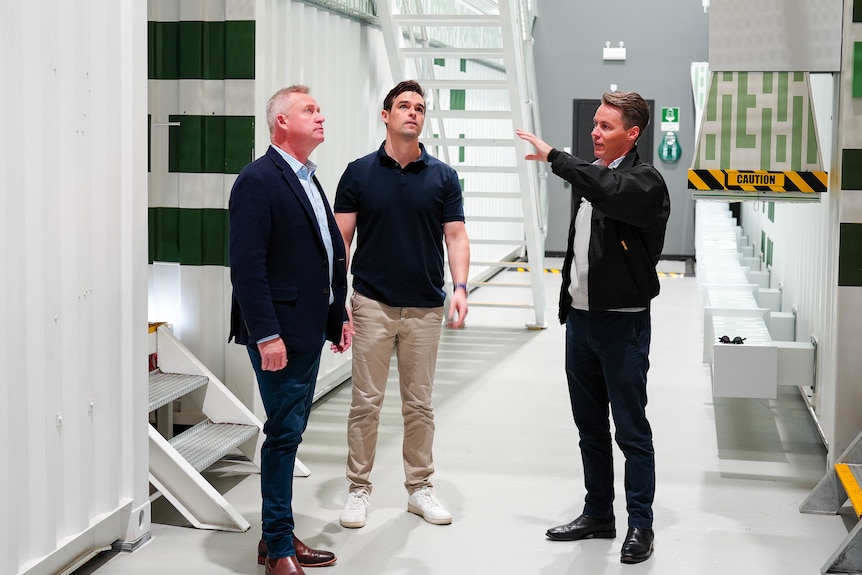
Jeremy Rockliff at the Firmus Technologies facility in Launceston in 2025, with Tim Rosenfield and Oliver Curtis. (Supplied: Tasmanian government)
In the joint statement, Firmus’s Oliver Curtis said “we’re grateful for Aurora’s partnership and for the confidence Tasmania has placed in what we’re trying to build”.
“Ultimately, this is about creating new baseload so that our AI factories are a grid asset, not grid strain. We think that’s how this industry has to operate — and we’re committed to proving it here first.”
Aurora declined to detail the unit cost of power and whether consideration had been given to supplying Firmus with more power going forward, citing “commercial in confidence, given they go to the price and expanded commercial engagement with Firmus”.