
In 1960 Robin Boyd wrote in The Australian Ugliness of the industrial-scale destruction of vegetation that resulted in sprawling suburbs of houses “shorn of porches, shelter and shade,” each sitting in “sterile, shaven neatness on its trimmed lawn.” We have experienced immense societal change in the years since then, yet Australia’s new suburban homes still largely match Boyd’s description. Our average house sizes have also grown ever larger, leaving little space for nature or community connection.
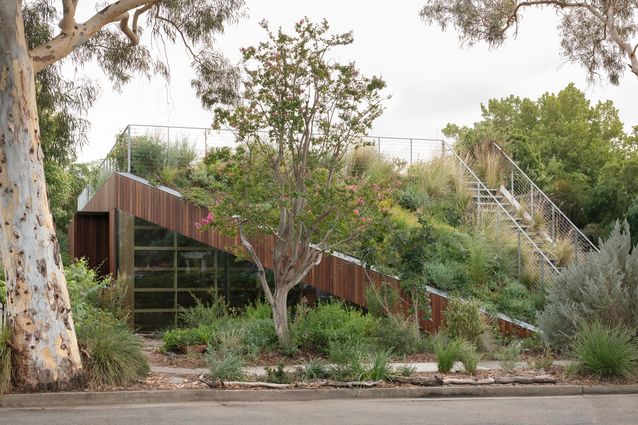
Bank Street House by Prior Barraclough proposes a very different model for Australian suburban life. The deceptively simple yet (quite literally) groundbreaking aim of this project was to make space for garden. The clients had lived on the site in Melbourne’s inner north for years in a large and inefficient double-storey house. After investigating renovation options, and with three sons entering teenage years, they resolved to start afresh to achieve as much garden as possible. Prior Barraclough took this admirable aim to heart, using a planted roof to wrap continuous planting up and over the entire site. As a result, the new single-storey house appears to the all-seeing eye of Google Maps as little more than an overgrown vacant lot. From the street it is almost unidentifiable as a dwelling, with only hints of precise carpentry visible below the hairy green cascade of the roof garden.
View gallery
It is difficult to describe the feeling of arriving on the roof of this house, having climbed up the steel steps from the footpath. You find yourself in a broad and shaggy allotment, a surreal plateau suspended above the nearby fences and rooflines . It is refreshingly uncontrolled up here, a scattered field of veggie patches and native planting, all enthusiastically selected by the client and her mum to promote biodiversity. It is also a credit to the neighbours who supported this unorthodox arrangement, understanding that it could bring benefits to all.
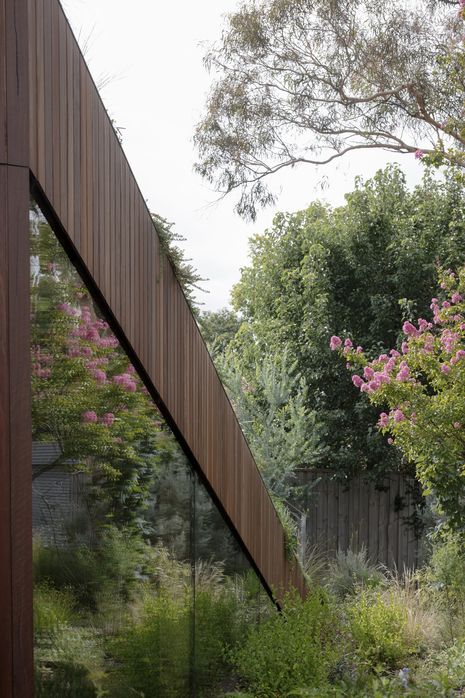
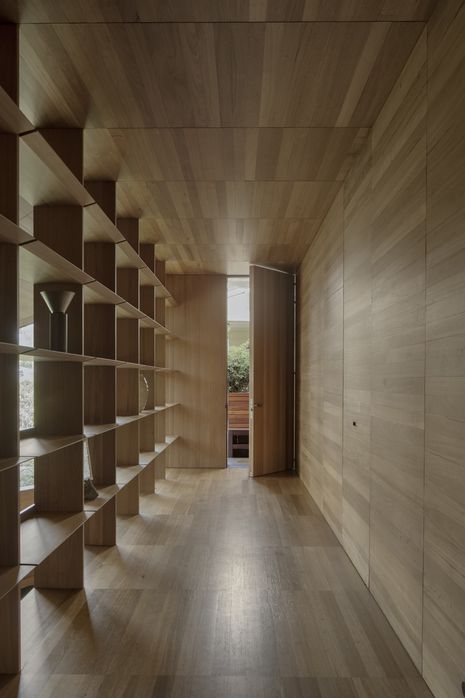
A domestic roof garden of this scale is an exceptional technical achievement. The steel-framed, fibre-cement-lined and membrane-wrapped structure both makes space for planting and provides enormous insulation to the home below. The entire project is testament to an exacting resolution of detail and a builder’s skill. Completely set-out to exact 75-millimetre board widths, the timber-lined interior is constructed from furniture-grade precision carpentry, with consistent refined details integrating all joinery and linings. The custom window assemblies along each side of the house also demonstrate this attention to detail. They are efficiently standardised across every room, allowing a level of resolution, prototyping and fabrication that would otherwise be impossible. Each window combines a fixed, floor-to-ceiling pane of glass, set deep into timber reveals, with discreet interior and exterior sliding shutters that conceal a large insect-screened opening. This level of craft has thoroughly removed visual clutter such as handles, winders, mullions, curtains and blinds, providing a calm and ordered background that comfortably absorbs the chaos of everyday family life.
View gallery
Essential to this project is a compact and well-resolved plan, which has achieved all the project’s ambitions within a smaller footprint. The complex living arrangements of a family of five, plus one very active dog, are distilled into an elegant, 190-square-metre diagram, compared to the approximately 240-square-metre house it replaced.
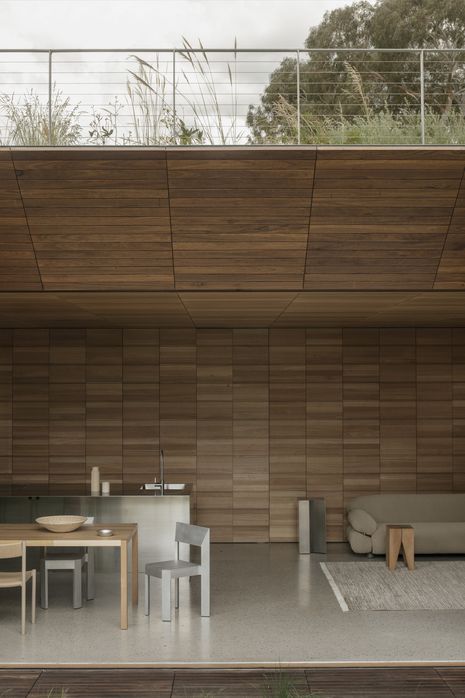
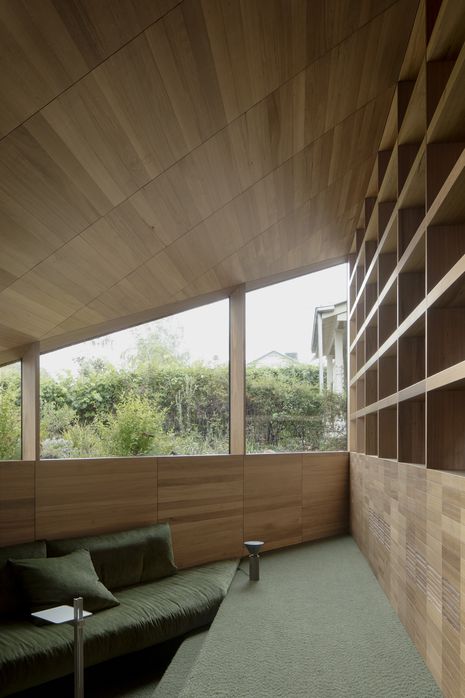
Generosity is achieved by keeping things simple; the largely symmetrical arrangement aligns private rooms either side of a central corridor, bookended by large living spaces to both the north and the south. These are very different in nature: the living and dining room to the north is focused on the wide opening to the sunny backyard, with integrated timber cabinetry and a reflective stainless-steel island used to prevent the kitchen from dominating the space. The family room to the south shares space with the entry and boldly stretches almost to the footpath under the folded roof plane. The floor level here is sunk into the ground, creating a generous and private lounge in a most unexpected location, the large triangular window providing views into tree canopy from the deep green carpet and cushions below.
View gallery
Also important is what is not in this plan: no front fence, no driveway, no garage, no boundary walls and only minimal side setbacks. Some of these may be contentious decisions, but practice co-founder Michael Barraclough notes that the design deliberately resists suburban conventions, instead privileging “openness, restraint, and community connection over domestic excess.”
View gallery
Clarity of purpose is very difficult to maintain in architecture. What starts as a clear diagram becomes easily muddied by time and the struggles of balancing competing demands. Prior Barraclough has successfully navigated these challenges to provide a bold new model for suburban living surrounded by garden.