
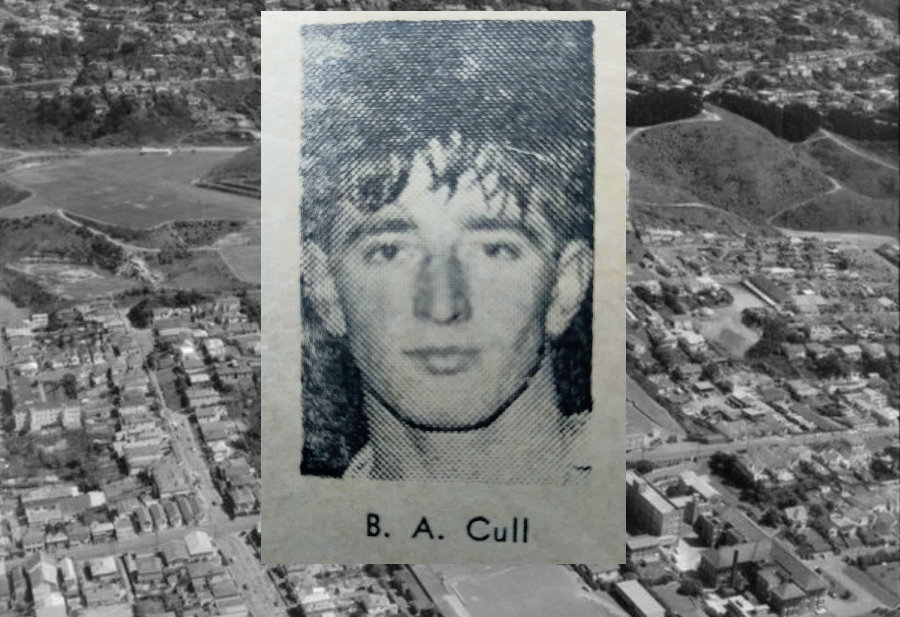
Barry Cull was Wellington’s first choice halfback for several seasons from the second half of the 1950s to the early 1960s.
Cull played for the Athletic club and was a leading player and personality in Wellington club rugby throughout this time in the competition. He was known to have a swift, accurate pass and a sniping running game that often got the crowd on its feet.
Over the course of Cull’s career, Athletic’s fortunes ebbed and flowed, from being a serious Jubilee Cup contender and champions in 1965 in at least a couple of years to struggling down in the Hardham Cup.
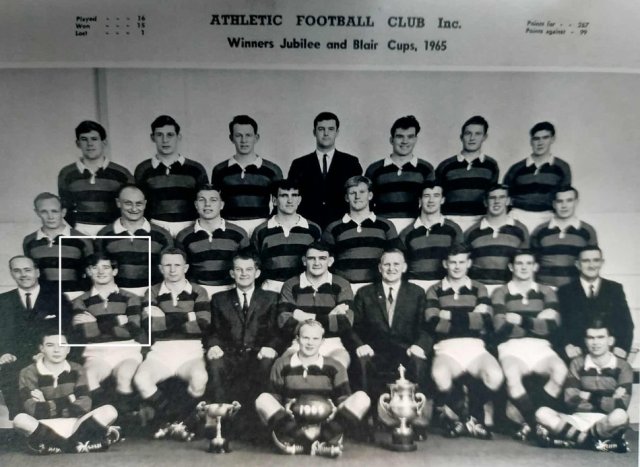 Barry Cull and Athletic – Jubilee Cup champions in 1965.
Cull’s Wellington career intercepted two other of the province’s great halfbacks, coming into the side at the tail end of Alby Makeham’s career and followed by his successor Marist’s Brian Coulter’s from the middle 1960s.
Barry Alfred Cull was born in Birmingham, England on 19 July 1938.
His family moved to New Zealand at a young age and settled in Tauramanui and he was educated at the local primary and high schools and was in the First XV between 1955-57. He also made his Senior club rugby debut for the Tauramanui club whilst still at school.
He played in Tauramanui in 1958 before moving down to Wellington. Cull’s profession was later listed as a school teacher, so he likely joined the teacher’s training college, joining Athletic at the same time and making his Senior A debut for his new club in his first year in 1959.
Athletic had two All Blacks in their side, Nev MacEwan and Russell Watt, and a long-time Wellington lock Dave Harker. They finished fourth in the Jubilee Cup to Petone in 1959.
Cull’s form was impressive. He was not eased into Wellington’s representative side; he was elevated by selectors Jack Taylor, Clarrie Gibbons and Vince Paino into the main halfback’s role and he played 13 times for the side that winter and spring, aged 21.
He made his debut for a Wellington XV against Marlbourough in a 44-0 win in Blenheim on Queen’s Birthday Monday, then five days later made his Wellington A debut in a 10-5 win over Auckland in Auckland. He was halfback inside livewire SPOB back Jimmy Taitoko, while his Athletic teammate Watt further out in the backline scored two tries.
An online article (credited below) picks up Cull’s story:
Cull played 14 times for Wellington that season and the Capital’s faithful grew used to the sight of him spying a gap and exploding through it, keeping his big forwards on the front foot. In the final match of the season against the Centurions club, marking All Black Roger Urbahn, Cull was certainly the classier of the two scrum halves, earning further commendations for his tidy, swift and lengthy transfers and electrifying breaks up the centre of the field, one which resulted in a splendid solo try.
Already he was being talked about as potentially one of the tour half-backs who should be taken to South Africa in 1960. Unfortunately for him, that was not too be.”
On 18 July 1959, Cull was in Wellington’s team that beat Canterbury 20-17, then was selected to play against the British and Irish Lions at Athletic Park on 1 August.
The touring Lions won comprehensively, prevailing 5 tries to nil, 21-6. But the following week’s Rugby Weekly was complimentary of Cull:
“Cull played by far the finest halfback game of any man fielded by a New Zealand team against the Lions. An injury to a rib muscle or ligament just before halftime affected his speed on the break to the extent that he was sometimes caught in possession in the second half, but this rare misfortune scarcely affected the judgement that he looked a played of exceptional promise.”
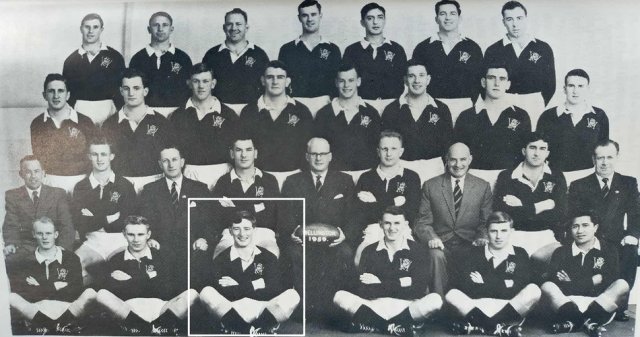 Barry Cull and the Wellington representative team in 1959.
Cull returned to play full seasons for Wellington in 1960, 1961, 1962 and 1963.
In 1960 he played for the North Island side in their annual fixture against the South.
In 1960 and again in the 1961-2 he played in New Zealand trial matches.
Other big games that Cull played in 1960 included their 19-6 away win over Taranaki (Cull scored a try in that game), 11-6 home win over Waikato, 17-6 away win over Otago (another try to Cull), 27-18 over Auckland at home and 33-11 victory over Hawke’s Bay at Wellington. Cull was also Wellington’s only try scorer in a return 9-22 loss to Auckland which was also a Ranfurly Shield challenge.
In May 1963 he played his second international fixture for Wellington, in a 14-9 loss to England.
In 1964 Bill Freeman took over the reins of the side as sole selector-coach and made some changes to the squad, such as launching the career of teenaged flanker Graham Williams. This included selecting Marist halfback Brian Coulter who was a year younger than Cull and who had moved up to Wellington from Canterbury in the off-season.
Cull’s Wellington career was over – having played 60 matches in five seasons and with the impressive strike rate of 15 tries.
For his club Athletic had been fourth in the Jubilee Cup in 1958, and Cull helped them improve to second equal with Marist in 1959 with a record of 11 wins, four losses and a draw.
They slipped to ninth in 1960 and settled for being Hardham Cup champions in 1961, and then struggled down in 11th in 1962.
But their fortunes climbed again in 1963. They were in contention for the Jubilee Cup but lost on the last day of the season to Marist and finished third.
An eighth placed finish in 1964 then gave way to Cull and Athletic winning the Jubilee Cup in 1965. The team clicked all year and they won 15 and lost one of 16 competition games, scoring 268 points and conceding just 99.
A Dominion review by Alex Veysey of their season, had this to say about Cull:
“Cull at halfback seemed to thrive with the burdens of representative rugby off his shoulders. In these past two seasons he has looked a player with a new dimension, a new maturity to salt his undoubted brilliance.”
That was the high-water mark of Cull’s Wellington career. He soon shifted home to Tauramanui and made five appearances for King Country in 1968. This was followed by another eight appearances for the Rams in 1969. He also played in another Ranfurly Shield match on 9 August 1969, in a 19-16 loss to holders Hawke’s Bay.
As well as being a teacher, later became a sports commentator in Taumarunui.
References:
Like this:
Like Loading…
Related
Discover more from ClubRugby.nz
Subscribe to get the latest posts sent to your email.