
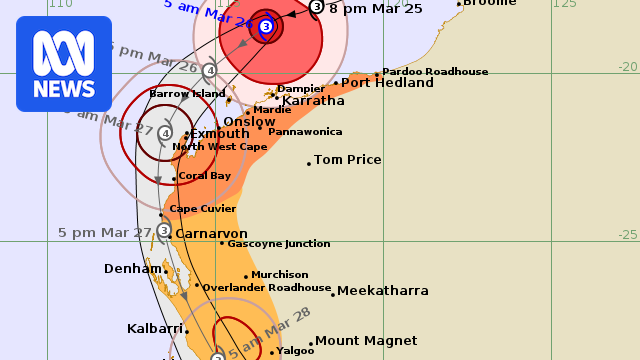
Residents along Western Australia’s Coral Coast are being urged to prepare, while tourists have been asked to leave the area as Tropical Cyclone Narelle increases to a category four system.
The system has been moving south and parallel to the coastline for most of this week and is expected to make landfall on Friday night or early Saturday morning on the Gascoyne coast.
Bureau of Meteorology senior forecaster Angus Hines said the Pilbara coastline was already seeing the effects of the cyclone.
“A severe category three tropical cyclone is a very powerful weather system,” he said.
“It’s estimated that the wind speed around the destructive core of Narelle could be sustained winds of about 150km/h with gusts up to 200km/h.”
Mr Hines said Narelle would likely cross the coast as a severe category three tropical cyclone.
“The current forecast shows this crossing location as most likely to be on the Gascoyne coast, somewhere between Carnarvon and Kalbarri, potentially around the Shark Bay and Denham area,” he said.
“This will mean destructive winds and a dangerous storm surge around the crossing area late on Friday and into Saturday.”
Residents in the Pilbara city of Karratha were preparing for the extreme weather by sandbagging on Wednesday afternoon.
The cyclone originally formed in the Coral Sea off Australia’s east coast, before causing flooding across the Northern Territory as it moved west.
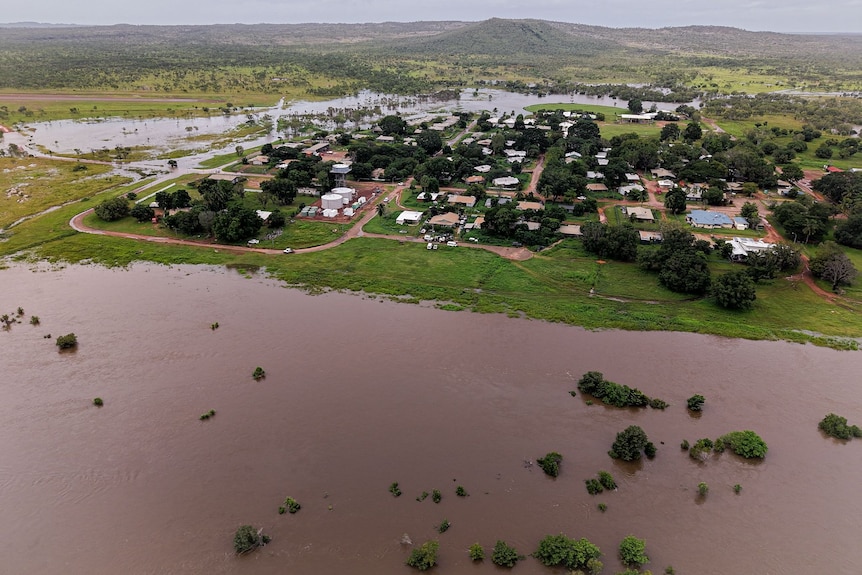
Kalumburu was inundated with rain from the system before it re-intensified off the WA coast. (Supplied: Samantha Wright.)
After dropping to tropical low status, Narelle re-intensified into a category one cyclone off the Kimberley coast in WA’s north on Wednesday morning, before moving in a southerly direction.
Cyclone and fuel supply problems
Shark Bay supermarket owner Jenny Douglas said they were fully stocked with food due to the upcoming Easter holidays; however, the lack of tourists and supply of diesel was concerning for her business.
She said Shark Bay and nearby Monkey Mia both relied on diesel for their power stations.
“We do have wind turbines, but they’re not 100 per cent reliable, so we do have a power station that struggles at the best of times, so we need fuel to keep that power station up,” Ms Douglas said.
“If we don’t get our tourism up and running, then we’ve outlaid a fair bit of cash and are not sure how we’re going to go.”
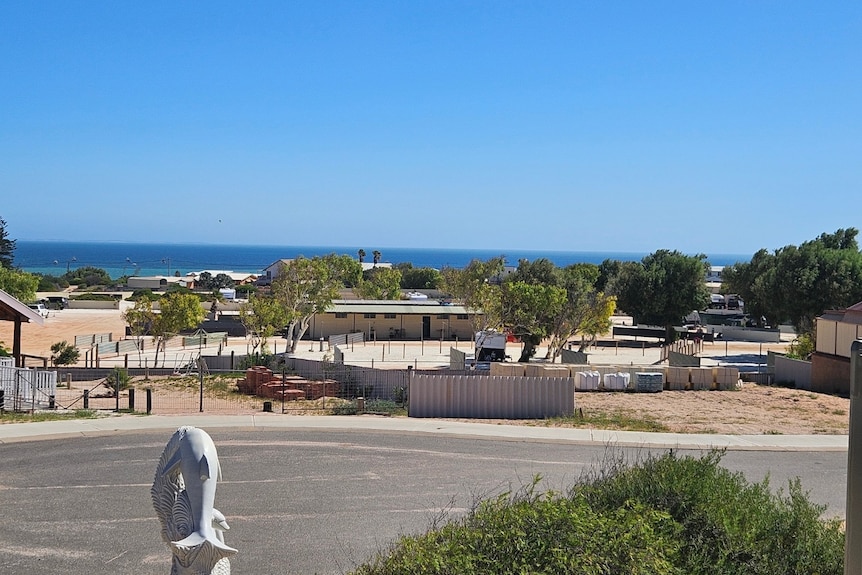
Tourists have left the Shark Bay Caravan Park before the cyclone arrives. (Supplied: Greg Ridgley)
Brad Gregory, who runs Exmouth Fuel Supplies, said he recently secured a supply and was confident it would be enough to last through the cyclone.
He said he had been flat out with people filling up before the system neared Exmouth tomorrow.
Petrol stations were busy and jerry cans in hot demand in and around the town, as convoys of cars towing caravans and boats began their journeys inland to escape Narelle’s path.
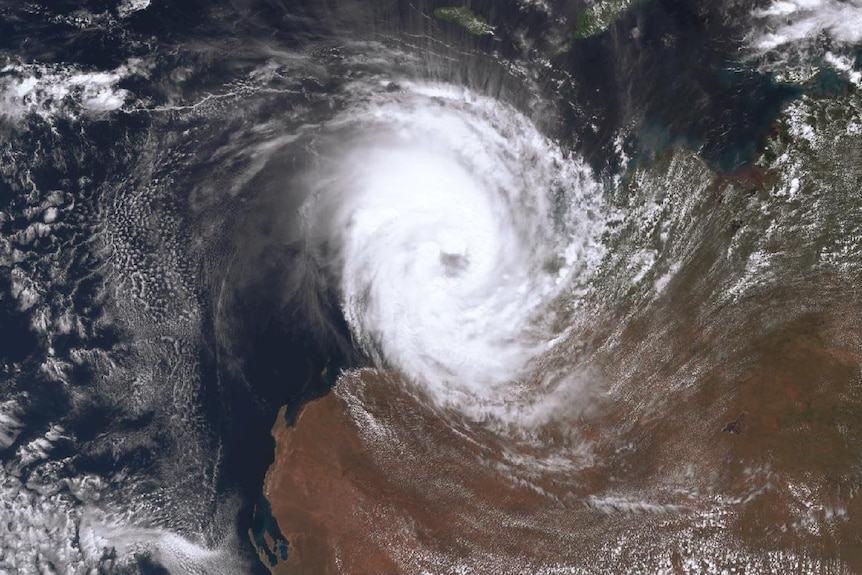
The latest satellite image of Tropical Cyclone Narelle. (Supplied: Bureau of Meteorology)
Southern homes are not ‘cyclone rated’
In Geraldton, about 155km south of where the Cyclone could make landfall, a local building surveyor said most homes there were not designed to withstand extreme winds.
While newer building codes required homes to meet higher wind ratings and cyclonic standards, many existing houses, particularly older builds or those with poor workmanship, remained vulnerable, Chadwick Barron said.

Chadwick Barron is a private building surveyor based in Geraldton. (ABC Midwest & Wheatbelt: Chris Lewis)
Many homes in Geraldton are non-brick and were built in the 1960s and 70s.
Mr Barron warned that flying debris was one of the biggest risks, often leading to broken windows and increased internal pressure that could result in roof failure.
Loading…
Construction issues and unsecured materials often worsened damage seen in places like Kalbarri during Cyclone Seroja.
Mr Barron said people should secure or remove all loose items around their home, reinforce fences where possible and protect windows.
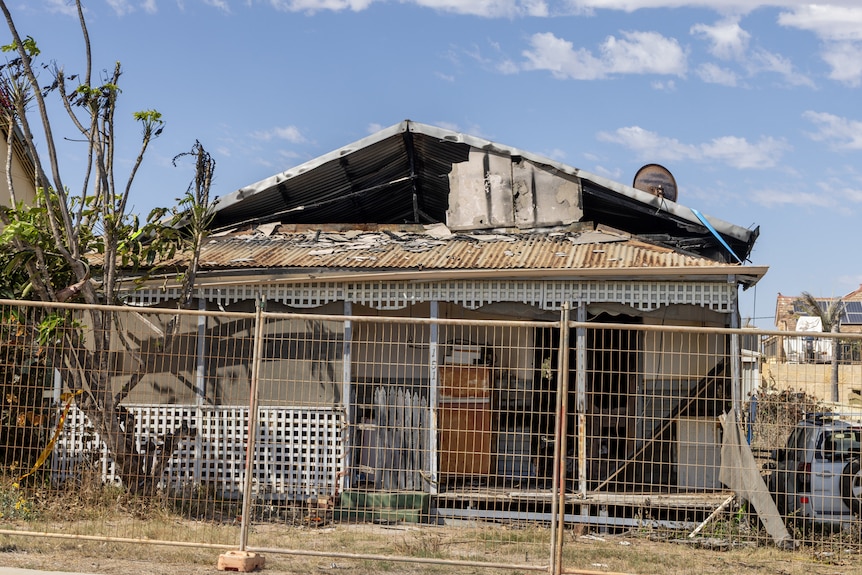
Already-damaged homes could generate dangerous debris as a result of the cyclone. (ABC Midwest & Wheatbelt: Chris Lewis)
If sheltering in place, people should stay in a small, central room away from external walls and openings.
However, he stressed that in the event of a category two or three cyclone, evacuation was often the safest option, especially in older or less structurally sound homes.
Drawing on his own experience, Mr Barron said he would leave early with his family rather than risk staying, emphasising that property could be replaced but lives could not.
Fuel supplies ‘touch and go’
Thirty kilometres south of Geraldton, the S-Bend service station and caravan park ran out of diesel for most of Wednesday.
Local employee Wendy Butterworth said it had run out of fuel at least four times in recent weeks, and it was vital they were resupplied as wild weather approached.
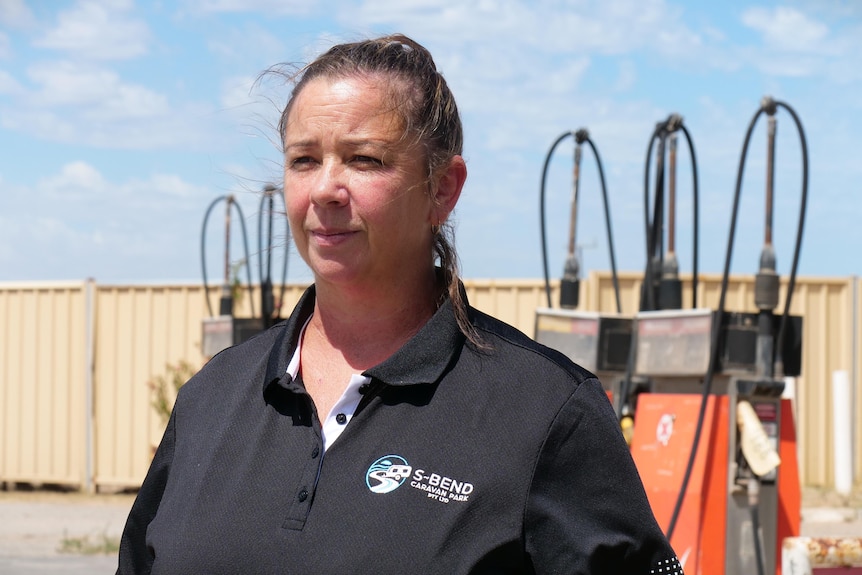
Wendy Butterworth says Mid West locals are stocking up on fuel to run generators. (ABC Midwest & Wheatbelt: Chloe Henville)
Ms Butterworth said the station’s first emergency fuel request this week was denied.
“We had to really plead, to say that we’re in the position where we’re the only outlet that can supply fuel in the 60-kilometre radius.”
She said the supplier “gave in” but could only provide half of what the fuel station needed.
It would be “touch and go” if the allocation would last, she said, as Mid West locals stocked up to run generators in anticipation of extended power outages.
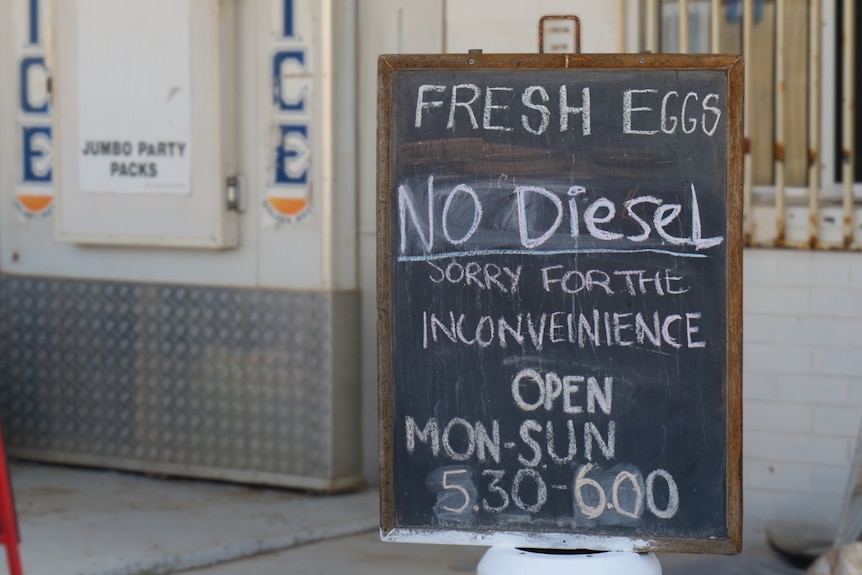
The S-Bend service station is hoping to receive more diesel before the area feels Narelle’s impacts. (ABC Midwest & Wheatbelt: Chloe Henville)
“I think if we stick to just supplying locals, I think we’ll be OK.”
Ms Butterworth said the caravan park had not yet seen many cancellations and staff were trying their best to keep travellers informed.
There was one man at the campground in a tent who was planning to stay during the cyclone, she said.
“We’re making plans to make him more comfortable and safer.”Caravan park and campsites cleared
Exmouth’s caravan park and nearby campsites were mostly cleared on Wednesday, with a few stragglers planning to hit the road this morning.
Shire President Matt Niikkula told about 160 people gathered at an emergency preparedness meeting on Wednesday afternoon that the only safe way to leave is inland.
He said there was a fair chance anything north of Nanutarra would be closed tomorrow, but Nanutarra itself had ample fuel, as did Tom Price and Paraburdoo, where Cheela Plains Station is hosting evacuees.
Mr Niikkula said Cyclone Mitchell had just been a practice run compared with what was to come.
“This is shaping up a little bit more like the real thing,” he said.
For those staying in town, an evacuation centre will be set up at the town hall from 11am today. Pets will not be allowed inside the evacuation centre.
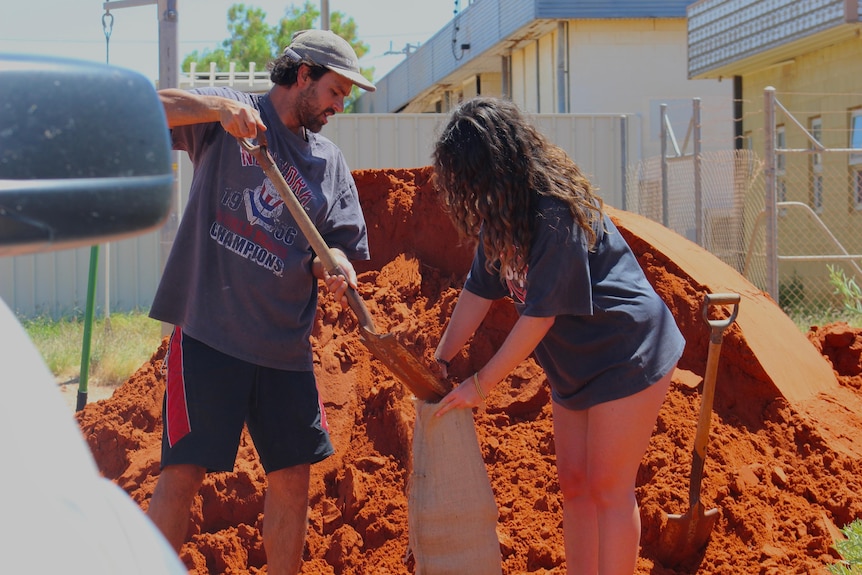
Residents in Exmouth prepared sandbags on Wednesday. (ABC News: Bridget McArthur)
DFES deputy incident controller David Cowdell reiterated Mr Niikkula’s advice to head inland.
“Heading south is risky … you’re basically going to be running ahead of it and you’re going to have to keep moving,” he said.
Mr Cowdell, who is also the West Pilbara’s district officer for natural hazards, said the location and intensity of the centre remained uncertain.
He said that once destructive winds were within 12 hours of Exmouth, an emergency warning would be issued — potentially earlier if that was expected in the middle of the night.
Mr Cowdell assured people that DFES had sufficient fuel to maintain its emergency response across the state.
As locals wait to see how things play out, he urged them to secure all loose property and take any rubbish that could become airborne to the tip before midday.
“The wind is the main risk that we’re worried about right here.”
Schools in Exmouth are expected to be closed tomorrow.