
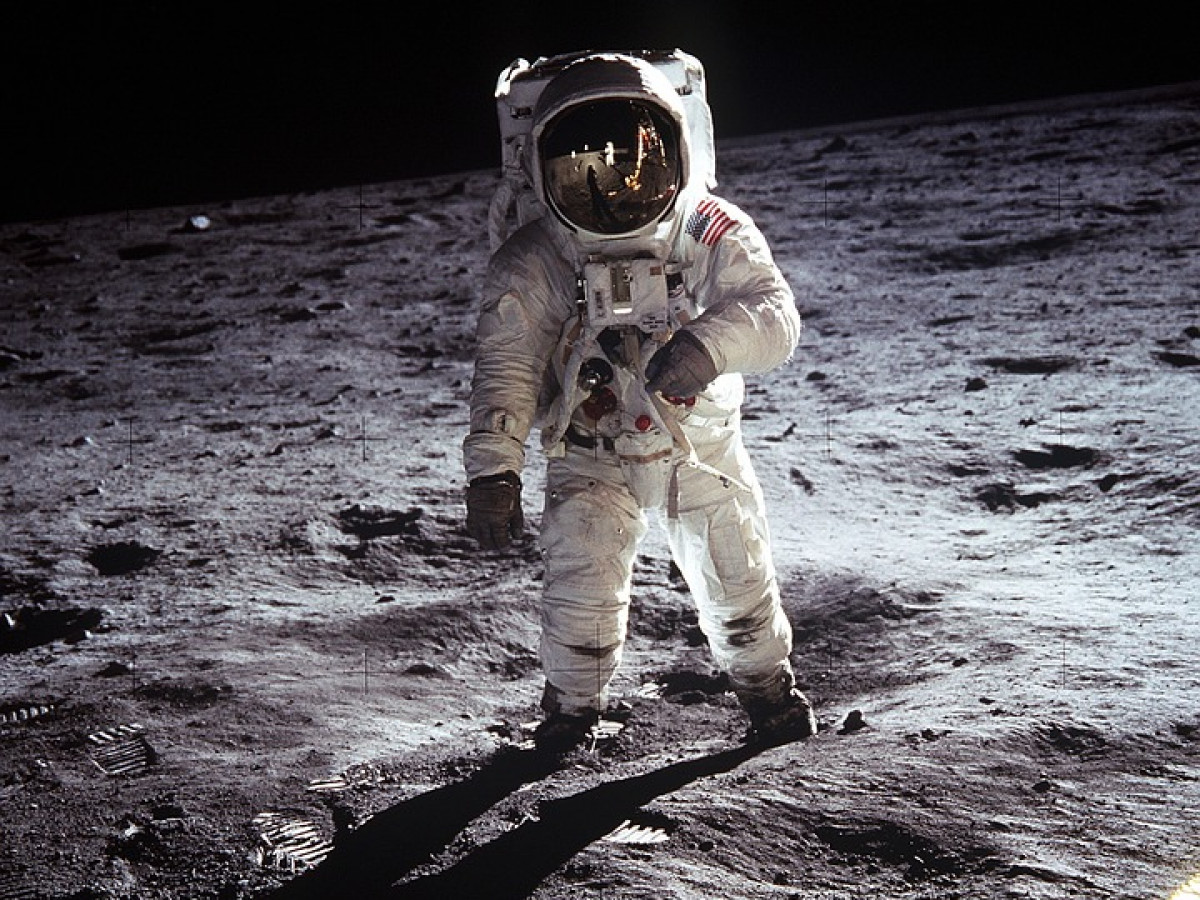
“That’s one small step for man, one giant leap for mankind.”
Absolutely remarkable, and it still is every time you hear it. But the race to the Moon isn’t just grainy archive from the Apollo missions. It’s happening right now between the United States and China, with both superpowers pushing the limits of technology, engineering, and human innovation in a bid to get there. The missions are expensive and require mastering rockets, navigation, and pinpoint landings. And things won’t get much easier once we are on the lunar surface, where astronauts will need to build habitats that shield them from radiation, temperature extremes, and even sharp sand. Then they’ll need food to fuel crews and keep them healthy in low gravity. Today, we explore the science of getting to, living on, and even farming on the Moon, and why we’d even want to go there at all. And this is where our first guest, Megan Argo, podcaster and reader in astrophysics at the University of Lancashire brings Chris Smith up to speed…
Megan – There was this big space race between America and the Soviets, who would get there first, and we’re now in a new epoch of that space race. There are minerals on the Moon, which could be commercially useful if we can figure out a way to extract them simply, and there’s also water deposits up there as well. So if you’re going to send humans up there to have a long-term base for resource extraction, you’re going to need to keep those astronauts safe. So they’re going to need a habitat that’s going to protect them from the harsh radiation environment of space; there’s no atmosphere on the Moon. So our atmosphere protects us here on the Earth from a lot of the nasty stuff coming from space; you don’t have that on the Moon, so you have to protect your astronauts in a different way. But if we can extract those resources, if you can extract water, you’ve got water for your astronauts, but you can also manufacture rocket fuel, and that’s much, much cheaper than sending fuel from the Earth to replenish what your astronauts need up there.
Chris – So you’re regarding the Moon very much as a staging post for further exploration, and also things like science, actually doing science there as well. So it’s not so much just because it’s there, we want to go and study it, or we want to exploit it. We can actually use it as a jumping-off point.
Megan – If your ultimate goal is to go and send humans to Mars, because nobody’s been to Mars yet, and there’s a lot of people who would love to go if they got the opportunity, and lots of countries would like to go there with people. If you’re planning to send humans to Mars, that is a much, much more significant undertaking, both in terms of the timescales, the time it takes to get to Mars, because remember, getting to the Moon only takes a few days; getting to Mars takes many months in a spacecraft. So you’re talking about much longer mission timescales. Mars has something of an atmosphere, but it’s not a very thick atmosphere. So again, a lot of those problems that you have to deal with on the Moon, if you can learn to deal with them on the Moon, where you’re relatively close to the Earth, and you can have a rescue craft, you know, standing by in orbit, should you need it. If you can test your systems, test your procedures in that relatively safe environment, it’s not a safe environment, but relatively speaking, it’s safer than going to Mars. If you get all of that right on the Moon, then when you do get the opportunity to go to Mars, you know that a lot of your systems, a lot of your procedures are going to work.
Chris – What’s the environment like on the Moon? So if we were thinking ahead and we wanted to build bases there, what sorts of threats or risks would people living there have to live with, or would we have to make sure we’d mitigate it?
Megan – There are a lot of risks. We think of the Moon as a fairly static environment. It’s actually not. So the Moon, it goes through a day-night cycle like we do on the Earth. Our day-night cycle is 24 hours. On the Moon, it’s a month. So you get two weeks of Earth time in daylight and then two weeks of darkness, and that results in temperature extremes. So you’ve got to make sure all of your electronics can cope with the high temperatures during the lunar daytime and the very, very, very cold temperatures of a lunar nighttime, and a lot of spacecraft die during the lunar night. Their batteries just don’t come back to life when daylight comes again. So you’ve got to make sure that everything you’re sending can cope with those temperature extremes, and that includes things like the seals on your habitats. You don’t want them flexing too much in this day-night cycle and then breaking. You’ve also got the dust. Dust on the Moon is really, really sharp. On the Earth, if you go to the beach and pick up a handful of sand, you look at it, and that sand is rounded. It’s been weathered. It’s been hit. It’s been moved around by waves over many, many hundreds, thousands, millions of years, and it’s been eroded. So you look at it, and it’s got rounded corners. It’s still sharp, but it’s nowhere near as sharp as the dust that you get on the Moon’s surface, where there is no atmosphere, and there is no weathering. So those little sharp bits of rock stay sharp, and what the Apollo astronauts found was that had huge problems in terms of what it did to their spacesuits. It clung to the spacesuits. It gets electrostatic. It gets charged as well. So it sticks to things in the same way that static electricity causes your hair to stick to things, and when that happens, and it gets caught in things like the creases, so anywhere where your arms flex, your legs flex, or behind your knees, any of those creases in the human body, with a spacesuit, with dust gets into those creases, it can damage the fabric. It can make holes in the spacesuit. And again, that’s really not what you want in an environment where there’s a vacuum outside your spacesuit. It gets into Velcro, stops Velcro working properly, and it can get into seals, and it can damage all kinds of tubes that flex as well and damage your electronics because of the electrostatic. So it’s going to be a huge problem. And again, something that’s an issue on Mars, too. So again, if we can learn to deal with it on the Moon, then we’re better prepared when we go to Mars. And then you’ve got other issues as well. We know from Lunar Reconnaissance Orbiter, for example, which has been taking photographs of the lunar surface for more than 15, 20 years now, that there are routine impacts on the Moon’s surface even today. There are small bits of rock that hit the Moon’s surface and cause new craters. That’s something you’re going to have to protect your manned base from. And then we now know also that the Moon does have some seismic activity. There are some moonquakes, if you like, that happen on the lunar surface, and there is evidence, again, from Lunar Reconnaissance Orbiter data, that there are new scarp features that open up on the Moon’s surface from time to time, where the surface slips and we get sort of small tectonic activity. Not tectonic plates like we have on the Earth’s surface, but still, it’s enough if you have a new fracture that opens up near your habitat, it potentially puts your astronauts in danger. And one last one, I guess, that’s really important to factor in is that there are significant amounts of cosmic rays on the Moon’s surface. Our atmosphere here on the Earth protects us from a lot of the most damaging cosmic rays, but once you go out past the Earth’s atmosphere, they’re going to be exposed to a lot of this high-energy radiation.
Chris – Talking to other space commentators and so on, they all say when they were young, they dreamed of being an astronaut. And then when they saw the harsh reality of what it would really involve, they changed their mind. Would you go?
Megan – I think I would like to go. I’m not sure I want to go there for six months, but I certainly would like to go and visit just to appreciate the view and standing on another solar system object. I think there would be something really quite exciting about that.