
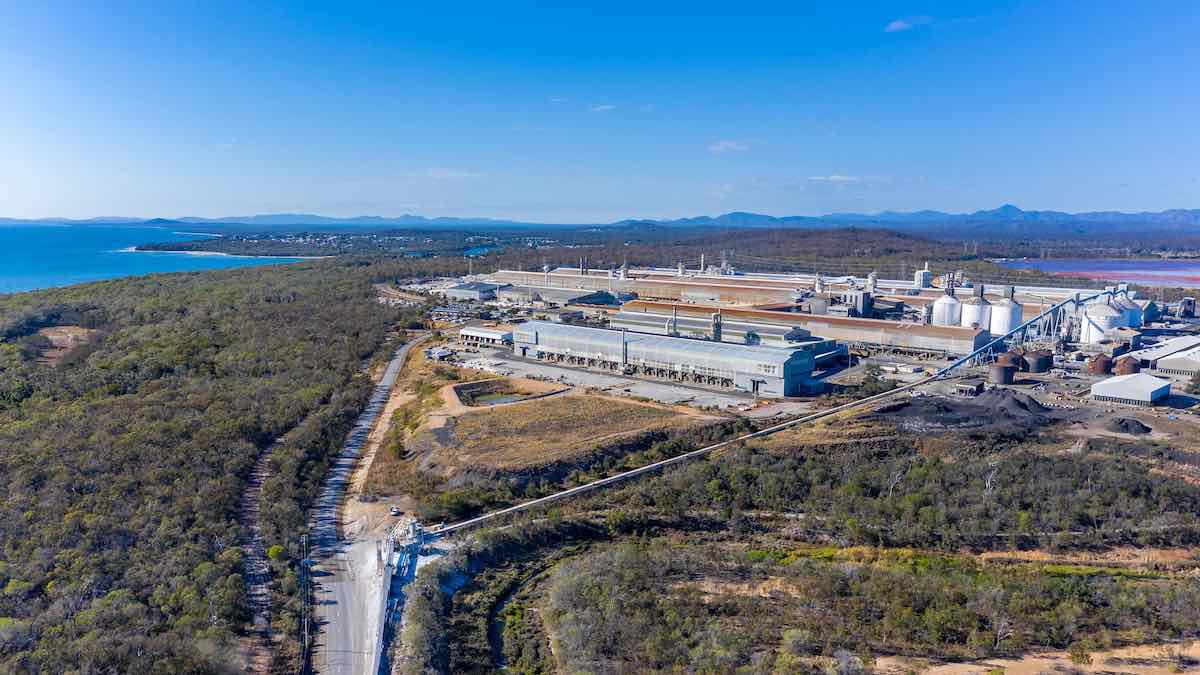
Australia’s second-largest aluminium smelter has been extended a $2 billion lifeline from federal and state governments, in a deal that will keep it running until at least 2040 and underpin $7.5 billion of new renewable energy generation and storage investment.
The federal Labor and Queensland LNP governments on Wednesday announced they will invest $1 billion each over 10 years – from 2030 to 2040 – to support the long-term future of Rio Tinto’s Boyne aluminium smelter in Gladstone.
For its part in the deal, Rio Tinto has committed to underwriting $7.5 billion of new wind, solar and battery storage development in the once coal dominated Gladstone region, which it will contract to supply the smelter’s energy needs through power purchase agreements (PPAs).
In its own media release, Rio said that in addition to previously announced PPAs, it has agreed to buy 40 per cent of the output from Lightsource bp’s Lower Wonga solar and battery project near Gympie, equivalent to 112 megawatts (MW) of solar, and three hours duration of storage.
“This is a story, here, from the federal government, about driving investment into our energy system,” federal minister for industry and innovation Tim Ayers told reporters on Wednesday.
“This facility … is at the centre of an industrial ecosystem that supports thousands of jobs, hundreds of businesses and builds our industrial capability overall as Australia makes Australia stronger and more resilient.
“It is a slam dunk, the economic case for this investment: It’s good for productivity, it’s good for economic resilience, it invests in electricity generation, it drives costs down, lifts productivity up, and makes Australia stronger.”
The future of the Gladstone smelter, which directly employs around 1,000 people in the region and is Queensland’s biggest single energy users, has been on “thin ice” for years, according to Rio Tinto, as it struggled to remain economically competitive in a decarbonising global market.
The 1,680 megawatt (MW) coal-fired power station that currently supplies the smelter – and which began operations in 1976 – is slated to close in 2029, at the same time as the current lot of power contracts for Rio’s Boyne smelter and Yarwun and Queensland alumina refineries expire.
Federal Coalition MPs, including the new leader of the National Party, Matt Canavan, have argued loudly and often that only coal can keep smelters like Boyne alive, and that it is the shift to renewables that is causing their demise.
But the smelter’s owner clearly has a different view, and it now appears that the state LNP – which has ripped up renewable targets and threaten to “call in” some of the Rio contracted projects – is now agreeing to support it, knowing it cannot afford to lose the state’s biggest electricity user and one of its biggest employers.
“This announcement backs in the thousands of Queensland workers that rely on smelter and gives industry the certainty it needs to invest in the region,” said the state’s minister for natural resources and mines, Dale Last.
“At a time when supply chain disruptions are being felt across the globe, this investment is needed now more than ever to safeguard Queensland’s sovereign manufacturing capabilities, and to build national resilience and international competitiveness.”
Rio Tinto – despite the streamlining of its decarbonisation division, announced earlier this week – has been very clear about no longer needing or wanting the expense of powering its generators with ageing and increasingly unreliable coal-fired power.
According a 2019 University of Queensland report, the Boyne smelter has a load of around 1000 MW and uses around 8 terawatt-hours (TWh) of electricity a year, the vast majority of which (810 MW) is supplied under a long-standing PPA with the Gladstone power station that is subsidised by the state government.
It suggests that the subsidy for renewables – $ 200 million a year – will be less than the discount it has received for using fossil fuels.
It was estimated by the report’s authors that the aggregate price paid by the smelter was heavily subsidised by the state, at less than $50/MWh – “significantly lower” than the then average spot price of $103/MWh, as reported by the Australian Energy Market Operator (AEMO).
“As fossil fuels become increasingly expensive, this investment, combined with the power purchase agreements we have already signed, positions Boyne to be among the world’s first aluminium smelters underpinned by solar and wind power,” Rio Tinto aluminium and lithium chief Jérôme Pécresse said in a company statement on Wednesday.
“It also ensures heavy manufacturing like aluminium smelting can continue in Gladstone for the long term and preserves one of the few fully integrated aluminium value chains in the world – from bauxite mining to alumina refining to aluminium smelting all in Queensland – as demand for aluminium continues to grow with the energy transition.”
Already, the mining giant has signed a massive solar and battery storage deal with Edify Energy for a 600 MW / 2,400 megawatt-hour (MWh) battery and 600 MW of solar from the Smoky Creek and Guthrie’s Gap solar farms, and has PPAs with the proposed 1.4 gigawatt (GW) Bungaban wind farm and 1.2 GW Upper Calliope solar project.
With the new Lightsource bp deal announced today, this brings total Queensland renewable power contracted by Rio Tinto to more than 2.8 GW, the company says, and 600 MW of storage.
In comments on Wednesday, Rio Tinto’s managing director of Pacific operations, Armando Torres, said all parties involved in the new deal had “worked very hard for many years” to secure the Boyne smelter’s future with cheap, green power.
“This smelter is important for the supply chain and finding an energy solution that moves us to a transition [to] renewables is not simple,” Torres told reporters at a doorstop interview.
“So, for us to find that solution that we’re announcing here today was a tremendous work from Queensland, from federal [government], from our teams, really to find a solution that that’s going to be quite a transformational solution for the smelter to be using renewable energy.
“Under this complex and difficult solution … we have a strong commitment for several projects that will be in development, and our contracts will be [for] at least 20 to 25 years.
“So, there’s a solution, strong commitment from Rio Tinto, strong commitment from the state of Queensland, strong commitment from Commonwealth.”