
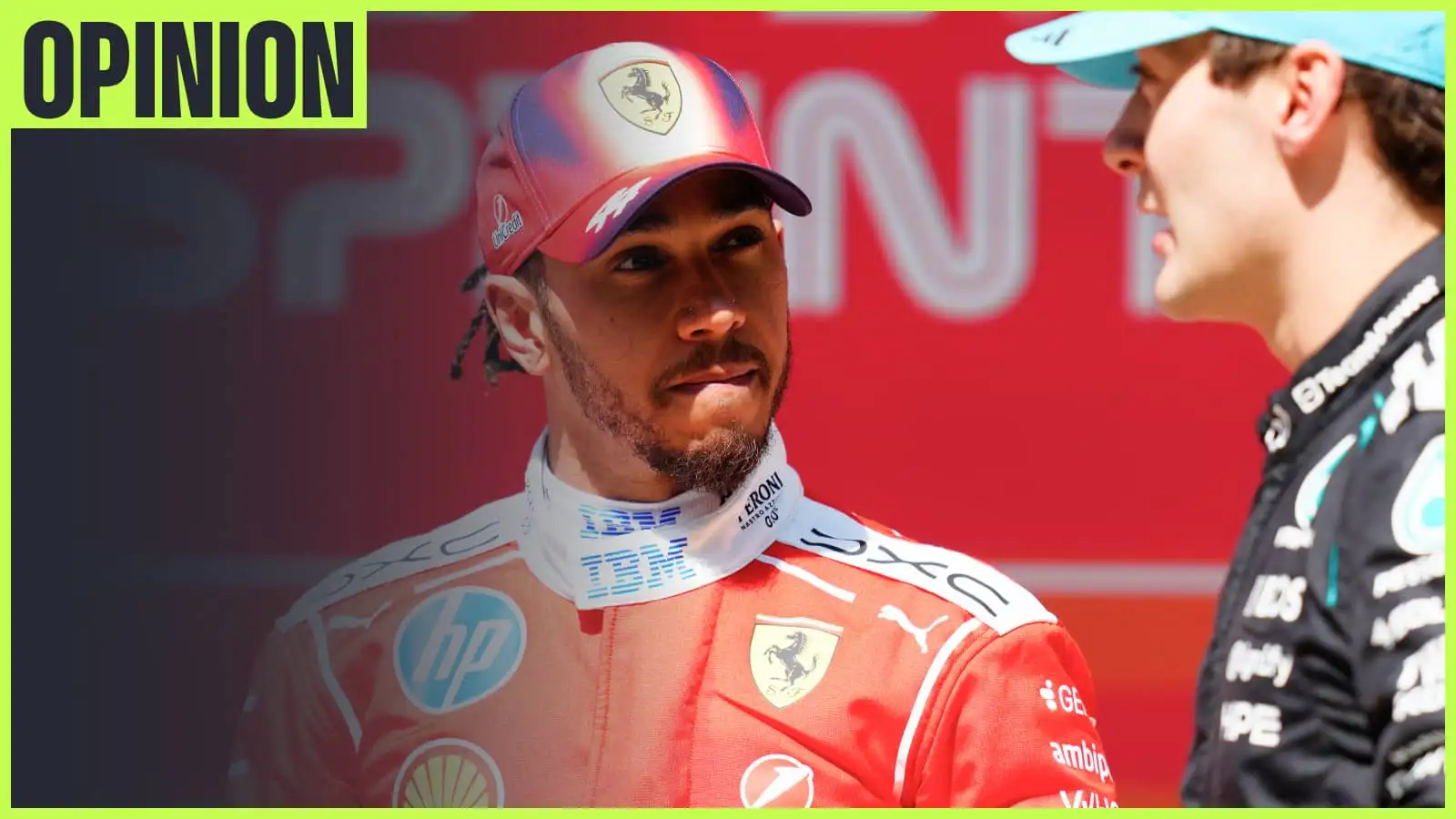
So where do you stand on the F1 2026 rules after two races of the new season? Are you on the side of Max Verstappen, who actively dislikes what the new cars ask of him, or do you agree with Lewis Hamilton that the racing is better than ever?
Hamilton’s battle with George Russell at the recent Chinese Grand Prix appeared to confirm that the new regulations are all style and no substance…
How Lewis Hamilton vs George Russell exposed the big weakness of F1 2026
A version of this article originally appeared in PlanetF1.com’s conclusions from the 2026 Chinese Grand Prix
Want more PlanetF1.com coverage? Add us as a preferred source on Google to your favourites list for news you can trust
In Australia, it was Formula Net Zero. In China, it was the “battery world championship.”
Credit for that one goes to a Mr F Alonso, who has a career in journalism to fall back on if the whole racing thing doesn’t go to plan.
There was talk of a better representation of the 2026 rules as the calendar moved from Australia to China and to a circuit with fewer energy demands.
Yet, ultimately, all of the holes in the regulations that appeared in Melbourne were still present and incorrect last time out in Shanghai.
Super clipping, which as many have pointed out over the last few weeks is anything but super, is here to stay, permanently stripping the world’s great corners of their challenge.
Go deeper: The problems with the F1 2026 rules
Formula Net Zero: F1’s soul is being destroyed by the 2026 rules
Bring back V10s? The F1 2026 rules are a step too far
And the racing, entertaining though it is at times, is riddled with the sort of gimmicky shallowness you would typically find in Formula E, recently described in these pages as the form of motorsport for people who do not like motorsport.
Exhibit A: the battle between George Russell and Lewis Hamilton in the opening laps of Saturday’s sprint race in China.
It looked great on the YouTube highlights videos and the Instagram reels.
Yet strip away the superficiality and, like Russell’s duel with Charles Leclerc in Australia, once again there was nothing more to it than the ebb and flow of energy management.
For lap after lap George would deploy his battery to nip past on the back straight… and Lewis would use his to get him back into Turn 1.
And that’s fine if you get your kicks out of the simple sight of one car going in front of another.
But for those who like a little driver skill to go with their motor racing?
There’s not much left here. It’s the very definition of style over substance.
Before F1 went big time a few years ago, Drive to Survive would take its content from whatever the on-track action produced and make the best of it.
Since 2021, though, there has been a creeping sense that the tail is wagging the dog, that the racing now exists primarily to advance the Drive to Survive narrative.
This is the sort of warped thinking that results in Insta-friendly highlights, an increased number of sprint races and shorter grand prix distances tailor-made for short attention spans, an idea floated by Stefano Domenicali, the Formula 1 chief executive, last year.
And so the thought occurred when the highlights reel ended on Saturday morning in China: what if the 2026 rules aren’t some great misstep after all, but instead part of the plan?
What if this is exactly what they – the powers that ought not to be – actually want?
And what they think F1 in the mid-2020s should look like?
Now that would be the real worry.
FIA makes welcome energy tweak for Japanese Grand Prix
It is one thing to turn the Turns 9-10 chicane at Albert Park and Turn 7 in Shanghai into charging stations.
It would have been a different matter entirely had the 2026 cars resulted in all those great corners at Suzuka losing their lustre.
So the FIA should be applauded for seeing a PR disaster coming and making a change to the energy management requirements for qualifying at the Japanese Grand Prix.
A statement issued to PlanetF1.com by the FIA on Thursday read: “Following discussions between the FIA, F1 teams and Power Unit Manufacturers, a minor adjustment to the energy management parameters for Qualifying at the Japanese GP has been agreed with the unanimous support of all Power Unit Manufacturers.
“To ensure that the intended balance between energy deployment and driver performance is maintained, the maximum permitted energy recharge for Qualifying this weekend has been reduced from 9.0 MJ to 8.0 MJ.
“This adjustment reflects feedback from drivers and teams, who have emphasised the importance of maintaining Qualifying as a performance challenge.
“The FIA notes that the first events under the 2026 Regulations have been operationally successful, and this targeted refinement is part of the normal process of optimisation as the new regulatory framework is further validated in real-world conditions.
“The FIA, together with F1 teams and Power Unit Manufacturers, continues to embrace evolutions to energy management, with further discussions scheduled in the coming weeks.”
Will this change suddenly result in the cars being able to run at full chat for an entire lap? Time will tell.
Yet this is at least an acknowledgement that the sustainable 2026 regulations have so far proven to be anything but.
Want to be the first to know exclusive information from the F1 paddock? Join our broadcast channel on WhatsApp to get the scoop on the latest developments from our team of accredited journalists.
You can also subscribe to the PlanetF1 YouTube channel for exclusive features, hear from our paddock journalists with stories from the heart of Formula 1 and much more!
Read next: Japan GP predictions: Hamilton beats Leclerc, Verstappen heroics, Russell’s big battle