
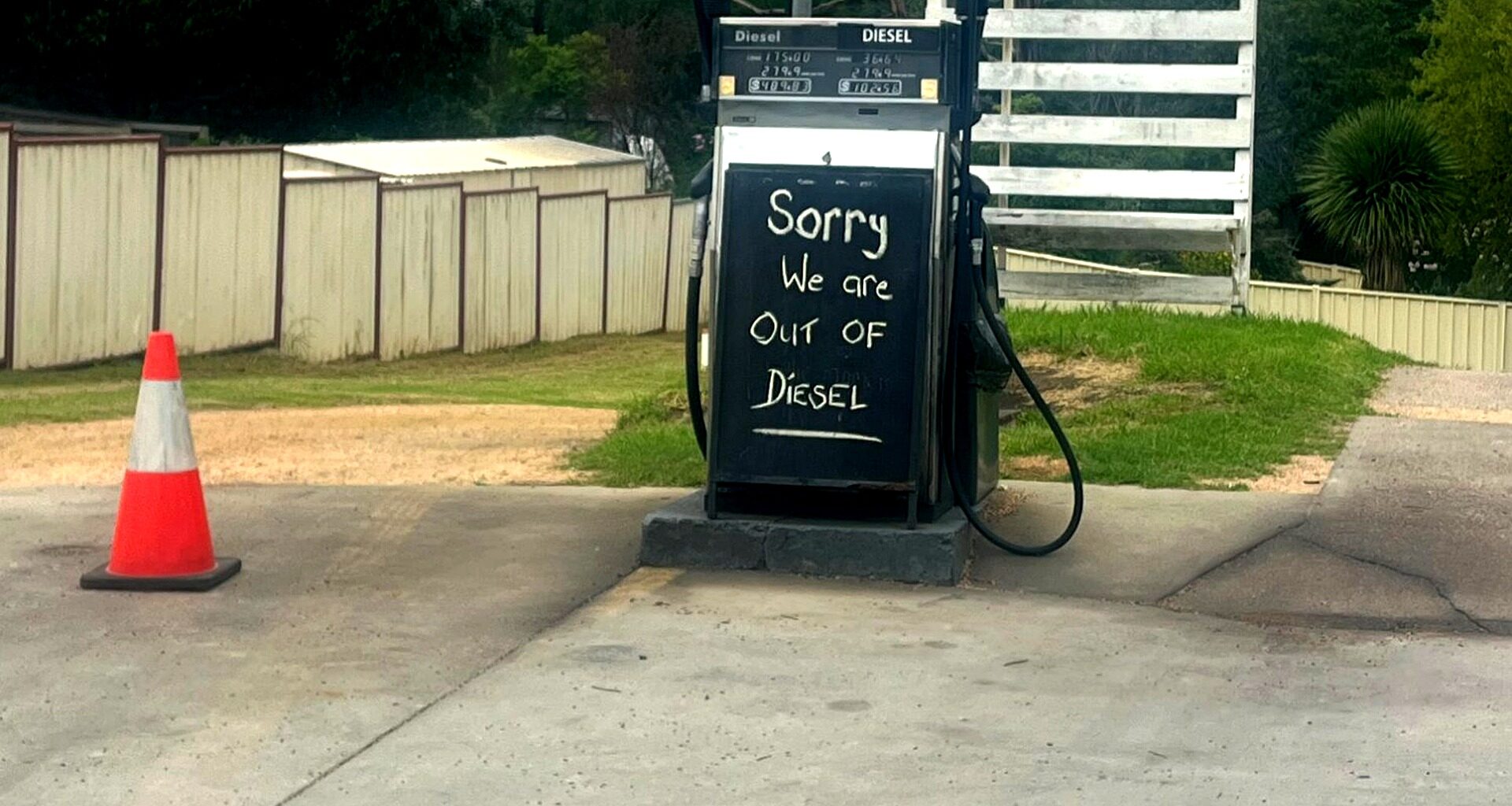
Australia could run out of fuel by mid-April, with the federal government unable to guarantee fuel supplies, according to documentation from the National Cabinet Meeting obtained by Wood Central tonight. At the same time, bowsers in rural and regional areas — which are critically important for transporting pallets, flooring, posts, piles, structural timbers, biofuels, and farming and agricultural goods — are already dry…despite the government claiming that fuel supplies are stable.
Tonight, Wood Central spoke exclusively to Denis Greensill, one of NSW’s big three harvest and haulage contractors who runs 35 trucks from Grafton north through the northern rivers, west to Glen Innes, and out to the port of Brisbane — moving between 5,000 and 10,000 cubic metres of hardwood every month into pallets, flooring, posts, piles and mine shafts.
Tonight, he revealed that his weekly fuel bill had jumped by $20,000 in less than a week.
“It’s now costing us $70,000 a week to operate our trucks — up from $50,000 last week — which works out to more than $300,000 (additional charges) every month,” he warned. And whilst Greensill is pushing some of that cost back to the mills, he says it never fully comes back. Some sawmills will absorb an extra $10 a metre — but for others, they’ve already reached their limit.
“You still don’t fully get it back […] that’s the only way we can survive. Some mills said they can’t pay anymore — that’s it. They’ve got their own markets, their own competitors. But everything’s going to go up regardless,” he said.
Greensill said the log flow on the north coast is already thinning, with sawmills still desperate to chase up missing timber deliveries, with the region serviced by just four crews working to sustainably harvest hardwood in the region.
 Earlier this week, Wood Central exclusively revealed that Anthony Dorney and his son — the fourth and fifth generations of the Dorney family — were forced to sell cattle to cover a monthly diesel bill that has blown past $400,000. [Photo: supplied to Wood Central / Central PR Group by the Dorney family for exclusive use]
Wood Central understands the pressure is far from easing and will likely get much worse. That’s because Australia’s ‘big four’ fuel suppliers — responsible for controlling 85 per cent of the wholesale petrol market — are now drawing 100 per cent of their contracted allocations, leaving independent retailers, the ones serving regional bowsers, to starve, buying from a spot market that has nothing to sell.
Today, the Australian Institute of Petroleum revealed that it was cautiously optimistic that the country can maintain the vast majority of supply, but only whilst Asian refineries keep producing from existing crude stocks — refineries that have not yet restocked from the Middle East.
And the Great Koala National Park moratorium on harvesting is compounding the damage.
The removal of forestry access from habitat areas has pushed contractors off their most workable ground — dubbed by Greensill to be A, B and C blocks that kept operations viable when wet weather closed everything else — leaving D and E blocks that are steeper, wetter, harder to reach and more expensive to work.
NSW Premier Chris Minns and Andrew Hurford, President of Timber NSW, at Hurfords Mill in Kyogle — where the conversation about the Great Koala National Park proposal is no longer abstract. For contractors like Dennis Greensill, the removal of A, B and C category harvesting blocks from koala habitat areas has pushed operations onto steeper, wetter and more expensive ground at the worst possible moment. (Photo Credit: Provided to Wood Central / Central PR Group by NSW Premier Chris Minns’ office)
“They’ve taken our prime blocks away […] we can always tinker around and get a couple of loads a day [in those blocks]. Now they put us into areas that are wet, and we’re just sitting there for three days, not moving until it’s dry,” Greensill said. “The GKNP has taken all the better areas away. The contractors are left with the D and E blocks — the high-cost ones — because of accessibility, road conditions, and rain. There’s a multitude of factors.”
Greensill’s operation moves more than sawlogs — biomass for sugar mill energy, power poles for Koppers, Coffs Harbour Hardwoods output, and sawdust to mushroom growers in Sydney — though that diversification offers little buffer when the fuel exposure runs across the entire fleet.
Already, fellow NSW contractor Anthony Dorney — running 25 trucks out of Bulahdelah — has been forced to sell cattle to cover a monthly fuel bill that has blown $400,000. For Greensill, costs have likely blown past $500,000.
“Food is the key. You’ve got to have food and the roof over your head. Primary production — timber, food — that should have priority when it comes to fuel availability,” Greensill said.
Speaking to Wood Central tonight, Steve Dobbyns, Executive Chair of Forest and Wood Communities Australia, rejected the government’s claims that current supplies are adequate, pointing to bowsers running dry across forest and wood communities as evidence that the official position does not reflect conditions on the ground.
Ampol’s Amplify Diesel board reads 299.9 cents per litre at a regional NSW service station — more than a dollar per litre above what city operators are paying and nearly 55 cents above the national average terminal gate price as of mid-March 2026. With 86.6 per cent of all domestic forest products freight moving by road, every cent at bowsers as this one flows directly into the cost of framing timber and pallets on Australian building sites. (Photo: Supplied to Central PR Group / Wood Central by Steve Dobbyns, FWCA for exclusive use)
“You’ve only got to look at dozens of sites across rural and regional communities, in the heart of forest and wood communities, to see that diesel is in short supply,’ he said. ‘The government is paying favourites with the cities — the 90 per cent — over the regions. It will lead to major shortages in the supermarkets, on the building sites and along the full value chain,” Dobbyns said.
Please note: This story is part of a special Wood Central series covering the fuel crisis in regional and rural communities and its impact on Australia’s $23 billion forest products value chain. For more information, click here for Wood Central’s exclusive story with Denis Greensill from Friday, March 20.

Jason Ross, publisher, is a 15-year professional in building and construction, connecting with more than 400 specifiers. A Gottstein Fellowship recipient, he is passionate about growing the market for wood-based information. Jason is Wood Central’s in-house emcee and is available for corporate host and MC services.