
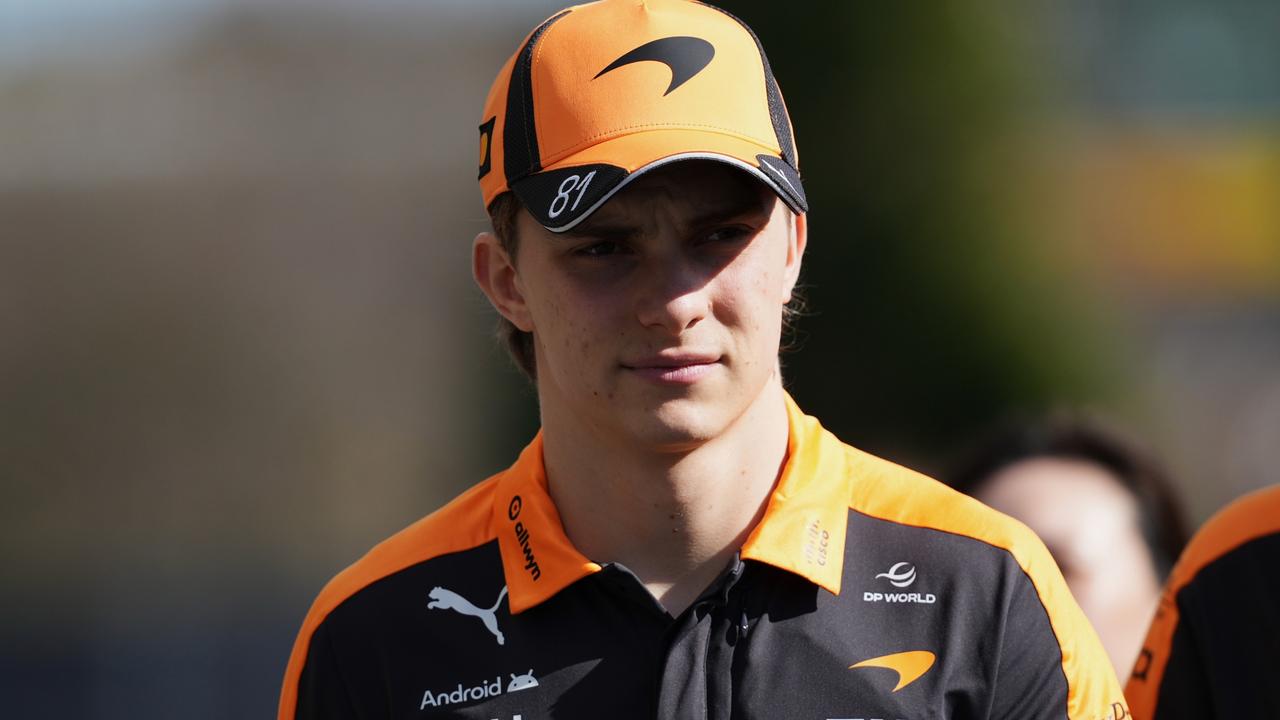
If you’re looking for one stat to illustrate how grim McLaren’s start to the season has been, consider this: Aston Martin, with its chronically unreliable car, has completed more racing laps than the papaya orange.
Across both weekends so far, including the sprints, McLaren has completed just 96 laps in racing conditions to Aston Martin’s 143.
Fox Sports, available on Kayo Sports, is the only place to watch every practice, qualifying session and race in the 2026 FIA Formula One World Championship™ LIVE in 4K. New to Kayo? Join now and get your first month for just $1.

It’s not simply because McLaren has only one classified grand prix finish so far; it’s that it has only one grand prix start.
Thanks to Oscar Piastri’s crash on the formation lap in Melbourne and then electrical issues for both Piastri and Lando Norris before the formation lap in Shanghai, the team has barely moved out of square one this year.
The double failure to start the Chinese Grand Prix was only the second double DNS in McLaren’s history.
McLaren was quick to point the finger at its Mercedes power unit for the historical anomaly, and in the Suzuka paddock the confirmed the problem lay with its engine supplier.
“We’ve put a lot of joint effort into understanding the problem and making sure it doesn’t happen again,” Piastri said. “We know what went wrong at least.”
The problem has left McLaren third on the title table but already a whopping 80 points adrift of championship leader Mercedes.
Piastri, with only three points to his name, is 12th in the standings and 48 points behind leader George Russell. Defending champion Norris is only slightly better off, sitting sixth and 36 points adrift.
“It’s certainly not been the most ideal start,” Piastri said understatedly. “All you can do is look at what is coming in the future.
“There’s no point dwelling on it. It wasn’t anything I could do. We’ve got a race here this weekend that we want to try and do better in — that’s all you can do, really.”
SHANGHAI, CHINA – MARCH 15: Oscar Piastri ha started the season on the back foot.Source: Getty Images
But Piastri also emphasised that even without the dual engine trouble, McLaren hasn’t started the year in title-defending form.
Both Mercedes and Ferrari have been well up the road over the two rounds so far, while in Melbourne Red Bull Racing looked like a close match too.
“We’re not as fast as we want to be, so I think we’ve got plenty to focus on apart from just a bad couple of races or non-races,” he said. “That’s what we’re putting our energy into — that’s what I’m putting my energy into.
“I think a lot of the things that I can control so far, like qualifying, have gone well considering where we stand.
“We’ve got optimism that we can improve in the future, and I think we’ve got the proof that we’ve done that in the past. It’s obviously going to take time, but I think we’re all confident that we can achieve that.
“We all have that taste of success now, and we want to get back to where we belong.”
The fightback starts this weekend.
PIT TALK PODCAST: Audi team principal Jonathan Wheatley leaves his job less than a year after moving to Hinwil. Is a switch to Aston Martin now on the cards? And we look ahead to this weekend’s Japanese Grand Prix.
FERRARI PLAYS DOWN EXPECTATIONS BEFORE APRIL UPGRADE PUSH
With McLaren out of the picture, at least for now, it falls to Ferrari to challenge Mercedes at the front of the field.
The Italian team has been the German marque’s closest challenger over the first two rounds, with its car on average the second quickest on the grid.
Its sizzling starts are its secret weapon. Despite having yet to start a grand prix on the front row, a Ferrari driver rocketed into the lead on the first lap in Melbourne and Shanghai, though at both events Mercedes eventually broke back through to finish in one-two formation.
Those starts, plus the SF-26’s quality through the corners, have sparked optimism that even if Ferrari hasn’t fully overhaul Mercedes, it will still be able to win key races where overtaking is difficult.
The Japanese Grand Prix has typically been one such race, with the narrow and risky Suzuka traditionally putting a premium on passing.
Max Verstappen won last year’s race from pole, for example, despite being clearly slower than the two McLaren drivers that shadowed him for the entire afternoon.
Lewis Hamilton — a five-time winner in Japan and coming off his first Ferrari podium in China — saw a chance to match Mercedes in the Suzuka layout.
“We only have two [straight-line mode] sections here,” he said, referring to the zones where the car’s active aerodynamics flip open into low-downforce mode. “Maybe that’s a positive for us, because every time Mercedes open up their [wings], they pull away.
“There’s less chance for them to do that here maybe … and maybe we can keep up with them more through the high-speed sections.”
SUZUKA, JAPAN – MARCH 26: Lewis Hamilton of Great Britain and Scuderia Ferrari walks in the Paddock during previews ahead of the F1 Grand Prix of JapanSource: Getty Images
Leclerc, though, was keen to play down expectations.
“I don’t think it’s as close as maybe people think,” he said.
“Our only chance to stay with them is to annoy them in the first few laps, but as soon as they get free air — they’ve shown their real pace in the last race, and I think there’s still these 0.4 or 0.5 seconds that we’ve seen throughout these first two races.
“There are still some very long back straights where we know Mercedes is going to be extremely strong, but it’s also a very twisty track in the first two sectors, so hopefully we can have a big enough advantage to be faster on the overall lap.
“But at the moment it looks unlikely with the picture that we’ve made ourselves in the first two races.”
Instead the Monegasque said Ferrari was better off playing the long game, with a significant upgrade window approaching thanks to the cancellation of the Bahrain and Saudi Arabian grands prix originally scheduled for April.
“This championship is going to be all about development and the upgrades that each team is going to bring,” he said. “For now we are in an okayish place, but of course we’re not here to only do podiums.
“We want to win races, which at the moment seems very difficult because Mercedes is at a very high level, but we are working very hard and especially the people back at the factory are working extremely hard to bring upgrades as soon as possible.
“I know there are quite a few things coming up soon. Whether this is going to make the difference or not, I don’t know, and I’m pretty sure the others are not on vacation either, so it’s going to be tough.
“We’ve got to focus on ourselves, not trying to overdo it, because it’s never good in these situations, and then we’ll see where that brings us.”
Verstappen linked to F1 move to Mercedes | 06:52
WILL THE NEW RULES MAKE RACING BETTER?
The arguments over whether Formula 1’s 2026 rules have taken the sport in the right direction will continue for months, if not years, but there’s no doubting that the regulations have generated more action in race conditions.
Drivers have access to 350 kilowatts of electrical power on demand — albeit only for as long as the battery lasts — via the boost button, which has become a major offensive tool in wheel-to-wheel combat.
Though some drivers have derided the boost button as artificial — a driver who uses their battery to make an overtake inevitably finds themselves down on power when attempting to defend, they argue — others have praised the formula for opening up more opportunities for racing.
“If you go back to karting, it’s the same thing,” Hamilton said. “People are going back and forth, back and forth. You can never break away.
“No-one ever has ever referred to go-karting as yoyo racing.
“It’s the best form of racing, and Formula 1 has not been the best form of racing in a long, long time. You just couldn’t follow.
“Out of all the cars that I’ve driven in 20 years, this is the only car that you can actually follow through high-speed [corners] and not completely lose everything that you have, and you can stay behind.
“I personally find it much more fun because [China was] the most overtaking and best battle I’ve had in probably maybe since Bahrain years and years ago with Nico [Rosberg].
“That’s how racing should be.”
With a sample size of only two venues, however, it’s hard to be definitive about how successfully the power unit can generate racing at some of the sport’s most stubbornly anti-overtaking circuit.
Suzuka has long ranked as a tough track for passing, with F1’s ever-widening cars increasingly ill-suited to racing on this decades-old narrow road. Racing has tended not to live up to the qualifying spectacle.
But could that be about to change with these new rules?
“A slightly smaller car, being much lighter, it has made a massive difference just in terms of how you race, how agile it is through corners,” title leader Russell said.
“The previous generation cars, you would say, were perfectly suited to a track like Suzuka because they had a lot of high-speed downforce. I think the lap times we saw last year were probably the fastest lap times we’d ever seen in Suzuka, yet the race was super boring.
“We will be slower through the esses this year. I think it will probably be an easy one-stop, same as last year, but it was an easy one-stop in China and it was a very exciting race.
“I guess this will be a good test for the regulations if this track now becomes an exciting race and it was once a boring race, that will be quite interesting.”
If Sunday’s race ends up being a thriller, it will meaningfully reframe the debate set for April over how the rules should be tweaked for the rest of the year — particularly if one change that has been made this weekend makes a positive difference to qualifying.
Bezzecchi dominates Brazil Grand Prix | 01:15
RULE TWEAK HINTS AT F1 FOCUS IN RULE CHANGE DEBATE
Though Formula 1 is holding firm with its regulations before crunch talks during the April break, the FIA has tweaked a key regulation for this weekend’s Japanese Grand Prix in a bid to improve the qualifying spectacle.
Suzuka Circuit is one of the world’s most fearsome tracks. Fast, flowing and punishing of mistakes, drivers universally love the challenge of the 65-year-old venue.
But there are fears this week that the majesty of the track will be undermined by the way drivers are required to trade corner speed for battery power by the 2026 engines.
That’s because the electrical power regenerated for every 0.1 seconds sacrificed in a high-speed corner could be worth 0.2 seconds or more down the straights, incentivising drivers to limit their speed around the lap.
In response to concerns that the iconic track’s single-lap challenge is at risk of being neutered, the maximum charge capacity has been reduced to 8 megajoules per lap in qualifying, down from what had been the regulatory maximum 9 megajoules.
Though the lower charge limit will mean lap times will be slower overall, it will reduce the need for lifting and coasting down the straights and for super clipping — redirecting combustion power to charge the battery — through the track’s legendary fast corners.
The megajoule limit reflects the maximum amount the battery can be charged during a lap. The battery has an effective maximum capacity of 4 megajoules, meaning in practice it can be fully charged and discharged twice for every tour of the 5.807-kilometre circuit.
Despite the track having been nominated for the most liberal battery rules before this change, drivers expect Suzuka to be challenging for the power unit.
The track’s lack of big braking zones and the preponderance of fast, sweeping and interconnected corners means there are few opportunities to charge the battery. Though the track isn’t expected to be as tough as Albert Park, which is among the four most difficult tracks on the calendar, teams are anticipating a more complex challenge than in Shanghai, which was among the season’s best non-street circuits.
Though the lower recharge limit will reduce the importance of charging the battery somewhat, Leclerc is sceptical it will completely save the qualifying spectacle.
“I don’t think it will be a game changer,” he said. “I think it will be pretty similar, apart from for the driver where maybe there’s a little bit less lift and coast, which is I think a good thing.”
While it might not eliminate the controversy over the sport’s new rules, this weekend’s tweak highlights where Formula 1 will be focusing its efforts during the break to appease some of its harshest critics.
“I think for qualifying there are still some changes that need to be done to make sure that we can push at the maximum, whatever the limit of the car is,” Leclerc said.
“So far for the first two races it was more about managing everything properly in qualifying rather than the actual flat-out push that we were used to in Q3 in the past years.
“There’s still some finetuning to be done on that, but I don’t think that this particular change will be a game changer for this weekend.”