

The Australian Securities and Investments Commission (ASIC) has expanded its presence in the Northern Territory, citing the need to hold banks and financial institutions in regional communities to account.
The independent government body, which regulates assets and financial services nationwide, opened a new office in Darwin on Thursday and has boosted local staff numbers, having formerly employed just a single person in the NT between 2015 and 2025.
“I’m about to finish at ASIC, and a lot of people ask me, ‘What was the most important thing you did?'” ASIC Chair Joe Longo said.
“I think one of the most important things I’ve done is to do this — I felt it was just unacceptable that we had one person here.”
Joe Longo says ASIC’s expansion in Darwin is a decision he is proud of. (ABC News: Michael Franchi)
Mr Longo said around 10 people now work out of the new office on Smith Street, allowing ASIC to enforce regulation in remote communities.
“I want ASIC to be more effective from a law enforcement perspective, to be able to go into remote communities and work with [them] to avoid harm occurring,” he said.
Expansion follows investigation into bank account fees
The commission’s expansion into the NT follows ASIC’s landmark Better Banking for Indigenous Customers investigation and report.
The 2024 report and its 2025 follow-up identified thousands of instances of banks keeping Indigenous customers with low incomes in high-fee accounts.
According to the report, more than 150,000 customers paid around $6 million in transaction fees they would not have incurred in the low-fee accounts they were eligible for.
Central Australia was identified in the report as a hotspot for the issue.
Mr Longo said he understood the banks were refunding the money, but ongoing challenges of “digital exclusion” made ASIC’s role in the regions increasingly important.
“As we have more online delivery of services – where interactions don’t involve people at all – you can see how that is a challenge in remote communities,” he said.
Across remote regions in the NT, several towns and communities have struggled with a shortage of banking options in recent years.
In 2022, the closure of the Westpac branch in Tennant Creek resulted in the Banking Code Compliance Committee placing public sanctions on the bank.
Small business compliance a priority
Beyond the scope of enforcement, Mr Longo said he hoped ASIC’s enhanced presence helped small and medium-sized businesses navigate regulation.
“If you want to start a business, it shouldn’t be any harder than it needs to be,” he said.
“It’s hard enough to develop a business case and to find investors and to actually conduct the business.”
Data shows investment in private industry across the NT has struggled in recent quarters, with investment levels contingent on large infrastructure projects.
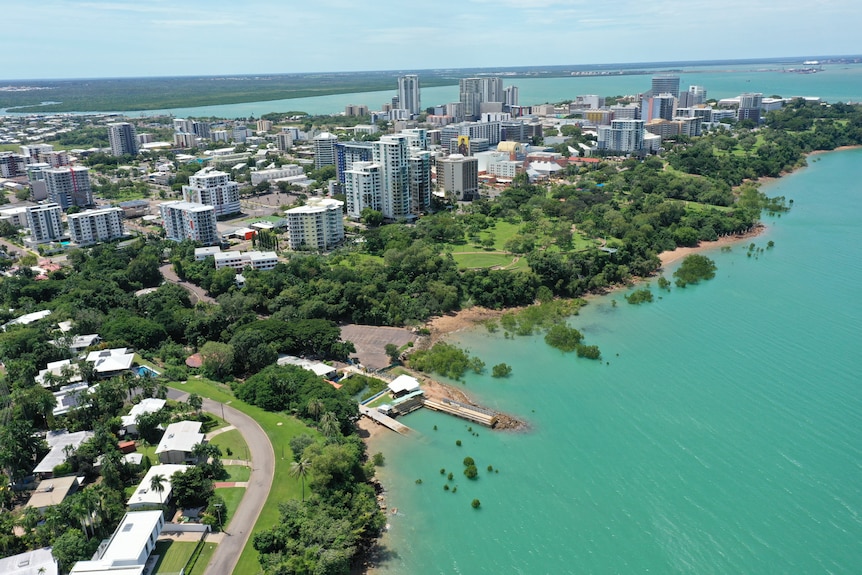
Investment in the NT private sector plummeted by 25 per cent in 2025, returning private investment to 2021 levels. (ABC News: Dane Hirst)
Mr Longo said complying with regulation was made more difficult for regional businesses.
“If you’re in a remote community, you’re sort of driven to what I would call a digital interaction — you’re on the phone, sending an e-mail,” he said.
“One of the things we’re trying to do at ASIC is to make those interactions, frankly, easier.”