
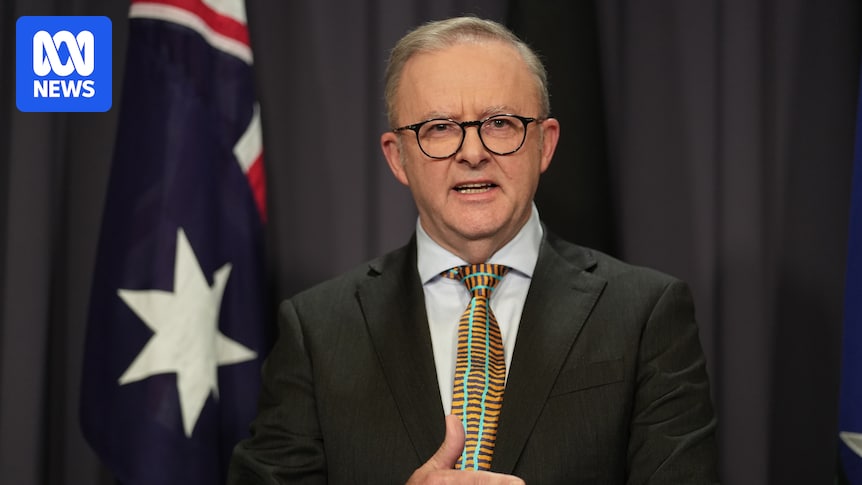
Prime Minister Anthony Albanese has kept the door open to halving taxes on petrol and diesel after the Coalition demanded temporary relief from sky-high fuel prices.
Mr Albanese also relented to pressure from the states for the Commonwealth to take a leading role in managing the fuel crisis sparked by the war in Iran.
Iran war live updates: For all the latest news on the Middle East war, read our blog.
He would not commit to price relief on fuel, but said his government was taking “every practical measure required to shield our nation from the worst of the global uncertainty”.
“My government has always been strong on cost-of-living measures. We’ll continue to do so. We [will] do so in a responsible way in the context of our budget considerations,” Mr Albanese said.
A tax of 53cents is paid on every litre of petrol and diesel sold at the bowser, meaning 26 cents per litre would be saved if retailers fully passed on a halving of the excise.
Those taxes have been temporarily halved during previous economic shocks, most recently for six months after Russia’s invasion of Ukraine forced a global rearrangement of energy supply chains.
Loading
The Australian Competition and Consumer Commission found that when the excise was halved in 2022, it was “largely” passed on by retailers, saving motorists about 24.3 cents per litre, with a six-week lag in price falls due to the way fuel is priced.
Opposition Leader Angus Taylor told reporters this morning the tax should be halved for three months, as well as an associated road user charge on heavy vehicles.
“We’re seeing this crisis right across our country right now, and we’re seeing a government which has failed to show leadership, has failed to show urgency and has failed to take action,” Mr Taylor said.
“I have written to the prime minister, and I have called on the government to slash the fuel excise.”
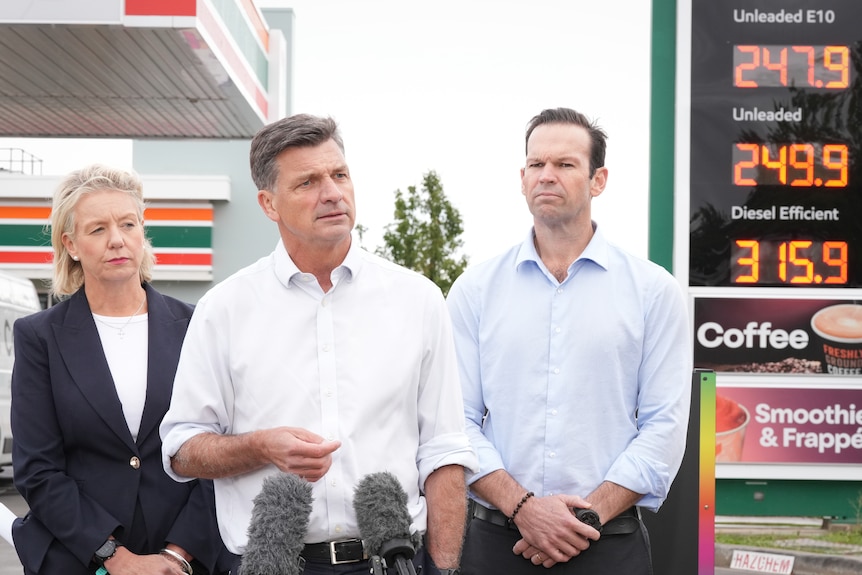
Angus Taylor says the fuel tax should be halved temporarily. (ABC News: Matt Roberts)
To cover the costs of halving the fuel tax, the opposition proposed ending the exemption from Fringe Benefits Tax for electric cars, unpicking a yet-to-begin subsidy scheme for green hydrogen, and pausing the government’s cheaper home-batteries scheme.
Mr Taylor said the opposition’s proposal was fully funded and would not put pressure on the Cheaper Home Batteries program, which provided discounts of up to 30 per cent on the installation of a household solar battery.
We want to know how much fuel costs where you are. Send us a photo.
However, the government dismissed Mr Taylor’s suggestion that the hit to revenue, an estimated $1.5 billion to $2 billion, could be paid by scrapping other energy schemes.
“They have also called for cuts to things that are making a difference to the cost of living, such as batteries … cuts to EV support,” Mr Albanese said.
“I don’t think there’s anyone out there today who has bought an electric vehicle who is regretting the decision at this point in time.”
PM relents to the national coordinator role
On Monday, the prime minister will convene a meeting of the national cabinet to coordinate the response to the fuel crisis.
State premiers called on the government yesterday to lead a nationally consistent response.
NSW Premier Chris Minns said “COVID-style” protocols were needed to avoid states going their own way on fuel rationing, working-from-home measures, or other measures to manage fuel demand.
Mr Albanese said today the government had learned the lessons of the COVID pandemic, in which the states sometimes took it upon themselves to respond, leading to a patchwork response across the country.
Energy Minister Chris Bowen assured the country that fuel supplies continued to flow and that importers had secured three additional shipments, as demand remains higher than usual.
He said that with every day that passed, his confidence grew that Australia could maintain that supply.
“That does give me confidence for the coming weeks, certainly every day that passes without more cancellations is more confidence going into April, and late April and into early May,” Mr Bowen said.
“Having said that, the international situation remains very uncertain. Prices are elevated in the international oil market; there’s no question about that.”
PM’s expectation Asian nations will ‘reciprocate’ on energy supply
The prime minister also gave his strongest indication yet that the government would be willing to use LNG exports as leverage in negotiations with the Asian nations that supply Australia with petrol.
“Our gas exports are very important in the region. And the context of our current circumstances is that Australia is a reliable supplier,” he said.
“We expect reciprocation in our economic relations.”
Australian officials and ministers have been in almost constant contact with counterparts in North and South-east Asia, which are still grappling with the supply shocks caused by the Iran war.
Malaysia has flagged it may have to restrict fuel exports in the future to meet its domestic needs, although it has also said that doing that would a last resort.
Malaysia’s Prime Minister Anwar Ibrahim also declared yesterday Malaysian vessels would be able to pass through the Strait of Hormuz — although it is not yet clear what material impact this will have.
Mr Bowen declared this morning that he was “very pleased” with his conversations with Malaysian officials.
“The Malaysian government has indicated to me that they regard their role as a reliable supplier of liquid fuel to Australia extremely importantly, and that they see Australia as a key ally and friend and they’ll continue to work with us,” he said.
Earlier this week Australia and Singapore also issued a joint statement after a phone call between Mr Albanese and his Singaporean counterpart Lawrence Wong saying both countries would “support the flow of essential goods, including petroleum oils, such as diesel, and liquefied natural gas between our two countries” and to “notify and consult each other on any disruptions with ramifications on the trade of energy”.
The two governments are now expediting discussions on a new agreement ensuring “essential supplies” continue to flow between the two countries.
Multiple diplomatic sources also said that while Australia had repeatedly raised the value of its role as reliable energy partner and LNG supplier, it was an exaggeration to say that Australia was using it as leverage in discussions.
“It’s not such a high-temperature conversation, nobody is talking about stopping LNG [and] nobody is expecting they will,” one official said.
Loading…