
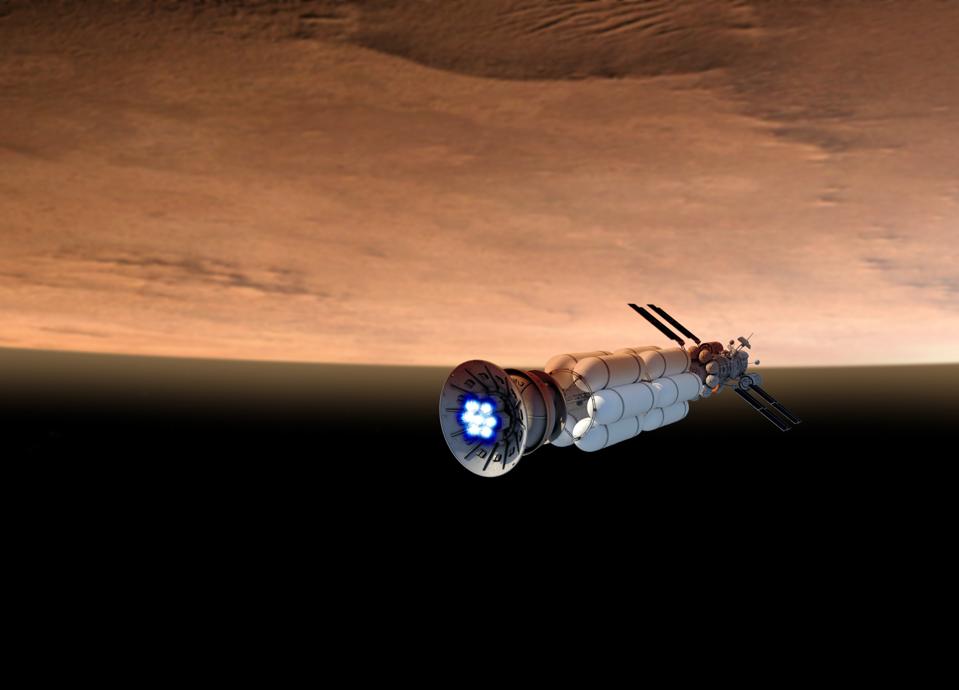
Just days before NASA launches the first crewed mission to the moon since 1972, it has set a December 2028 launch for its first nuclear-powered spacecraft to Mars.
NASA has unveiled an ambitious plan to send the first nuclear-powered spacecraft to Mars by 2028. It comes in the wake of the cancellation of NASA’s once-flagship Mars Sample Return (MSR) mission, which was designed to rendezvous with the Perseverance rover and bring back the first-ever samples of rocks from an alien planet to Earth in 2033.
Announced by Jared Isaacman, NASA Administrator, at the agency’s “Ignition” event on March 24, 2026, the mission centers on Space Reactor-1 (SR-1) Freedom — a spacecraft designed not just to reach Mars, but to pioneer a new era of deep-space travel.
Meet NASA’s ‘SR-1 Freedom’ Spacecraft
At the heart of the ambitious Mars mission is SR-1 Freedom, which NASA describes as the first spacecraft to use nuclear electric propulsion for an interplanetary journey. NEP is essentially a compact nuclear power plant in space, using a fission reactor to generate electricity that powers thrusters. Allowing sustained propulsion over long distances, it enables heavier payloads and more flexible missions. It also operates independently of sunlight, making it viable for deep-space exploration far beyond Mars.
“After decades of study and millions spent on concepts that have never left Earth, America will finally get underway on nuclear power in space,” said Isaacman during the event. SR-1 Freedom is designed not just for Mars, but for journeys across the solar system.
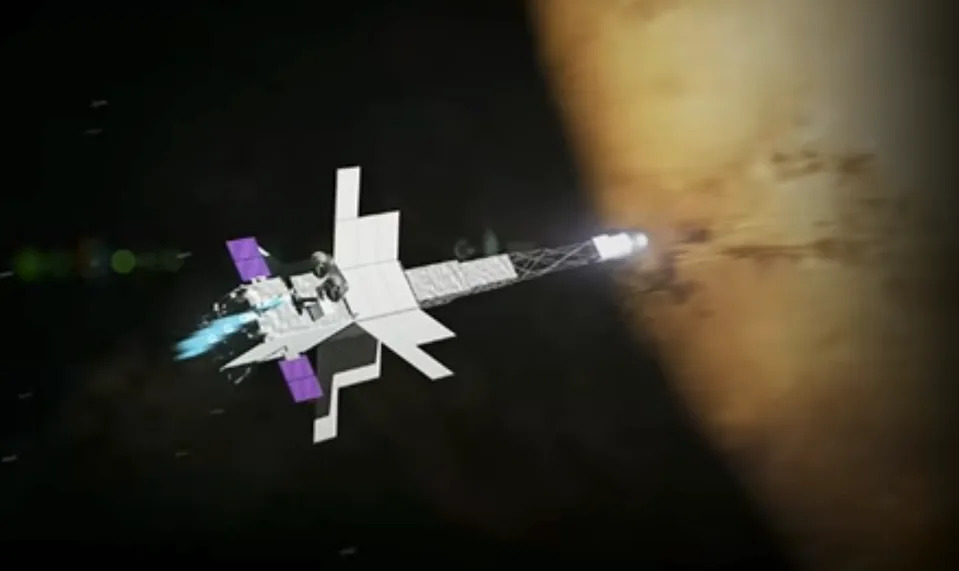
An artist’s impression of NASA’s ‘SR-1 Freedom’ spacecraft, from NASA’s “Ignition” presentation on March 24, 2026.
NASA via YouTubeNASA SR-1 Freedom: Goodbye, Lunar Gateway
SR-1 Freedom will also use a system designed for a spacecraft that NASA is canceling. Lunar Gateway, a space station designed to orbit the moon and due to begin launching next year, will now be repurposed as part of SR-1 Freedom — specifically its Power and Propulsion Element. NASA also announced that it plans to share the reactor design for SR-1 Freedom with private industry.
NASA SR-1 Freedom: ‘Skyfall’ Helicopters On Mars
Buoyed by the spectacular success of the Ingenuity drone that, as part of the Perseverance rover’s mission, flew 72 times in 2021-2024, NASA said it SR-1 will deploy three autonomous helicopters or drones at Mars. This “Skyfall” payload — described as “Ingenuity‑class” helicopters — will be deployed mid-descent, with the helicopters landing in different locations. Using cameras and ground-penetrating radar, they will map terrain, analyze slopes and hazards, and search for subsurface water ice — critical for identifying safe and resource-rich landing sites for future human missions.
NASA SR-1 Freedom: Launch And Arrival At Mars
The SR-1 Freedom mission is scheduled for launch in December 2028, the beginning of a short window when Mars and Earth are on the same side of the solar system. With Mars aligned with the sun and Earth on March 25, 2029 — something that only happens once every 26 months — a so-called Hohmann transfer window opens in December 2028. It will take about a year to reach Mars and may continue to another target after deploying “Skyfall.”
SR-1 Freedom’s launch date puts it after NASA’s Artemis V mission, currently scheduled for late-2028, which is planned to be the second landing of astronauts on the lunar surface after Artemis IV in 2027.
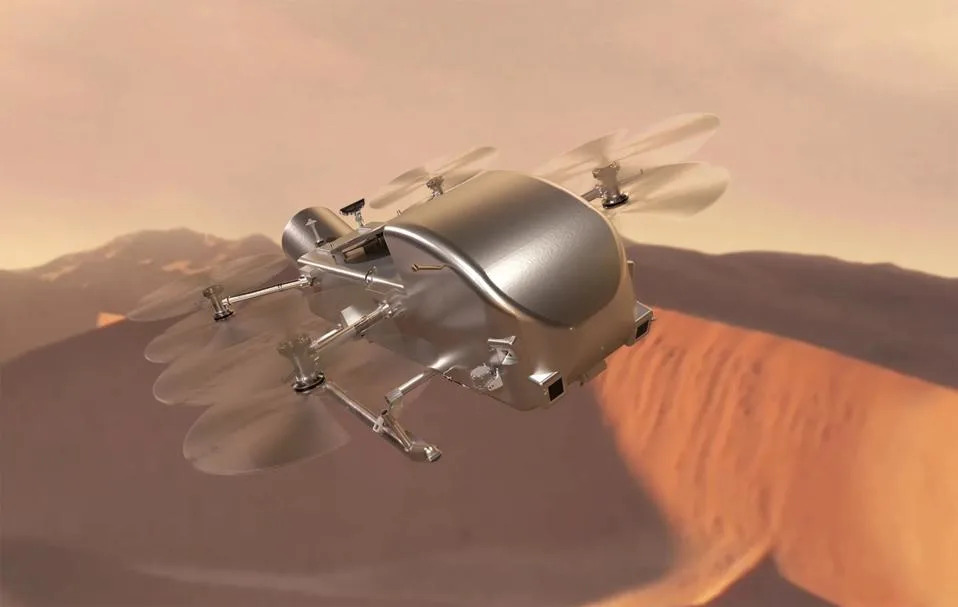
Artist’s concept of Dragonfly soaring over the dunes of Saturn’s moon Titan.
NASA/Johns Hopkins APL/Steve GribbenNASA’s Other Helicopter: Dragonfly On Titan
Also due to launch in 2028 is NASA’s $3.35 billion mission to Titan, Saturn’s largest moon and the second-largest in the solar system. Arriving in 2034, a spacecraft will deploy a rotorcraft lander — called Dragonfly — to the surface. It will choose a new location to land every Titan day (equivalent to 16 Earth days) to take samples of the moon’s prebiotic chemistry. It will also sample Titan’s lakes, rivers, and seas of liquid methane and ethane, a feature that makes it the only known world besides Earth with liquids on its surface.
Wishing you clear skies and wide eyes.