
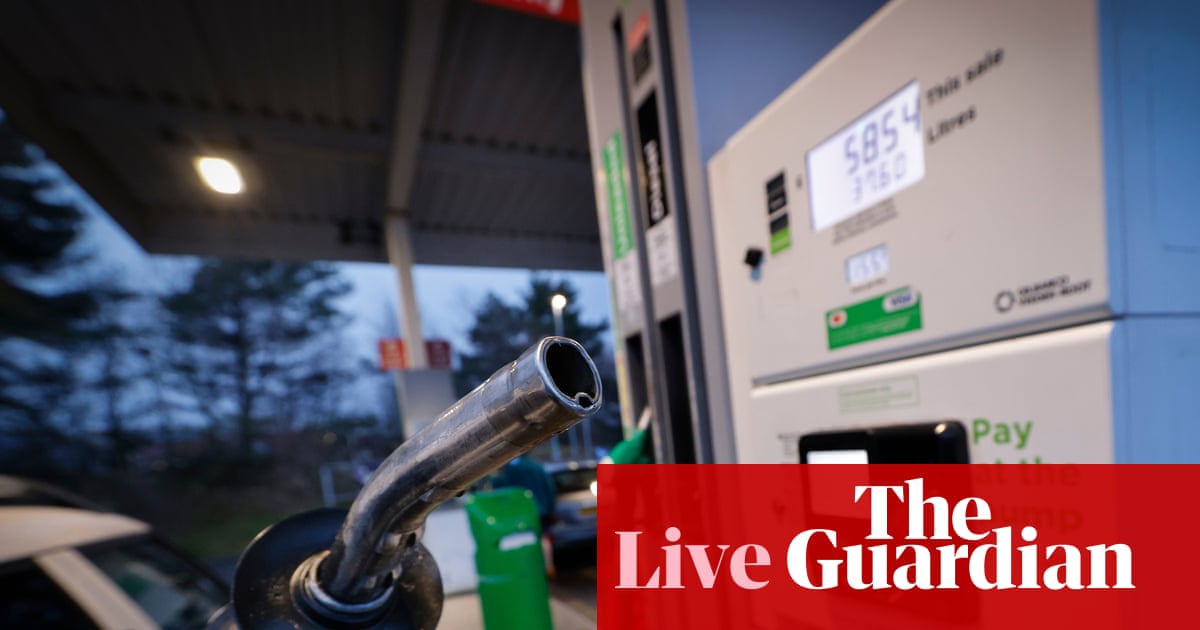
Average UK petrol price hits 150p a litre, first time since May 2024
UK petrol prices have hit their highest level since May 2024 as fuel retailers continue to push up costs at the pump.
The RAC has reported this morning that petrol has risen through the 150p mark, with the average price now 150.11p a litre.
The average price of diesel is now 177.68p.
Just before the Iran war started, petrol cost 132.83p a litre on average, and diesel was 142.38p a litre.
RAC head of policy, Simon Williams, says motorists will feel the extra cost if they drive this Easter.
double quotation markWith the long-awaited four-day Easter weekend almost within touching distance, the cost of getting away by car is going to be noticeably higher this year.
And with average prices at motorway services at 166p for unleaded and 182p for diesel, drivers on long journeys will need to plan very carefully where they refuel. The best advice remains to shop around for fuel and make use of free apps such as myRAC to never pay a penny more for fuel than is absolutely necessary.
The UK government has warned that it will not allow companies to take advantage of the crisis by short-changing consumers; petrol retailers have denied allegations of price gouging.
Updated at 08.52 EDT
Key events
Show key events only
Please turn on JavaScript to use this feature
US consumer confidence hit by Iran war
US consumer confidence has dropped this month, as the Iran war pushes up fuel prices across the States and hits the stock market.
The University of Michigan’s consumer morale report shows that sentiment fell back 6% this month to its lowest level since December 2025.
Its Index of Consumer Sentiment has fallen to 53.3 points this month, down from 56.6 in February, with consumers less positive about current economic conditions and future economic prospects.
Surveys of Consumers director Joanne Hsu says weathier Americans were most concerned about the situation:
double quotation markDeclines were seen across age and political party. Consumers with middle and higher incomes and stock wealth, buffeted by both escalating gas prices and volatile financial markets in the wake of the Iran conflict, exhibited particularly large drops in sentiment.
Overall, the short-run economic outlook plunged 14%, and year-ahead expected personal finances sank 10%, while declines in long-run expectations were more subdued. These patterns suggest that, at this time, consumers may not expect recent negative developments to persist far into the future.
Here’s Luke Bosdet, the AA’s spokesman, on the situation in UK road fuel prices today:
double quotation mark“Fuel price averages provided to the AA show that supermarkets last week were averaging more than 5p a litre cheaper for petrol and diesel. Pump price increases this week suggest that the superstores may now be beginning to catch up with oil companies and independents.
“Drivers are canny enough, helped by fuel price apps, to spot where to find the cheaper fuel and head to those stations. However, the smart ones will also know that, where they may have to wait to fill up or there is some kind of disruption, another fuel station is likely just down the road with prices a bit more expensive but without having to waste money in a queue.
“The fuel trade media has highlighted instances of disrupted deliveries but these have been sporadic and quickly rectified in a matter of hours – with drivers able to go elsewhere meantime.”
ShareIran war causing ‘temporary shortages’ at some petrol pumps, says Asda boss
The boss of Asda has warned that some petrol pumps are witnessing “temporary shortages” amid tight supply linked to the conflict in the Middle East and higher demand.
Allan Leighton, executive chairman of Asda, blamed elevated demand from customers for causing a small number of local “spikes”, but insisted the issues are not nationwide.
Leighton also rejected accusations that petrol sellers might be “profiteering” from higher pricing in recent weeks.
He told PA Media that the issue has only affected “the odd pump” at a small number of its petrol forecourts, highlighting no forecourts have been fully short of fuel.
He said:
double quotation mark“Our fuel volumes are up quite significantly and clearly demand has been outstripping supply.
Supply is tight and we are all trying hard on that.
The issue is a temporary one, and some could see issues when we are waiting for delivery, and we can expect to see that continue.
The spikiness at the moment makes this tricky for us, as spikes can lead to temporary shortages. These are temporary and are addressed very quickly.”
Two Chinese container ships have turned backed after trying to exit the Gulf via the Strait of Hormuz on Friday, ship-tracking data reported by Reuters shows.
The CSCL Indian Ocean and CSCL Arctic Ocean, both Hong Kong flagged, have been stuck in the Gulf since the U.S.-Israeli war with Iran began late last month.
They attempted to pass through the strait at 0350 GMT on Friday but then turned back, analysis from the Kpler data platform showed.
ShareWall Street falls despite Trump’s 10-day extension
Donald Trump’s decision to give Iran ten days to open up the strait of Hormuz has not brought cheer to Wall Street.
Stocks are falling in early trading in New York, a day after the worst session since the Iran war began.
The Dow Jones industrial average has dropped by 411 points, or 0.9%, at the start of trading to 45,548 points.
The broader S&P 500 share index is down 0.7% at 6,427.43.
David Morrison, senior market analyst at financial services provider Trade Nation, points out:
double quotation markMoves are headline driven. But the simple fact is that sentiment is likely to stay negative for as long as the Strait of Hormuz remains unsafe for shipping and controlled by Iran.
A protracted war in the Middle East could shave as much as 0.6 percentage points off European Union economic output in 2026 and 2027, according to an estimate from the European Commission.
double quotation markSuch a scenario would also push inflation 1.1 to 1.5 percentage points higher this year than in the most recent round of forecasts in November, the bloc’s economy chief Valdis Dombrovskis told EU finance ministers on Friday, according to people familiar with the matter who spoke on the condition of anonymity.
A shorter conflict would still result in 0.4 percentage points lower growth and 1 percentage point higher inflation in 2026, the people said.
Oil prices remain higher today, which is likely to keep prices higher at the pumps in the weeks ahead.
Brent crude is up 2.5% today at $110.68 a barrel, showing that energy markets have not been placated by Donald Trump’s pledge to avoid striking Iranian energy targets for a further 10 days.
Traders will have concluded that this 10 delay grace period extends the time when little oil will flow through the strait of Hormuz, leaving supplies restricted.
ShareXTB: Reeves could lower inflation fears by cutting motor fuel tax
UK government borrowing costs, like petrol prices, are continuing to be pushed up by the Iran war.
The yield (or interest rate) on 10-year UK gilts is back over 5% today, up 13 basis points (0.13 of a percentage point) at 5.08%.
That will disappoint chancellor Rachel Reeves; higher bond yields mean the cost of government borrowing is up, eating into her fiscal headroom.
Rising bond yields indicate the City is anticipating higher inflation.
Kathleen Brooks, research director at XTB, suggests the chancellor could burst those expectations by cutting tax on motor fuel.
Brooks explains:
double quotation markBonds are also selling off and yields are up sharply. UK 10- year Gilts are higher by 11bps and are leading the sell off. So far this week, UK yields are higher by another 17bps, since the onset of this crisis, UK 2-year yields are higher by 110bps.
This is an astonishing move, and the government is partly to blame. It is unwilling to cut fuel duty or VAT on fuel in this environment. Instead it is blaming price gouging by petrol forecourt owners. There is absolutely no evidence of this, and the RAC has reported that forecourt owners only make a slim 6% profit margin on a liter of fuel. It is the government’s coffers who line their pockets during an energy price shock. Businesses are now calling this out, and we shall see if this causes the government to act to cut fuel taxes. If they do this, it would immediately lower inflation expectations and bring down bond yields.
ShareUK petrol & diesel prices since the start of Iran conflict Photograph: PA Graphics/PAShareAverage UK petrol price hits 150p a litre, first time since May 2024
UK petrol prices have hit their highest level since May 2024 as fuel retailers continue to push up costs at the pump.
The RAC has reported this morning that petrol has risen through the 150p mark, with the average price now 150.11p a litre.
The average price of diesel is now 177.68p.
Just before the Iran war started, petrol cost 132.83p a litre on average, and diesel was 142.38p a litre.
RAC head of policy, Simon Williams, says motorists will feel the extra cost if they drive this Easter.
double quotation markWith the long-awaited four-day Easter weekend almost within touching distance, the cost of getting away by car is going to be noticeably higher this year.
And with average prices at motorway services at 166p for unleaded and 182p for diesel, drivers on long journeys will need to plan very carefully where they refuel. The best advice remains to shop around for fuel and make use of free apps such as myRAC to never pay a penny more for fuel than is absolutely necessary.
The UK government has warned that it will not allow companies to take advantage of the crisis by short-changing consumers; petrol retailers have denied allegations of price gouging.
Updated at 08.52 EDT
BofA negative on European stocks
Analysts at Bank of America fear European stock markets have further to fall, after a rough March.
The pan-European Stoxx 600 index is down over 8% since the US and Israel began the Iran war at the end of February, falling back from record highs.
Despite that drop, Bank of America remains negative on European equities.
In a research note this morning, it says markets appear to be pricing in a scenario where very little demand destruction occurs but with the potential for higher inflation.
BofA, though, warns of the risk that a lengthy conflict leads to demand destruction, through a squeeze on consumers’ purchasing power.
Its analysts told clients:
double quotation markOur global strategists highlight that the current episode has important similarities with 2007/08 (a spike in oil prices in combination with a weak US labour market and growing credit-market risks against the backdrop of low risk premia), while our global economists argue that markets have so far mainly focused on inflation risks and might be underpricing downside risks to growth.
We stay negative on European equities, with a further 10% projected downside for the Stoxx 600, following an 8.5% decline from the all-time high in February.
Updated at 08.50 EDT
UK mortgage rates climb again to 19-month high
Average UK mortgage rates have climbed yet again, as the Middle East conflict drives up borrowing costs.
Data provider Moneyfacts reports:
Average 2-year fix has risen from 4.83% at the start of March to 5.75% today. It’s highest since August 2024, and up from 5.67% yesterday.
Average 5-year fix has risen from 4.95% at the start of March to 5.69% today. It’s highest since December 2023, and up from 5.62% yesterday
The City money markets are indicating that the Bank of England will raise interest rates three times by the end of 2026, to 4.5%, from 3.75% today.
Many economsts, though, have predicted the BoE will hold borrowing costs, rather than hike and risk further weakening the economy.
Adam French, head of consumer finance at Moneyfacts, says:
double quotation markMortgage rates have continued to rise sharply, with around three in four active lenders increasing rates, launching or withdrawing products this week. The speed at which pricing is shifting is remarkable, the benchmark Moneyfacts average mortgage rate has risen from 5.40% on Monday to 5.65% today, its highest level in 19 months.
Products have been slowly trickling back onto the market in recent days, with 160 added since Wednesday, but priced at much higher rates than previously which has been driving up average rates on new mortgages. There is still a net 1,620 fewer products on the market than there were when lenders began pulling deals in response to rising funding costs on 9 March 2026.
The softer end of the mortgage market has been taking some of the biggest hits as short-medium term rate expectations have been completely turned on their head. The very cheapest deals have shifted significantly, with the lowest rate available to borrowers across the UK now at 4.47%, up from 3.51% before the conflict with Iran began – almost a full percentage point higher. This adds an extra £132 per month – almost £1,600 per year – to the cost of borrowing £250,000 over 25 years.
While a quicker resolution to the conflict in the Middle East could ease pressure on rates, the reality is that a more volatile world is a more expensive world. Anyone looking to buy or remortgage this year needs to prepare for substantially higher costs than previously expected.
Updated at 07.16 EDT
European bond yields are rising…
European government bonds are weakening, as fears of the inflationary consequences of the Iran war rise.
UK government bond prices have fallen, pushing up the yield (or interest rate) on the debt.
Ten-year gilt yields are up 10 basis points (0.1 percentage point) at 5.048%.
Two-year gilt yields are 7.5bps higher at 4.6%.
Reuters reports that France’s 10-year government bond yield has hit itss highest since June 2009 at 3.876%, up 8 bps.
German government debt is suffering too – the yield on 2-year bunds has reached its highest since July 2024 at 2.768%, up 5 bps
ShareEuropean markets in the red as traders don’t buy Trump’s TACO
It’s another morning of anxious trading on Europe’s bourses.
The pan-European Stoxx 600 index has dropped by 0.66%, with losses on Germany’s Dax index (-0.75%), France’s CAC 40 (-0.34), Spain’s IBEX (-0.6%) and the Italian FTSE Mib (-0.7%).
The UK’s FTSE 100 couldn’t hold onto its earlier gains either – it’s down 40 points or 0.4% at 9,931 points.
Neil Wilson, of Saxo Markets, points out that Trump’s latest delay is not a deal – and that’s what investors want to see.
double quotation markMinutes after US stocks posted their worst day since the Middle East war, Trump was back on Truth Social extending his deadline for a peace deal with Iran by 10 days, claiming talks were going “very well”. So far so Taco … but markets ain’t buying it with crude oil prices stubbornly higher and equity markets lower while the dollar and bond yields are elevated.
Trump extended his deadline to Iran to 6 April, but while this scales back the risk of immediate escalation, it does not indicate a clear path to resolution. Markets have largely shrugged it off with Brent back to $110, rising for a third day and European stock markets selling off again in early trade on Friday morning.
Updated at 07.20 EDT
Brent hits $110/barrel as markets don’t buy into Trump’s claims
The Brent crude oil price is now up 2% above $110 a barrel, for the first time since Monday, as markets shrug off Donald Trump’s new 10-day extension for Iran to open the strait of Hormuz.
Aaron Hill, chief market analyst at FP Markets, suggests traders may be “calling Trump’s bluff”.
He explains:
double quotation markCommodity traders clearly did not buy into Trump’s de-escalation commentary, which is understandable. Brent is currently higher by nearly 2% this morning.
Sustained oil prices north of US$100 will clearly cement a more volatile market environment. Essentially, for stocks to gain a footing, oil prices must drop – oil is a fundamental input for crucial industries.